Sensors & Wearables

In this knowledge hub of Medical Design Briefs, get the latest news about the medical sensors market, including wearables, resistors, ingestibles, and lab-on-a-chip technology.

Stories

41,103
0
0
30
White Papers: Medical
Document cover
Calculating Liquid Flow Through Orifices — A Technical Guide
For the broad array of industrial applications concerned with liquid flow control, extremely accurate, repeatable results are necessary to successful operation. To achieve such...

INSIDER: Sensors/Data Acquisition
Researchers have developed an oxygen scavenger that consumes excess oxygen by converting it into water. Crucially, this alcohol oxidase does not react with the actual target substances —...
Feature Image
News: Medical
Robert Cohen, vice president, innovation and technology, orthopaedic group at Stryker, has been named the next chair of the AdvaMed Digital Health Tech Board of Directors. He succeeds Dr. Taha Kass-Hout, global chief science and technology officer at GE HealthCare, who served as the inaugural chair of the board overseeing the then-newly created division. Read on to learn more.
Feature Image
Briefs: Medical
EPFL researchers have engineered a fiber-based electronic sensor that remains functional even when stretched to over 10 times its original length. The device holds promise for smart textiles, physical rehabilitation devices, and soft robotics. Read on to learn more about it.
Feature Image
Briefs: Medical
University of Texas at Dallas researchers have developed biosensor technology that when combined with artificial intelligence (AI) shows promise for detecting lung cancer through breath analysis. Read on to learn more.
Feature Image
Briefs: RF & Microwave Electronics
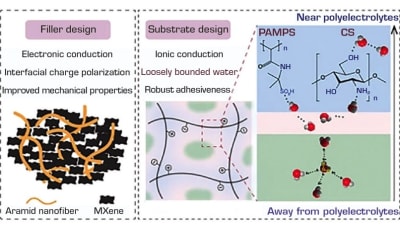
Researchers from Harbin Institute of Technology and their collaborators have developed a multifunctional polyelectrolyte hydrogel reinforced with aramid nanofibers (ANFs) and MXene nanosheets, achieving outstanding performance in absorption-dominated electromagnetic interference (EMI) shielding and wearable sensing. Read on to learn more.
Feature Image
R&D: Wearables
Engineers have developed a next-generation wearable system that enables people to control machines using everyday gestures — even while running, riding in a car, or floating on turbulent ocean waves. Read on to learn more about it.
Feature Image
R&D: Sensors/Data Acquisition
A low-cost, portable biosensor can quickly identify a protein whose altered levels are associated with psychiatric disorders, such as depression, schizophrenia, and bipolar disorder. When it becomes commercially available in the future, it may contribute to early detection, which is essential for treating and monitoring patients’ clinical conditions. Read on to learn more.
Feature Image
R&D: Wearables
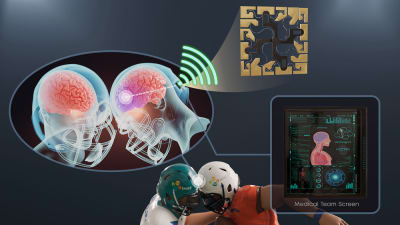
Researchers are exploring new ways to utilize microwave technology in monitoring and assessing health conditions. The results of experiments conducted with realistic models are promising. Bras that detect breast cancer, leg sleeves that identify blood clots, and a helmet that monitors the effects of radiation therapy offer a glimpse into what future healthcare might look like. Read on to learn more.
Feature Image
INSIDER: Wearables
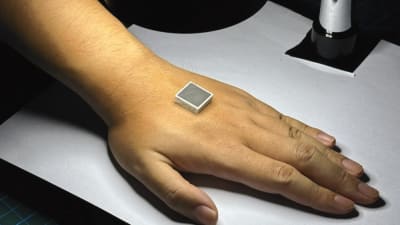
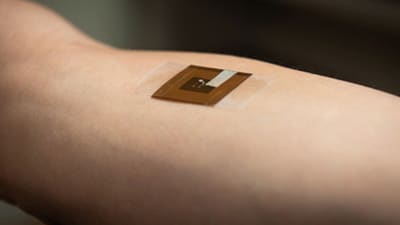
Researchers have developed a groundbreaking, battery-free wearable patch that could help detect skin cancer earlier and more accurately, potentially saving lives by making screening more...
Feature Image
Products: Wearables
Throughout the year, the editors of Medical Design Briefs choose a Product of the Month that has exceptional technical merit and practical value for MDB’s design engineering readers.
Feature Image
INSIDER: Sensors/Data Acquisition
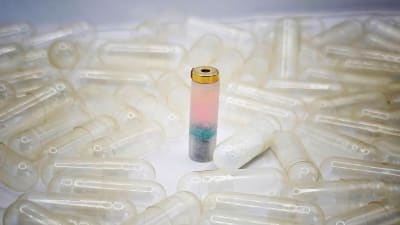
Engineers have created the first ingestible bioprinter that can be guided to disease sites to print tissue within the body. Called MEDS (Magnetic Endoluminal Deposition System), the...
Feature Image
Products: Medical
Listen to the new season of the Medical Design Briefs podcast. These four episodes focus on the impact of wearables on healthcare.
Feature Image
Briefs: Sensors/Data Acquisition
Researchers, led by Rice University’s Yong Lin Kong, have developed a soft but strong metamaterial that can be controlled remotely to rapidly transform its size and shape. The invention, published in Science Advances, represents a significant advancement that can potentially transform ingestible and implantable medical devices. Read on to learn more about it.
Feature Image
Briefs: Medical
A KAIST research team has developed a smart patch that can precisely observe internal changes through sweat when simply attached to the body. This is expected to greatly contribute to the advancement of chronic disease management and personalized healthcare technologies. Read on to learn more.
Feature Image
Briefs: Sensors/Data Acquisition
Medical pumps are at the heart of modern healthcare delivery. Their success depends on precise, reliable, and safe operation — capabilities enabled by advanced sensor technologies. From occlusion detection to bubble monitoring and temperature control, sensors provide the intelligence that allows pumps to perform with confidence in critical care environments. Read on to learn more.
Feature Image
R&D: Wearables
Researchers have developed novel ISM-based sweat sensors that feature enhanced signal stability and performance and avoid skin contact, while also being reusable, making them practical for daily use. Read on to learn more.
Feature Image
R&D: Manufacturing & Prototyping
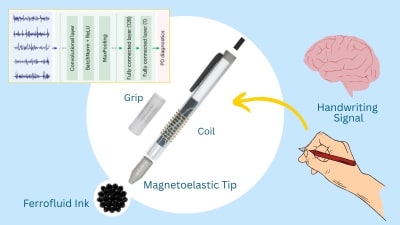
Researchers have developed a smart, self-powered magnetoelastic pen that could help detect early signs of Parkinson’s by analyzing a person’s handwriting. The highly sensitive diagnostic pen features a soft, silicon magnetoelastic tip and ferrofluid ink — a special liquid containing tiny magnetic particles. Read on to learn more about it.
Feature Image
R&D: AR/AI
During the first two years of life, the motor development of children is monitored closely, as motion is the natural base for their other development and interaction with the environment. Current methods do not allow accurate developmental monitoring throughout early childhood. MAIJU (Motor Assessment of Infants with a Jumpsuit) is designed to solve these problems. Read on to learn more about it.
Feature Image
Features: Medical
On-body biosensors have crossed the threshold from technological novelty to clinical tool driving medical decisions. The most successful devices share common traits: They provide clinically actionable information, reliably measure rapidly changing biomarkers, account for confounding variables, and utilize established reimbursement pathways. Read on to learn more about them.
Feature Image
Trivia: Wearables
What wearable medical device uses tumor-treating fields delivered through adhesive transducer arrays to treat advanced non-small cell lung cancer?
Feature Image
Features: AR/AI
The next phase of medical device innovation will be defined by systems that are not only responsive but also autonomous and personalized. Read on to learn more.
Feature Image
Products: Sensors/Data Acquisition
See the new products and services, including EPIGAP OSA Photonics GmbH's surface-mount device (SMD) shortwave infrared (SWIR); Moticont's linear voice coil servo motor; Dart Controls' high-performance pulse width modulation (PWM) controller for 12–48-V battery powered equipment; a compact, fullservice RTD sensor from Burns Engineering; and more.
Feature Image
Briefs: AR/AI
Although lithium is highly effective to treat bipolar disorder, the chemical has a narrow therapeutic window — too high a dose can be toxic to patients, causing kidney damage, thyroid damage, or even death, while too low a dose renders the treatment ineffective. Read on to learn how a wearable sensor may thwart this issue.
Feature Image
R&D: Wearables
Researchers have developed a wearable wound monitoring device with integrated sensors that could reduce infection risks by minimizing the need for frequent physical contact. The proof-of-concept device is designed for reuse, making it more cost-effective and practical than disposable smart bandages and other emerging wound monitoring technologies. Read on to learn more.
Feature Image
Trivia: Medical
What consumer technology device became the first FDA-approved over-the-counter (OTC) assistive hearing device for adults with mild to moderate hearing loss?
Feature Image
Blog: Medical
In this Q&A with Medical Design Briefs, Michael Klitzke, principal system architect at TE Connectivity, discusses how advances in sensor miniaturization, packaging,...
Feature Image
INSIDER: Medical
A smart, self-powered magnetoelastic pen could help detect early signs of Parkinson’s by analyzing a person’s handwriting. The highly sensitive diagnostic pen features a soft,...
Feature Image
INSIDER: Wearables
A wearable technology enables real-time, noninvasive tracking and optimized treatment for diabetic patients. It enables precise drug dosing through continuous, real-time monitoring of disease...
Feature Image

Ask the Expert

Ralph Bright on the Power of Power Cords
Feature Image

Understanding power system components and how to connect them correctly is critical to meeting regulatory requirements and designing successful electrical products for worldwide markets. Interpower’s Ralph Bright defines these requirements and explains how to know which cord to select for your application.

Inside Story

Inside Story: Trends in Packaging and Sterilization

Feature Image

Eurofins Medical Device Testing (MDT) provides a full scope of testing services. In this interview, Eurofins’ experts, Sunny Modi, PhD, Director of Package Testing; and Elizabeth Sydnor, Director of Microbiology; answer common questions on medical device packaging and sterilization.

Videos