
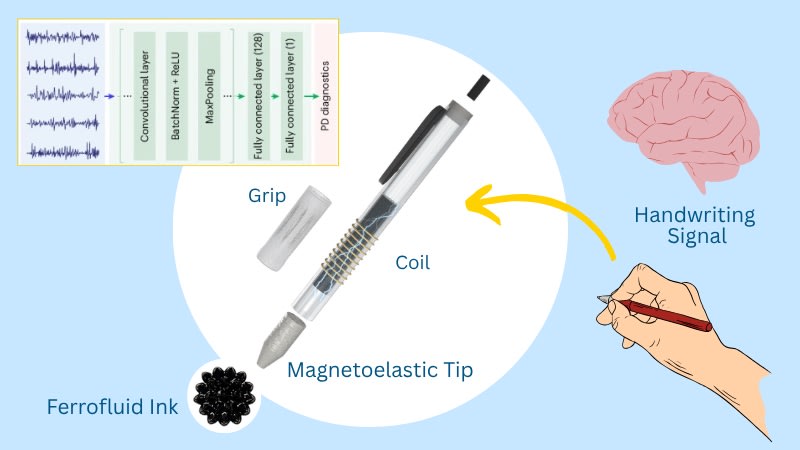
Researchers have developed a smart, self-powered magnetoelastic pen that could help detect early signs of Parkinson’s by analyzing a person’s handwriting. The highly sensitive diagnostic pen features a soft, silicon magnetoelastic tip and ferrofluid ink — a special liquid containing tiny magnetic particles.
When the pen’s tip is pressed against a surface or moved in the air, the pen converts both on-surface and in-air writing motions into high-fidelity, quantifiable signals through a coil of conductive yarn wrapped around the pen’s barrel. Although not intended for writing, the pen is self-powered leveraging changes in the magnetic properties of its tip and the dynamic flow of the ferrofluid ink to generate data.
To test the pen’s diagnostic potential, the team conducted a pilot study with 16 participants, three of whom had Parkinson’s disease. The pen recorded detailed handwriting signals, which were then analyzed by a neural network trained to detect motor patterns associated with the disease. The model was able to distinguish participants with Parkinson’s from healthy individuals with an average accuracy of 96.22 percent.
The researchers anticipate that this pen could transform early detection of Parkinson’s and other neurodegenerative conditions. Rather than waiting for symptoms to become disruptive, primary care physicians or geriatric specialists could administer a quick handwriting test during routine visits and use the data to inform earlier referrals or treatment. (Image credit: Jun Chen Lab/UCLA)
For more information, visit here .