

Supply chain disruptions are no longer abstract problems for economists to debate. For the medical device industry, they are a direct threat that hits engineers, designers, and manufacturers at the core of their operations. These issues are not just about a hospital running out of supplies; they are about a company’s inability to design, produce, and deliver life-saving technology to the market. This article explores how engineering and innovation are becoming the primary tools for building a more resilient and reliable medical device supply chain.
Why Supply Chain Resilience Matters for Device Makers
The impact of supply chain fragility on medical device makers is profound and multifaceted. When a critical component, from a specialized microchip to a rare earth metal, becomes unavailable, it can immediately halt research and development. Engineers cannot finalize designs or build prototypes, causing significant delays in the product development pipeline. This has a domino effect, pushing back regulatory submissions, like those for FDA approval, and ultimately delaying a product’s launch. The financial and operational strain is immense.
A 2021 study by McKinsey & Company found that supply chain disruptions cause an average 45 percent revenue loss for medical device companies, an indicator of the serious financial risk involved.1 Production lines can go idle, leading to lost revenue and increased overheads. These operational inefficiencies can quickly erode profit margins and damage a company’s reputation for reliability.
Best Engineering Strategies for Supply Stability in Medical Devices
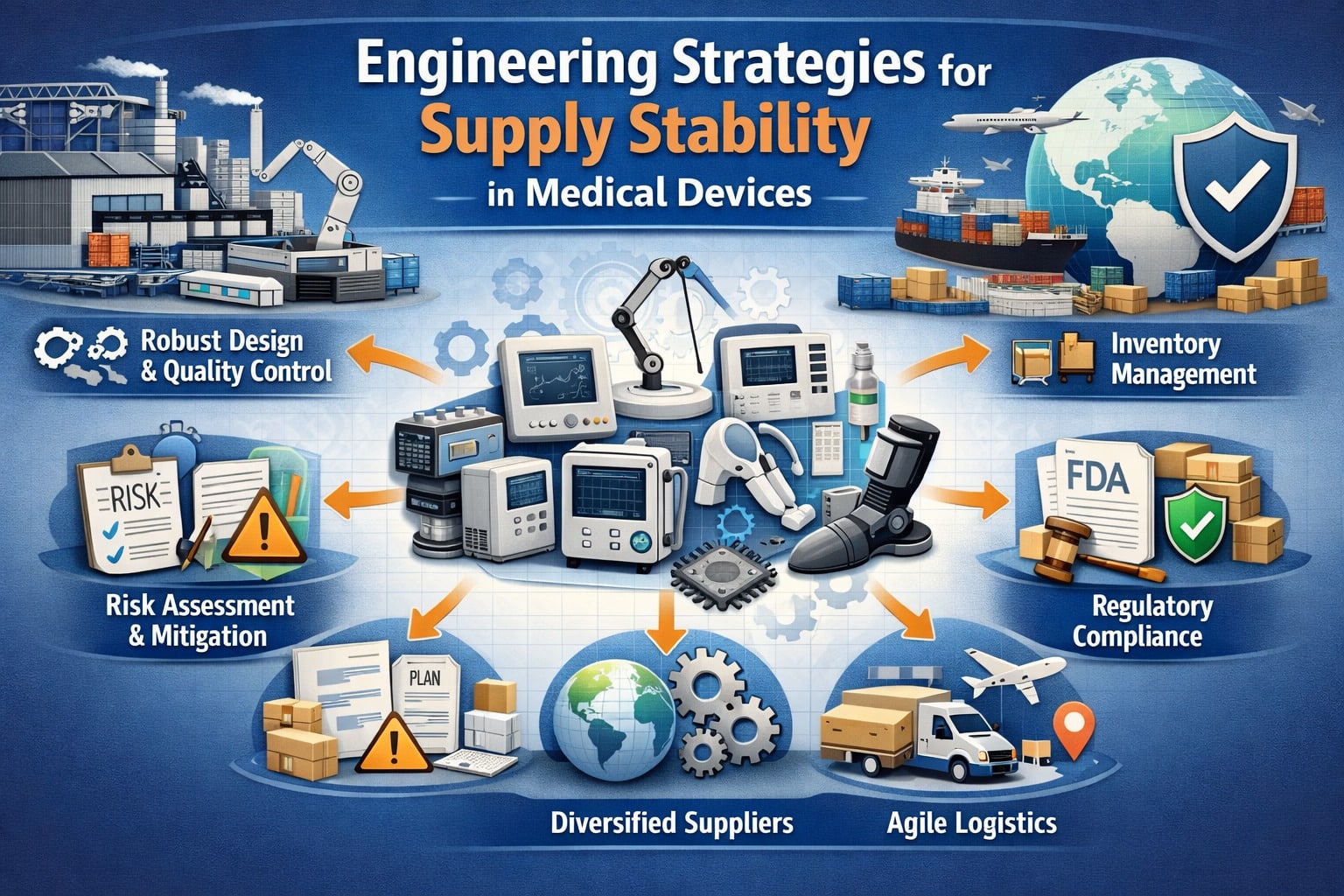
Building resilience isn’t just about stocking up on parts. It requires a fundamental shift in how devices are designed and manufactured, with engineers taking a leading role. The goal is to embed stability into the product from its very inception.2
Strategy 1: Material and Component Substitution. A key strategy for engineers is to design with flexibility in mind. This involves qualifying multiple vendors and alternative materials for critical components during the initial design phase. Instead of relying on a single, specialized microcontroller, a device can be designed with a modular architecture that allows it to function with several different compatible chips from various suppliers. This proactive approach, often called design for resilience, can prevent a supply shortage from bringing production to a standstill. It also requires close collaboration with quality and regulatory teams to ensure that any material substitution is validated and approved.
Strategy 2: Modular Design and Platform Engineering. Modular design is a powerful approach that allows companies to build products from standardized, interchangeable blocks. If one module’s components become scarce, it can be replaced with a different module that performs the same function. This approach not only streamlines the design process but also makes it easier to manage the inventory of parts. By using a single, validated core platform, a company can introduce new product variations without having to redesign the entire device. This reduces dependency on vulnerable, single-source parts and accelerates time to market for new products.
Strategy 3: Diversified and Localized Manufacturing. The pandemic taught the medical device industry a hard lesson about over-reliance on a single geographic region for manufacturing. A robust strategy now involves establishing redundant manufacturing sites or forming partnerships with contract manufacturers in different parts of the world. This diversification minimizes the impact of localized issues, whether they are natural disasters, geopolitical events, or public health crises. The trend toward nearshoring or reshoring critical manufacturing to domestic regions is gaining traction, with a 2022 survey by MedTech Europe reporting that 60 percent of companies are planning to increase their domestic manufacturing capabilities.3 While this may increase initial costs, it provides a crucial buffer against global disruptions.
Tech Solutions Strengthening Medical Device Supply Chains
Technology is providing powerful new tools for building resilience, extending from the factory floor to the final point of delivery.
Advanced manufacturing techniques like additive manufacturing, or 3D printing, are allowing device companies to rapidly produce complex prototypes and even end-use parts in-house. This capability can bypass a temporary shortage of an externally sourced component, allowing engineers to continue development or manufacturing on a limited basis. Robotics and automation are also key, as they reduce the reliance on manual labor, which can be a point of failure during a public health crisis or labor shortage. Automated assembly lines can operate continuously, maintaining production schedules regardless of external labor conditions.
Beyond the factory, digital tracking and smart logistics are providing unprecedented visibility. IoT (Internet of Things) sensors, RFID tags, and cloud-based platforms can track the location and condition of every component in the supply chain in real time.4 This allows companies to identify a potential disruption before it occurs. For instance, if a shipment is delayed due to a port closure, the system can automatically alert the team, allowing them to reroute the order or source the part from an alternative supplier. Research from Deloitte found that companies with high supply chain visibility experienced a 25 percent lower average inventory and a 20 percent lower rate of missed deliveries compared to their peers.
Building Partnerships for Long-Term Supply Stability
Technology and engineering strategies are only as effective as the partnerships that support them. The pandemic underscored the critical need for deeper collaboration across the entire supply chain.
Medical device companies are now building stronger, more transparent relationships with their healthcare distributors. This involves sharing data on demand forecasts, production schedules, and inventory levels to foster a more proactive and collaborative environment. Instead of a transactional relationship, the focus is on a shared goal of resilience. The industry is also learning to work more closely with regulators to streamline emergency approval processes for new designs or alternative parts.
Lessons from the pandemic have taught companies that robust partnerships, built on trust and open communication, are the best defense against unforeseen events. These collaborations are now shaping future design and sourcing decisions, prioritizing supply security over cost savings. Companies are moving away from the lean, just-in-time model toward a more just-in-case philosophy.5
Conclusion
Supply chain disruptions have redefined the priorities for medical device engineering.6 The focus has shifted from simply designing the most advanced device to engineering a product that can actually be built and delivered reliably. This new paradigm requires engineers to think beyond the device itself and consider the entire ecosystem of its creation, from the sourcing of raw materials to the final distribution.
The proactive strategies of material substitution, modular design, and localized manufacturing, combined with the power of modern technology, are creating a more resilient industry. The future of medical device engineering will be defined by its ability to integrate stability and security into every stage of the product lifecycle, ensuring that life-saving technology remains accessible when it is needed most.
This article was written by Lesley Barton, National Clinical and Training Manager at Bunzl & AMHC, Dandenong South VIC, Australia. Through the Clinical Care Connections (CCC) program, she has strengthened training initiatives in continence, wound care, and medical consumables. For more information, visit here .
References
- “What is supply chain?” McKinsey & Company, August 7, 2022.
- “Resilient supply chains,” Organisation for Economic Co-operation and Development.
- “MedTech Europe Survey Report analysing the availability of Medical Devices in 2022 in connection to the Medical Device Regulation (MDR) implementation,” 14 July 2022, MedTech Europe.
- What Is RFID Technology, and How Does It Work?, GS1.
- B. Balkhi et al., “Just-in-time approach in healthcare inventory management: Does it really work?” Saudi Pharm J. 2022 Nov 3;30(12):1830–1835. doi: 10.1016/j.jsps.2022.10.013.
- N. Fryer, “Managing Supply Chain Disruption,” Sheer Logistics, December 4, 2024.

Overview
The MedTech Europe Survey Report (July 2022) assesses the impact of the EU Medical Device Regulation (MDR) implementation on device availability, focusing on certification progress, company challenges, and implications for innovation. Based on 475 responses from large and SME companies, representing 60-70% of the EU medical device market revenue, the report highlights critical concerns regarding MDR compliance ahead of the 26 May 2024 deadline.
Key findings reveal slow transition to MDR certification, with only about 14% of necessary Quality Management System (QMS) and Technical File certificates issued since 2019. Approximately 70% of submitted applications remain under review, causing lengthy certification timelines averaging 13-18 months. Large companies are disproportionately affected by delays due to broader portfolios and more frequent updates to guidance documents. SMEs face particular difficulties related to lack of access to Notified Bodies and slower certification rates (SMEs have submitted and received certificates for a significantly lower proportion of expected devices compared to large companies).
Several internal issues exacerbate certification delays, including fragmented and non-harmonized interpretations of the MDR and MDCG guidance among Notified Bodies, lack of responsiveness, and unpredictable timelines. Three MDCG guidance documents on classification, clinical evaluation equivalence, and clinical evidence for legacy devices are most frequently reported as causes of delays. Over 20% of companies attribute certification delays to new or revised MDCG guidance, and nearly half of those delays require rework of applications.
The report forewarns dramatic reductions in product portfolios, especially legacy devices, as few have successfully transitioned. If unaddressed, this could mean widespread market withdrawal of legacy devices by May 2024, threatening patient access across Europe and beyond, given many countries' reliance on CE marking. Innovation is also reported to be shifting away from Europe, with companies prioritizing launches in other regions such as the USA and Asia due to MDR complexities and recertification burdens.
MedTech Europe calls for urgent action by decision-makers to alleviate MDR implementation bottlenecks and ensure medical devices remain available to EU patients. The industry commits to supporting regulatory improvements, emphasizing the need to balance patient safety with timely access to both established and novel medical technologies in Europe.