
Researchers from Harbin Institute of Technology and their collaborators have developed a multifunctional polyelectrolyte hydrogel reinforced with aramid nanofibers (ANFs) and MXene nanosheets, achieving outstanding performance in absorption-dominated electromagnetic interference (EMI) shielding and wearable sensing. This innovative hydrogel addresses the long-standing challenge of balancing electrical conductivity and effective EMI absorption in flexible electronic materials. The research was published in the journal Nano-Micro Letters. 1
Why the Aramid/MXene Hydrogel Matters
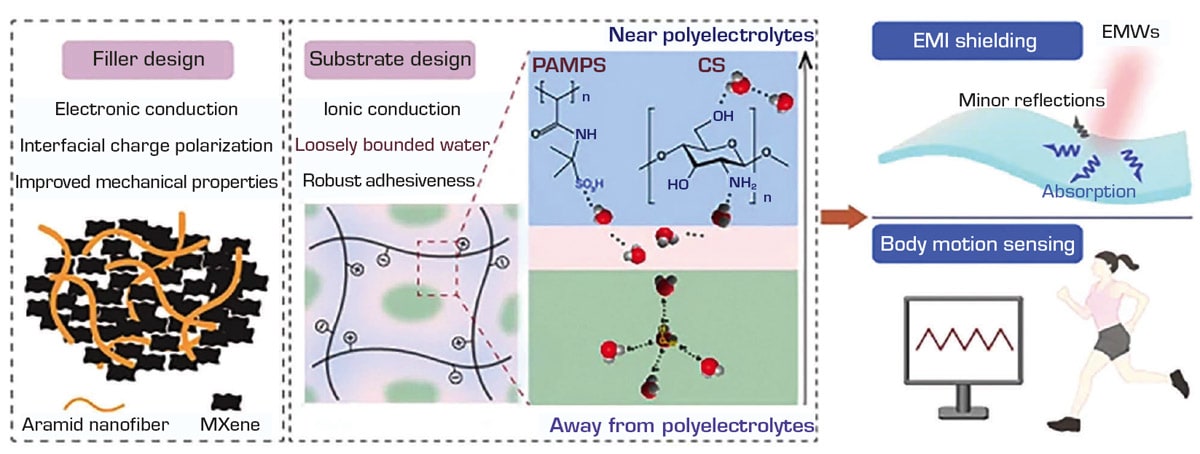
High EMI Absorption Efficiency. The hydrogel achieves an absorption-to-total shielding effectiveness ratio (SEA/SET) exceeding 94 percent in the X-band, and a shielding effectiveness of up to 110 dB in the THz range, enabling near-total EMI protection.
Mechanical Robustness. The hydrogel maintains consistent EMI shielding performance under mechanical deformation, low temperatures, and drying conditions, demonstrating excellent environmental adaptability.
Wearable Sensing. With high strain sensitivity, fast response (380 ms), and broad strain detection up to 400 percent, the hydrogel also functions as a flexible sensor for human motion monitoring.
Innovative Design and Mechanisms
Polyelectrolyte Hydration Engineering. The hydrogel incorporates AMPS and chitosan, enhancing ionic conductivity and forming intermediate water (IW) — a highly mobile water state that facilitates polarization relaxation under electromagnetic fields.
Multiscale Interface Architecture. ANFs provide structural reinforcement, while MXene nanosheets create conductive pathways and polarization centers. Their interfacial interactions and synergy with IW collectively lead to enhanced absorption-dominated shielding.
Mechanism-Driven EMI Shielding. Unlike traditional reflection-dominated materials, this hydrogel achieves EMI suppression primarily through conductive loss, interfacial polarization, and dielectric loss from IW, ensuring efficient energy dissipation.
Future Outlook
Scalability and Integration. The hydrogel can be fabricated via scalable processing and conformally adhered to various substrates, suggesting strong potential for integration into wearable electronics, soft robotics, and on-skin sensors.
Multifunctionality Expansion. Further studies may explore doping strategies, composite architectures, and neural interface applications to broaden the material’s functionalities in EMI shielding–sensor fusion platforms.
Mechanistic Insights. This study highlights a new paradigm for absorption-dominated EMI shielding by leveraging hydration dynamics and multicomponent nanostructures, offering a path toward intelligent, adaptive electromagnetic materials.
For more information, contact Xuqing Liu at
Reference
- Guo, J., Zhang, T., Hao, X. et al., “Aramid Nanofiber/MXene-Reinforced Polyelectrolyte Hydrogels for Absorption-Dominated Electromagnetic Interference Shielding and Wearable Sensing,” Nano-Micro Lett. 17, 271 (2025).