
Inside this issue
Overview
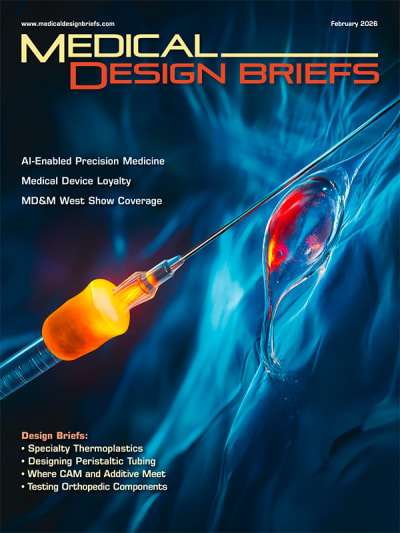
The February 2026 issue of Medical Design Briefs provides a comprehensive overview of current trends, innovations, and challenges in the medical device and healthcare technology industries. Featuring a diverse collection of articles, design briefs, product announcements, and expert insights, this edition highlights how advanced manufacturing, precision medicine, patient-centered services, and novel materials are shaping the future of medtech.
A key thematic focus of the issue is the evolving landscape of medical device loyalty, emphasizing that service quality and patient-centered approaches are now paramount over product features alone. An in-depth feature explores a diabetes device manufacturer’s journey from commoditization threat to generating over 0 million in new recurring revenue by shifting focus from technology-centric to holistic, patient-focused solutions. Using the Jobs to be Done methodology, the company developed comprehensive support systems and integrated service offerings that significantly improved patient retention. This paradigm highlights the growing importance of delivering intelligent devices combined with integrated services that address customer needs throughout their healthcare journey, underscoring the need for medtech companies to invest in service infrastructure and adapt financially and organizationally for a service-driven business model.
Advanced manufacturing techniques and material science innovations receive detailed attention, reflecting their critical role in enabling next-generation medical devices. Podcasts and technical briefs discuss how automation, robotics, artificial intelligence (AI), and 3D printing technologies streamline production, improve quality control, and enable rapid prototyping for personalized implants, prosthetics, and surgical tools. New materials such as specialty thermoplastics are showcased for their biocompatibility, sterilization capability, regulatory compliance, and cost-effectiveness, with a particular highlight on polyetherimide (PEI) resins and PEI-silicon blends as alternatives to fluoropolymers to meet PFAS regulatory challenges. The issue stresses how advances in materials processing and engineering expertise are accelerating innovations from prototype to scale production, enabling medical devices with enhanced performance and sustainability.
A notable feature highlights the Wearable Ultrasound Imaging Technology Engineering Collaboration (WITEC), a pioneering interdisciplinary R&D initiative aimed at developing innovative wearable ultrasound systems for continuous, real-time monitoring of chronic cardiovascular and other diseases. Led jointly by academic and clinical experts, WITEC focuses on bioadhesive couplants, nanostructured metamaterials, and ultrasonic transducers to enable portable, cart-based, and eventually fully integrated wearable bioadhesive ultrasound (BAUS) platforms for improved patient management outside hospital settings. This work represents a significant step toward proactive, community-based care, offering richer clinical insights and empowering patients with greater self-management capabilities.
Complementing the theme of wearable healthcare technologies, the issue also covers research breakthroughs from Penn State University in shrinking materials for smart devices. The approach involves printing liquid metal patterns on heat-shrinkable polymer substrates, enabling scalable, versatile, shape-conforming, wireless electronics that can adapt to 3D surfaces like the human body. A proof-of-concept wearable ring with embedded accelerometer demonstrated successful networked gesture detection, illustrating potential applications in health monitoring and household automation. This innovation signifies progress toward customizable, Internet-enabled wearables that are accessible, cost-effective, and adaptable to complex surfaces.
The issue also reflects on operational and strategic challenges facing medical device manufacturers, including navigating trade policy volatility and tariffs. An editorial commentary discusses how companies have moved from initial tariff-related apprehension to implementing practical mitigation strategies such as dual sourcing, nearshoring, inventory buffering, and selective reshoring to enhance resilience. The analysis underscores a cultural shift toward embedding flexibility into supply chains and manufacturing operations, enabling sustained innovation amid regulatory and geopolitical uncertainties. Financial incentives and tax policies also play a pivotal role in encouraging domestic investment and regional manufacturing hubs, reinforcing the industry's adaptability.
In the realm of clinical innovations and device safety, the magazine presents solutions such as a customizable Finger Brace from Carnegie Mellon University that switches from stiff to flexible with simple movements, enabling more comfortable injury recovery. This 3D printable device can be tailored via software using patient-specific finger metrics, illustrating the growing intersection of digital design, additive manufacturing, and personalized medicine. Other design briefs introduce safety syringes and reusable autoinjectors that combine passive needle protection with sustainability goals, advanced power conversion systems optimized for medical imaging, and rugged computing platforms designed for mission-critical healthcare environments.
The issue concludes with a roundup of new products and technologies from established and emerging medtech companies emphasizing innovation, quality, and patient benefit. These include mobile surface measuring systems, metal powder bed fusion 3D printers for high-detail additive manufacturing, and medical-grade power supplies with integrated thermal management for continuous operation in imaging and diagnostic devices.
Overall, this February 2026 issue of Medical Design Briefs paints a rich, multifaceted picture of how medical device development is evolving beyond traditional boundaries. It highlights the integration of cutting-edge technologies with a renewed focus on patient experience, service quality, operational agility, and sustainable innovation. By bringing together leading experts and showcasing real-world applications, it offers valuable insights for engineers, designers, clinicians, and business leaders striving to advance healthcare technology that improves outcomes, enhances quality of life, and meets the demands of an increasingly complex global environment.
Features
-
Articles
8 From Consensus Oncology to Individualized Biology
14 Why Medical Device Loyalty Depends on Services, Not Features
19 MD&M West
-
R & D
22 Printable Nanoparticles Enable Mass Produced Biosensors
22 Under-the-Skin Electrode for Epilepsy Tracking
22 Terahertz Wave Control for Enhanced Biomedical Technology
22 Stretchable Waveguides Maintain Stable Transmission Even When Bent
-
Global Innovations
50 Retina-Mimicking Eye Phantom Replicates Human Retinal Structures
-
From the Editor
Tech Briefs
-
24 Specialty Thermoplastics for Medical Tubing Address PFAS, Processing, and System Cost Challenges
27 Force Measurement, Material Testing for Critical Orthopedic Components
30 Where CAM and Additive Meet, Improving Medical Manufacturing Efficiency
33 Designing Peristaltic Tubing for Continuous Bioprocessing Reliability
36 High-Tech Imaging in Scattering Media for Medical Applications
38 Highly Sensitive Wearable Pressure Sensors Inspired by Cat Whiskers
40 Breakthrough Surgical Device Makes Hip Arthroscopy Safer
42 Center to Develop Wearable Ultrasound Imaging for Real-Time Monitoring of Chronic Conditions