
Devin Brock
TE Connectivity
As medical technology advances, infusion and other medical pumps are becoming smarter, more portable, and more connected. These systems deliver critical fluids with precision — whether life-saving medications, blood products, or nutrients — and any interruption can directly affect patient outcomes. To meet rising expectations for reliability, accuracy, and safety, engineers are increasingly relying on advanced sensing technologies.
Sensors now play an integral role in medical pump applications, enabling automated monitoring and control of infusion therapy while supporting trends toward miniaturization, mobility, and the Internet of Medical Things (IoMT). For pump engineers, understanding sensor capabilities, trade-offs, and integration considerations is critical for ensuring patient safety and regulatory compliance.
The Expanding Role of Sensors in Infusion Pumps
Infusion pumps are widely used in hospitals, clinics, and home settings to deliver fluids at controlled rates. Unlike manual administration, pumps can dispense very small doses, maintain steady infusion, and reduce clinical staff workload. But because these devices often handle high-risk medications, their safety features are paramount.
Modern smart pumps now include advanced algorithms and connectivity features that help prevent programming errors, detect adverse drug interactions, and alert users to unsafe conditions. Underlying these capabilities are sensors that monitor flow, detect occlusions or bubbles, control motor performance, and, in some cases, track fluid temperature. For engineers, selecting the right sensors involves balancing size, cost, performance, and durability — especially as pumps become smaller and more mobile.
Occlusion Detection with Force Sensors
One of the most critical safety features in an infusion pump is occlusion detection. When a blockage occurs in the tubing, the pressure inside the line increases. Force sensors — often placed under the tubing where it meets the housing — detect this pressure by measuring the expansion of the tubing against the sensor surface. When the applied force exceeds set thresholds, the system triggers an alarm.
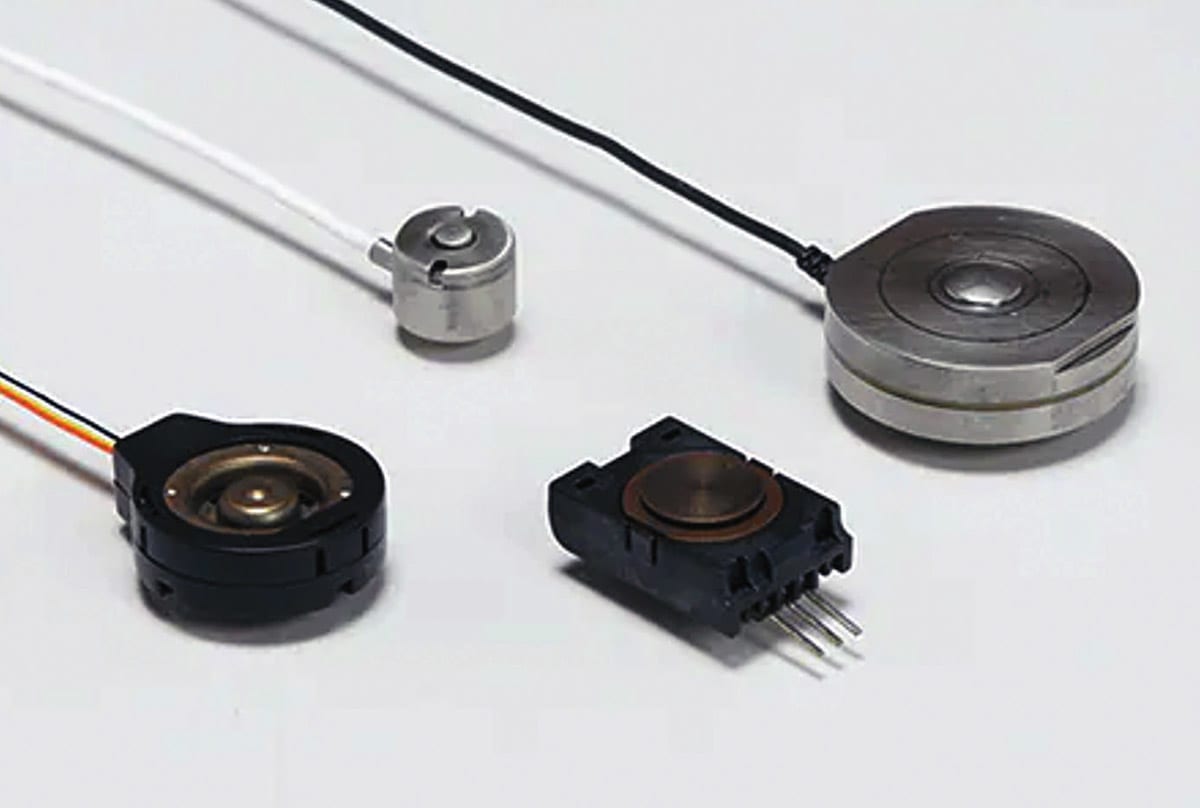
Force sensors used in pumps must deliver consistent performance over millions of cycles while remaining compact and cost-effective. TE Connectivity’s portfolio, for example, includes several technologies — foil strain gage, silicon fused strain gage, and MEMS strain gage — that provide high accuracy, long-term stability, and durability.
Among these, TE’s Microfused technology is particularly well suited for medical applications. It uses silicon strain gages bonded to stainless steel substrates at high temperatures, eliminating organic epoxies that degrade over time. This design enables excellent span and zero stability, superior resolution, and virtually unlimited cycle life.
For pumps with tighter space constraints, sensors such as TE’s FS20 and FC22 offer compact designs with excellent temperature compensation and accuracy (±1 percent of span). Their long life expectancy and flexible integration options make them suitable for portable pump applications.
Bubble Detection with Ultrasonic Sensors
Air embolism caused by bubbles in IV tubing poses severe risks. Ultrasonic bubble detectors, such as TE’s AD-102, provide continuous, noninvasive monitoring of infusion lines.
These detectors clamp directly onto the tubing and use a piezoelectric transducer to transmit an ultrasonic signal. Liquids transmit the signal efficiently, while bubbles disrupt it, creating a measurable drop in amplitude. The system then issues an alert to clinicians. Key advantages of ultrasonic bubble detection include:
Non-contact sensing: No direct contact with fluids, reducing contamination risk.
Fast response: Detection time under 0.5 milliseconds.
Self-diagnostics: Continuous monitoring of sensor functionality.
Flexibility: Customizable for tube sizes from 3 to 10 mm.
For engineers, these features translate into reliable safety assurance with straightforward integration into pump designs.
Temperature Sensing in Infusion Therapy
Maintaining proper temperature during intravenous fluid administration is essential for patient safety. Cold infusions can disrupt thermoregulation, while overheated fluids pose risks of tissue damage. Increasingly, infusion pumps integrate temperature sensing as a built-in feature rather than relying on external warming units.
NTC thermistor probes enable precise monitoring and control of infused fluids, supporting advanced pump systems where accuracy and safety are paramount.
Meeting Design Challenges
Engineers face several challenges when integrating sensors into pump systems:
Miniaturization: Portable and wearable pumps demand sensors with smaller footprints but uncompromised performance.
Reliability: Long device lifetimes require sensors with proven stability over millions of cycles.
Cost: Competitive healthcare markets push manufacturers to adopt lower-cost components without sacrificing safety.
Regulatory compliance: Sensors must meet medical standards such as ISO 13485, FDA registration, and risk management documentation.
Application Fields Beyond Infusion
While infusion pumps are a primary focus, force and bubble detection technologies extend into many other medical applications, including drug-delivery systems, surgical instruments, irrigation pumps, hospital beds, and blood flow monitoring devices.
Ambulatory drug-delivery systems: Combining force, pressure, and flow sensors for safe, mobile therapies.
Surgical staplers and ocular instruments: Precision force measurement for accuracy and safety.
Saline irrigation pumps in orthopedic surgery: Optimizing flow control.
Patient weight monitoring and hospital beds: Load cells for accurate measurement.
Hemodialysis and blood flow monitoring: Reliable bubble detection under critical conditions.
Conclusion
Medical pumps are at the heart of modern healthcare delivery. Their success depends on precise, reliable, and safe operation — capabilities enabled by advanced sensor technologies. From occlusion detection to bubble monitoring and temperature control, sensors provide the intelligence that allows pumps to perform with confidence in critical care environments.
For medical device engineers, mastering sensor selection and integration is no longer optional. It is central to the design of next-generation pumps that align with IoMT connectivity, regulatory expectations, and patient safety priorities. TE Connectivity continues to advance these sensing technologies, ensuring that every connection counts.
This article was written by Devin Brock, Field Application Engineer at TE Connectivity, Berwyn, PA. For more information, visit here .