Sensors & Wearables

In this knowledge hub of Medical Design Briefs, get the latest news about the medical sensors market, including wearables, resistors, ingestibles, and lab-on-a-chip technology.

Stories

41,103
0
60
30
Briefs: Medical
Researchers have developed comfortable, washable smart pajamas that can monitor sleep disorders such as sleep apnea at home, without the need for sticky patches, cumbersome equipment or a visit to a specialist sleep clinic. Read on to learn more.
Feature Image
R&D: Sensors/Data Acquisition
Researchers have combined miniaturized hardware and intelligent algorithms to create a cost-effective, compact powerful tool capable of solving real-world problems in areas like healthcare. Read on to learn more.
Feature Image
R&D: Medical
Researchers have developed a pacifier designed to monitor a baby’s electrolyte levels in real time, potentially eliminating the need for repeated invasive blood draws. The team constructed a tiny tunnel, or microfluidic channel, into the body of the pacifier. Read on to learn more.
Feature Image
INSIDER: Sensors/Data Acquisition
A major challenge in self-powered wearable sensors for healthcare monitoring is distinguishing different signals when they occur at the same time. Researchers have addressed this issue by uncovering...
Feature Image
Features: Wearables
Wearable technology is transforming psychiatric care at home by offering real-time insights that help care teams make informed decisions faster. With constant monitoring, these devices help identify early signs of distress or deterioration, enabling timely interventions that can prevent hospitalizations and promote better patient outcomes. Read on to learn more.
Feature Image
Features: Wearables
Digital health is evolving in leaps and bounds, which could be threatening its success. Digital healthcare faces a significant challenge: it is evolving too rapidly for its target market. Read on to learn more about the situation.
Feature Image
Products: Sensors/Data Acquisition
See where the product focus is this month: sensors, including a programmable IMU-based sensor system from Bosch Sensortec; tactile force sensors from Tekscan; capacitive sensors from EBE sensors + motion; and Introtek's noninvasive air bubble sensor that incorporates the latest ultrasonic technology.
Feature Image
Briefs: Sensors/Data Acquisition
A major challenge in self-powered wearable sensors for healthcare monitoring is distinguishing different signals when they occur at the same time. Researchers from Penn State and China’s Hebei University of Technology addressed this issue by uncovering a new property of a sensor material. Read on to learn more about it.
Feature Image
Briefs: Sensors/Data Acquisition
Researchers have developed a multifunctional sensor based on semiconductor fibers that emulates the five human senses. The technology developed in the study is expected to be utilized in fields such as wearables, Internet of Things (IoT), electronic devices, and soft robotics. Read on to learn more.
Feature Image
Briefs: Medical
Researchers at the University of California, Irvine and New York’s Columbia University have embedded transistors in a soft, conformable material to create a biocompatible sensor implant that monitors neurological functions through successive phases of a patient’s development. Read on to learn more.
Feature Image
From the Editor: Medical
In December, we asked Medical Design Briefs readers to cast their ballot to choose from our eight Products of the Month the technology they felt was the most significant new introduction to the design engineering community in 2024. Here is the winner of the 2024 Medical Design Briefs’ Readers’ Choice Product of the Year. Read on to learn more.
Feature Image
Briefs: Sensors/Data Acquisition
While smartwatches and fitness trackers have paved the way, upcoming innovations in hearables (earbuds that monitor health), augmented reality glasses, smart patches and smart clothing will push the boundaries of what biosensors can do. As demand for these devices increases, the focus will shift to making them more energy-efficient, secure, and even more embedded in daily life. Read on to learn more.
Feature Image
R&D: Sensors/Data Acquisition
Researchers have developed an optical biosensor that can rapidly detect monkeypox, the virus that causes mpox. The technology could allow clinicians to diagnose the disease at the point of care rather than wait for lab results. Read on to learn more.
Feature Image
R&D: Medical
A conductive ink can be printed directly on the surface of a patient’s head and measure their brainwaves. These e-tattoos serve as the sensors for electroencephalography (EEG), a medical test that measures the brain’s electrical activity. EEG can help diagnose and monitor brain tumors, sleep disorders and other brain issues. Read on to learn more.
Feature Image
R&D: Wearables
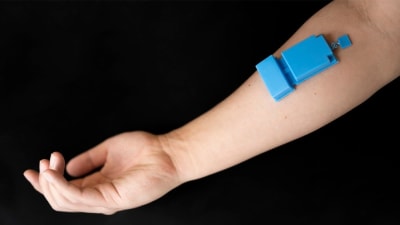
Engineers have developed a wearable ultrasound device that can provide long-term, wireless monitoring of muscle activity with potential applications in healthcare and human-machine interfaces. Designed to stick to the skin with a layer of adhesive and powered by a battery, the device enables high-resolution tracking of muscle function without invasive procedures. Read on to learn more.
Feature Image
R&D: Wearables
A new device aims to detect acute exacerbations of chronic conditions. The wearable monitoring device contains multiple types of sensors, enabling faster and more accurate detection of exacerbations of chronic obstructive pulmonary disease and chronic conditions like asthma, heart disease and other inflammatory disorders. Read on to learn more about it.
Feature Image
White Papers: Test & Measurement
Document cover
Calculating Gas Flow Through Orifices — A Technical Guide
Medical applications dealing with gases are many. Precise flow is required for correct mixing of gases and for pneumatic equipment applications, as examples. There are several...

Features: Medical
The healthcare landscape in 2025 will be reshaped by advancements in data analytics, AI, IoT, and wearable technologies, which together promise predictive, personalized, and accessible care. Read on to learn more about Editor and Director of Medical Content Sherrie Trigg's, as well as other industry professionals', thoughts on the matter.
Feature Image
Products: Sensors/Data Acquisition
Listen to MDB's medical podcasts, including one on the rise of advanced sensor technologies; one on the advancements that allow for continuous, real-time data collection from within the human body; one on the exploration of devices from fitness trackers to smartwatches; and one on the transformative role of microfabrication and MEMS technology in advancing sensor integration for medical devices. Listen now!
Feature Image
Briefs: Sensors/Data Acquisition
New research from NYU shows it’s possible to develop and build microchips that can not only identify multiple diseases from a single cough or air sample, but can also be produced at scale. Read on to learn more.
Feature Image
R&D: Wearables
Researchers have developed a gel polymer-based triboelectric nanogenerator that generates electrical signals from body movement to power electronics like LEDs and functions as a self-powered touch panel for user identification. The device can stretch up to 375 percent of its original size and withstand rigorous mechanical deformations, making it suitable for wearable applications. Read on to learn more.
Feature Image
R&D: Medical
A team has developed new biosensors with which the ratio of NADPH to NADP+ can be measured in living cells in real time for the first time. The team’s observations provide new insights into the evolution of the most important protective function of cells, cellular detoxification. Read on to learn more.
Feature Image
R&D: Wearables
Researchers have developed a three-dimensional stretchable piezoelectric energy harvester that can harvest electrical energy using body movements. The device is to be used as a wearable energy harvester as it can be attached to the skin or clothes. Read on to learn more.
Feature Image
Features: Wearables
Read on to learn more about a significant step forward in the rapidly evolving field of digital therapeutics (DTx).
Feature Image
Trivia: Medical
In 2012, what technology that is ubiquitous in our everyday lives was used to recognize and measure DNA concentration?
Feature Image
Podcasts: Medical
How advanced sensor technologies driving the development of wearables and health-monitoring devices.
Feature Image
Podcasts: Wearables
How microfabrication and MEMS technology are driving sensor-based medical devices.
Feature Image
INSIDER: Sensors/Data Acquisition
Researchers hope to transform diabetes management by eliminating the pain and hassle. The paper-based biosensor system uses Bacillus subtilis bacterial spores that germinate in response to glucose in...
Feature Image
News: Robotics, Automation & Control
Mohammad Habibur (Habib) Rahman, Director of the BioRobotics Laboratory at the University of Wisconsin-Milwaukee, and his team have been developing a portable, assistive robotic arm that therapists can use to assess and treat patients whether or not they are not in the same location.
Feature Image

Ask the Expert

Eric Dietsch on the Benefits of Nitinol Wire

Feature Image

In collaboration with the Fort Wayne Metals Engineering team, Eric Dietsch focuses on supporting customers with material recommendations, product development, and education. Eric is available to help you and your company with any Nitinol-related questions or needs that you may have.

Inside Story

Inside Story: Trends in Packaging and Sterilization

Feature Image

Eurofins Medical Device Testing (MDT) provides a full scope of testing services. In this interview, Eurofins’ experts, Sunny Modi, PhD, Director of Package Testing; and Elizabeth Sydnor, Director of Microbiology; answer common questions on medical device packaging and sterilization.

Videos