This article highlights four remarkable women — Dr. Patricia Bath, Rosalind Franklin, Dr. Helen Free, and Dr. Marie Curie — whose pioneering work has shaped modern medicine and continues to inspire future generations. Read on to learn more about them.
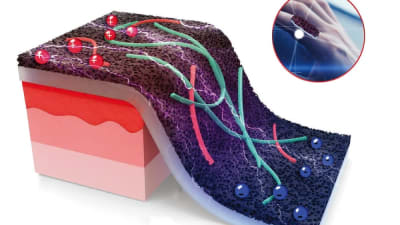
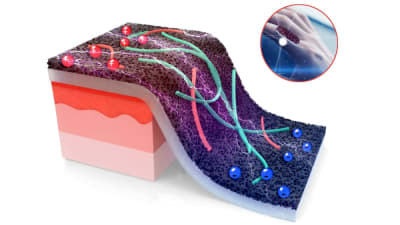
Researchers have developed a new method to pull moisture from the air and turn that water into electricity. The paper-based wearable device provides sustained high-efficiency power output through moisture capture. Read on to learn more about it.
A new device aims to detect acute exacerbations of chronic conditions. The wearable monitoring device contains multiple types of sensors, enabling faster and more accurate detection of exacerbations of chronic obstructive pulmonary disease and chronic conditions like asthma, heart disease and other inflammatory disorders. Read on to learn more about it.
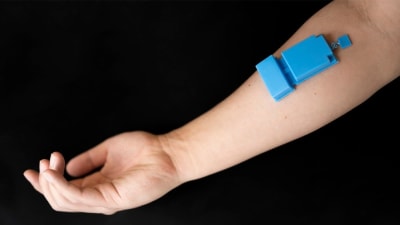
Engineers have developed a wearable ultrasound device that can provide long-term, wireless monitoring of muscle activity with potential applications in healthcare and human-machine interfaces. Designed to stick to the skin with a layer of adhesive and powered by a battery, the device enables high-resolution tracking of muscle function without invasive procedures. Read on to learn more.
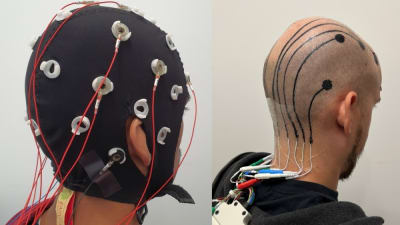
A conductive ink can be printed directly on the surface of a patient’s head and measure their brainwaves. These e-tattoos serve as the sensors for electroencephalography (EEG), a medical test that measures the brain’s electrical activity. EEG can help diagnose and monitor brain tumors, sleep disorders and other brain issues. Read on to learn more.
Researchers have developed an optical biosensor that can rapidly detect monkeypox, the virus that causes mpox. The technology could allow clinicians to diagnose the disease at the point of care rather than wait for lab results. Read on to learn more.
Researchers are developing soft sensor materials based on ceramics. Such sensors can feel temperature, strain, pressure, or humidity, for instance, which makes them interesting for use in medicine, but also in the field of soft robotics. Read on to learn more.
Manufacturing engineers tend to focus on new machinery and ways to maximize production lines. Improving communication can also increase efficiency and reduce costly and dangerous mistakes. Good communication becomes more critical as the medical device manufacturing industry grows increasingly complex with the addition of robotics and automation. Read on to learn more.
MedAccred is an industry-managed, consensus-driven approach to ensuring critical manufacturing process quality throughout the medical device supply chain. The MedAccred program is administered by PRI and governed by the original equipment manufacturer (OEM) subscribers who define program requirements, review audit reports, and accept non-conformance resolutions. Read on to learn more.
While smartwatches and fitness trackers have paved the way, upcoming innovations in hearables (earbuds that monitor health), augmented reality glasses, smart patches and smart clothing will push the boundaries of what biosensors can do. As demand for these devices increases, the focus will shift to making them more energy-efficient, secure, and even more embedded in daily life. Read on to learn more.
In December, we asked Medical Design Briefs readers to cast their ballot to choose from our eight Products of the Month the technology they felt was the most significant new introduction to the design engineering community in 2024. Here is the winner of the 2024 Medical Design Briefs’ Readers’ Choice Product of the Year. Read on to learn more.
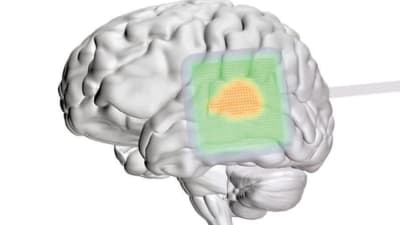
Researchers at the University of California, Irvine and New York’s Columbia University have embedded transistors in a soft, conformable material to create a biocompatible sensor implant that monitors neurological functions through successive phases of a patient’s development. Read on to learn more.
Researchers have successfully developed what they believe is the world’s smallest multifunctional biomedical robots. Capable of imaging, high-precision motion, and multifunctional operations like sampling, drug delivery, and laser ablation, the robot offers competitive imaging performance and a tenfold improvement in obstacle detection. Read on to learn more.
Researchers at University of Galway have developed a way of bioprinting tissues that change shape as a result of cell-generated forces, in the same way that it happens in biological tissues during organ development. The breakthrough science focused on replicating heart tissues, bringing research closer to generating functional, bioprinted organs. Read on to learn more.
A research team led by Dr. Youngdo Jeong of the Center for Advanced Biomolecular Recognition the Korea Institute of Science and Technology has developed a urine-based diagnostic kit for bladder cancer that can be conveniently used at home. This kit can accurately detect bladder cancer biomarkers without any preprocessing of urine samples. Read on to learn more.
Researchers have developed a multifunctional sensor based on semiconductor fibers that emulates the five human senses. The technology developed in the study is expected to be utilized in fields such as wearables, Internet of Things (IoT), electronic devices, and soft robotics. Read on to learn more.
A major challenge in self-powered wearable sensors for healthcare monitoring is distinguishing different signals when they occur at the same time. Researchers from Penn State and China’s Hebei University of Technology addressed this issue by uncovering a new property of a sensor material. Read on to learn more about it.
Despite its advantages, laparoscopic surgery remains largely inaccessible in low- and middle-income countries (LMICs) due to the high cost of equipment and other logistical challenges. To bridge this gap, researchers recently developed the KeyScope, an affordable laparoscope designed specifically for LMICs. Read on to learn more.
Boston Scientific is a market leader in pacemakers, defibrillators, monitoring equipment, spinal and brain stimulation, stents, catheters, and ablation devices. Read on to learn how the company improved upon cardiac monitoring.
See the videos of the month, including one on a thin film that combines an electrode grid and LEDs and can both track and produce a visual representation of the brain’s activity in real-time during surgery; one on an implantable piezoelectric ultrasound stimulator (ImPULS) that generates an ultrasonic focal pressure of 100 kPa to modulate the activity of neurons; one on AiSee, an AI-powered ‘eye’ for visually impaired people to ‘see’ objects; and more.
See the new products and services, including a new reciprocating head for medical tubing from Guill Tool; EpoxySet's state-of-the-art UV adhesives, the UV-8675, specifically designed for bonding PVC tubing in medical devices; Mahr Inc.'s expanded length measurement product line; Zeus' latest addition to its StreamLiner series of ultra-thin-walled catheter liners; and more.
See where the product focus is this month: sensors, including a programmable IMU-based sensor system from Bosch Sensortec; tactile force sensors from Tekscan; capacitive sensors from EBE sensors + motion; and Introtek's noninvasive air bubble sensor that incorporates the latest ultrasonic technology.
A research team from the University of Freiburg and the Medical Center – University of Freiburg has developed a novel biomimetic speaking valve technology that could significantly increase the safety of tracheostomized patients. Read on to learn more.
While DNA damage caused by space radiation exposure has long been recognized as a major threat to astronaut health, a recent study published in Redox Biology reveals an unexpected culprit in the atmosphere of the ISS itself: elevated carbon dioxide (CO2) levels. In this study, mice were sent into space where they spent 5–6 week aboard the ISS. Read on to learn more.
Digital health is evolving in leaps and bounds, which could be threatening its success. Digital healthcare faces a significant challenge: it is evolving too rapidly for its target market. Read on to learn more about the situation.
Wearable technology is transforming psychiatric care at home by offering real-time insights that help care teams make informed decisions faster. With constant monitoring, these devices help identify early signs of distress or deterioration, enabling timely interventions that can prevent hospitalizations and promote better patient outcomes. Read on to learn more.
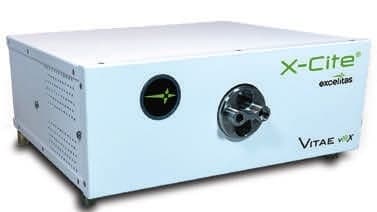
See the product of the month: Excelitas Technologies' platform for high-precision medical illumination and diagnostic applications such as endoscopy and surgical visualization.
Recent successes in cultivating human heart tissue, knee cartilage, and pharmaceutical crystals in space have relied on technology that was initially developed decades ago with support from NASA.
A major challenge in self-powered wearable sensors for healthcare monitoring is distinguishing different signals when they occur at the same time. Researchers have addressed this issue by uncovering...
The medical device industry constantly evaluates product and packaging materials and designs to meet business objectives, sustainability targets, and changing consumer preferences. Tactics...
As device designs become increasingly sophisticated, medtech companies are understandably seeking contract design and manufacturing partners that can accompany them on...
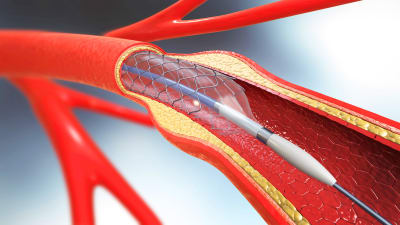
Boston Scientific Corporation has entered into a definitive agreement to acquire SoniVie Ltd., a privately held medical device company that has developed the TIVUS™ Intravascular Ultrasound System....
A team of researchers has created an innovative drug-delivery system with potential to improve drug development. The drug-delivery system is a coordination network composed of only metal...
ASTM International’s medical and surgical devices committee (F04) is developing a proposed standard for a wrought nickel-titanium alloy. The alloy covered by the...
This white paper presents an overview of mixing technologies implemented across many of today’s highly competitive pharmaceutical and medical industries, as well as new...
Screening methods for the cancer can be unreliable and result in false positives. To remedy this problem, scientists are developing a less-invasive portable device that would use blood...
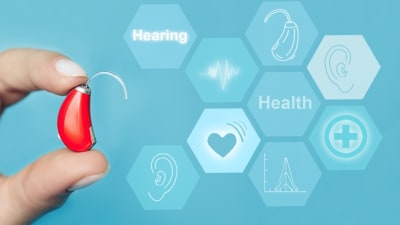
March 3rd is recognized as World Hearing Day. One of the most significant medical device innovations for hearing impairment is the cochlear implant. In what year was the first commercially available multi-channel cochlear implant...
Improving extruded components requires careful attention to a number of factors, including dimensional tolerance, material selection, and processing. Trelleborg’s Dan Sanchez provides detailed insights into each of these considerations to help you advance your device innovations while reducing costs and speeding time to market.
Inside Story: Trends in Packaging and Sterilization
Eurofins Medical Device Testing (MDT) provides a full scope of testing services. In this interview, Eurofins’ experts, Sunny Modi, PhD, Director of Package Testing; and Elizabeth Sydnor, Director of Microbiology; answer common questions on medical device packaging and sterilization.

















 INSIDER: Medical
 Features: Medical
 Podcasts: Design
 From the Editor: Medical
 Features: Materials
 Podcasts: Medical

 Podcasts: Medical
 Podcasts: Design
 On-Demand Webinars: Medical
 Podcasts: Manufacturing & Prototyping