
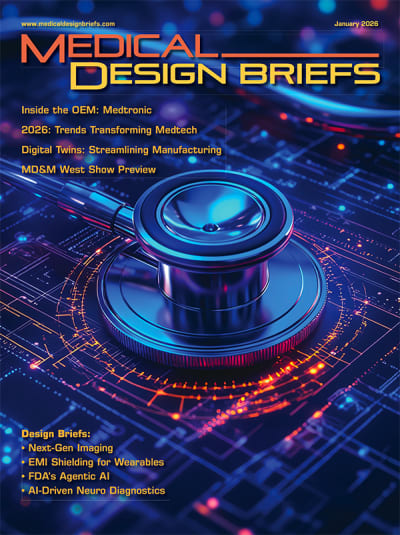
Inside this issue
Overview
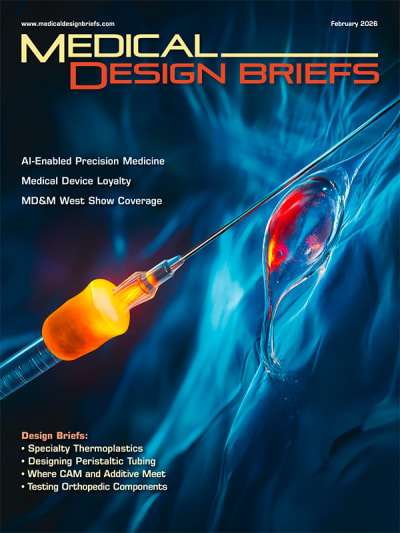
The January 2026 issue of Medical Design Briefs presents a comprehensive overview of transformative trends, innovations, and strategies shaping the medical device industry in 2026. Anchored by a deep dive into Medtronic’s growth and innovation roadmap, this edition balances visionary insights with practical developments across design, manufacturing, regulatory compliance, and emerging technologies.
Key Industry Themes and Trends
The issue opens with a focus on the rapid evolution of medical device engineering, emphasizing that 2026 marks a significant inflection point. Devices shift from isolated instruments to adaptive, intelligent, and interoperable systems that integrate deeply into healthcare delivery, regulatory compliance workflows, and global markets. This convergence demands new technical capabilities, organizational structures, and strategic approaches from engineering teams.
A detailed feature explores how artificial intelligence (AI) is revolutionizing medical device design and development. From accelerating iterative design cycles to enabling smarter, more user-friendly products, AI is portrayed as an essential tool for staying competitive. Sessions previewed at upcoming conferences discuss evidence-based strategies for managing AI-related risks such as hallucination mitigation, prompt engineering, and security, highlighting increasing regulatory attention and the need for robust cybersecurity frameworks.
Medtronic’s Strategic Outlook
A centerpiece article profiles Medtronic’s renewed strategic focus under its new CFO Christophe Piéton. The company is leveraging a "flywheel" approach, combining operational discipline, innovation acceleration, and strategic reinvestment to fuel long-term growth. Key growth drivers include expanding AI-powered surgical systems like the Hugo platform, and launching groundbreaking therapies such as renal denervation for hypertension, a market with 18 million potential U.S. patients. Medtronic is preparing a mid-2026 strategic update outlining post-inflection growth priorities, financial targets, and innovation investments, signaling confidence in robust, scalable future momentum.
Innovations in Materials and Manufacturing
The issue highlights pioneering technical advances including a novel 3D printing technique that grows metals and ceramics inside a water-based hydrogel scaffold. This approach yields ultra-strong, lightweight, and complex biomedical device structures beyond traditional photopolymer limitations, enabling next-gen sensor and device architectures.
Other featured innovations include bioadhesive sponges that combine mussel adhesive proteins with decellularized extracellular matrix to enable rapid, biocompatible internal bleeding control, and low-cost, portable biosensors for detecting psychiatric disorder-associated proteins via saliva analysis. These advances underscore the potential for biomaterials and diagnostics to enhance therapeutic efficacy and monitoring.
In manufacturing, attention is drawn to regionalized, vertically integrated supply chain strategies emphasizing sustainability, repairability, and circular economy principles amid service-enabled, recurring revenue business models. Digital twins and advanced automation are also spotlighted as key enablers of leaner, faster production cycles.
Regulatory and Quality Management Developments
Regulatory landscape shifts are underscored by sessions on the FDA’s cybersecurity framework for connected medical devices, including new premarket submission requirements under Section 524B of the Federal Food, Drug, and Cosmetic Act. These guidelines mandate integration of security within product development, risk monitoring, software bill of materials management, and comprehensive postmarket surveillance.
The launch of cloud-based quality management platforms tailored for life sciences exemplifies technology adoption to streamline compliance with ISO and FDA regulations. These platforms provide centralized document control, CAPA management, real-time quality metrics dashboards, and automated workflows to reduce validation cycle times and support audit readiness.
Additionally, TÜV SÜD’s new IECEE component certification for medical device safety-related parts aims to simplify global market entry by certifying components early to IEC 60601-1 standards, facilitating faster device approvals with internationally recognized reports.
Emerging Wearable Technologies and Sensors
The R&D roundup features emerging wearable medical technologies exploiting low-power microwave signals for noninvasive health monitoring. Examples include bras detecting breast cancer, leg sleeves identifying blood clots, and lightweight helmets monitoring brain tumor responses during radiation therapy by analyzing microwave signal changes in tissue. This approach promises earlier detection and more personalized treatment monitoring.
The issue also highlights biosensor developments, such as an ultra-sensitive, cost-effective strip measuring brain-derived neurotrophic factor (BDNF) levels in saliva within minutes. Such portable diagnostics have potential applications in early identification and ongoing management of depressive and other psychiatric disorders.
Industry Events and Thought Leadership
Previewed conference presentations address the scaling of overmolded needle manufacturing for at-home care devices, AI’s transformative role in medical technology, strategies for crowdfunding success in medtech startups, and the integration of electromagnetic sensor technology in neurohealth applications. These sessions collectively illustrate the multifaceted pathways toward innovation adoption, regulatory compliance, and market validation.
Product and Component Innovations
New product briefs introduce advanced fiber laser marking systems designed for UDI compliance on complex medical components, 360-degree shielded M8 cable connectors optimized for low-noise signal transmission in space-constrained medical environments, and digital commissioning and validation services that leverage risk-based, automated documentation workflows to streamline medical device facility qualification.
Conclusion
This issue of Medical Design Briefs offers a panoramic view of the medtech landscape in 2026—a year characterized by convergence, innovation, and integration. From Medtronic’s strategic renewal and AI-driven design to breakthrough biomaterials, advanced manufacturing, regulatory modernization, and wearable sensing technologies, the articles collectively underscore that success in this environment will require cross-disciplinary collaboration, technical agility, and continuous adaptation to evolving clinical, regulatory, and market demands. The issue is both a state-of-the-industry snapshot and a strategic guide for stakeholders aiming to navigate the accelerating pace of medical device innovation and commercialization in the near future.
Features
-
Articles
6 Inside the OEM: Medtronic’s Growth and Next Wave of Innovation
11 Faster From Lab to Patient to Win the Race Against Time
15 Engineering for the Future: The Trends Transforming Medtech in 2026
-
R & D
38 Wearable Health Tech Brings Research to People
38 Bioadhesive Sponge Stops Internal Bleeding
38 3D Printing Method ‘Grows’ Ultra-Strong Materials
38 Biosensor Identifies Protein Linked to Depression
-
Global Innovations
56 Microcatheter Delivers Therapies to the Tiniest Blood Vessels
-
From the Editor
4 From the Editor: FDA’s Big AI Moment Signals a New Era for Medtech
-
Videos of the Month
Tech Briefs
-
40 Advanced High-Repetition-Rate Lasers Drive Next-Gen Imaging
43 FDA Deploys Agentic AI to Modernize Regulatory Workflows
45 Closing the EEG Bottleneck: How AI-Driven EEG Signal Analysis Is Reshaping Neurological Diagnostics
48 Tiny Neural Implant Wirelessly Tracks Brain
49 Biosensor Could Lead to Breath Test for Lung Cancer