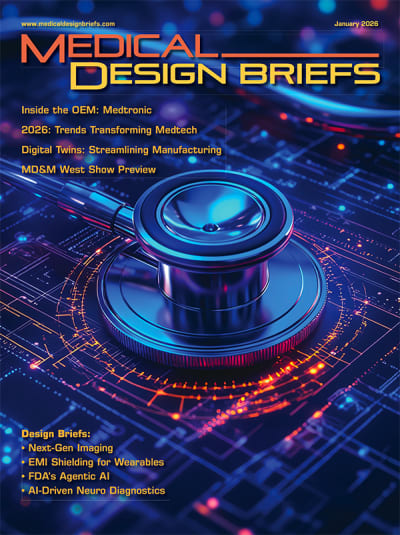


As the medtech ecosystem braces for another year of rapid transformation, the need for clarity, adaptability, and technical depth has never been greater. The Winter 2025 Medical Design Briefs Resource Guide continues our mission to provide expert-driven insights into the components, materials, and manufacturing strategies shaping next-generation devices.
Like our summer edition, this semi-annual guide moves beyond traditional listings to offer curated editorial content across key technology segments. Each section presents a focused feature article, exploring the trends, engineering challenges, and strategic considerations influencing product development today. Whether you’re navigating supply-chain volatility, advancing material performance, or integrating more automation on the factory floor, this guide is designed to support your decision-making throughout the year.
This issue begins with an in-depth look at how contract manufacturers are reinventing themselves for a new era defined by greater customization, tighter timelines, and the need to flex between high-mix and high-volume production. In electronics, we examine two timely frontiers: the engineering of compact, energy-efficient drug-delivery pens and the persistent ebb and flow of the global electronics supply chain that continues to shape sourcing strategies for OEMs.
Rising demand for IV disposables — driven by chronic disease prevalence, infection-control priorities, and shifting care models — is the focus of our disposables section. In fluid management and tubing, we explore advances in polyimide technology that are enabling smaller, more precise, and more durable interventional devices.
Our materials coverage highlights new surface-active antimicrobial coatings that raise the bar for device safety, alongside a feature on how OEM toll processing is helping manufacturers scale high-value materials with greater consistency and efficiency.
From there, we turn to robotics and automation, where custom motion-control components are unlocking new performance levels in medical equipment design. Rounding out the issue, our test and measurement article addresses a critical challenge: reducing biocompatibility risks arising from material and supplier changes.
This guide is designed to serve not only as a snapshot of today’s evolving landscape but as a practical reference you can return to as you refine designs, evaluate partners, and navigate your 2026 planning cycles. Each section offers insights intended to spark ideas, inform specifications, and support more resilient engineering and manufacturing strategies.
Sherrie Trigg
Editor and Director of Medical Content