R&D: Medical
An innovative magnetic wound-healing gel promises to accelerate the healing of diabetic wounds, reduce the rates of recurrence, and in turn, lower the incidents of limb amputations.
R&D: Medical
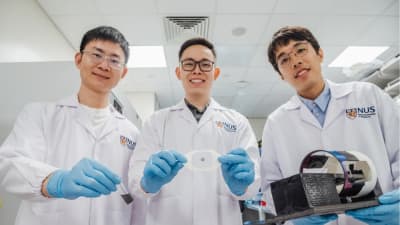
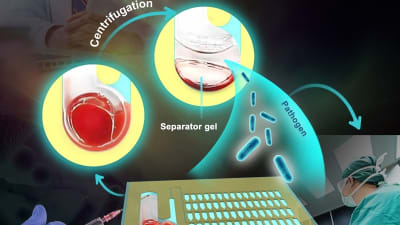
Researchers have developed an integrated microfluidic chip (BSI-AST chip) for rapid AST from positive blood cultures (PBCs).
INSIDER: Semiconductors & ICs
Researchers have developed an intelligent biochip imitates the retina of the eye. With such bioelectronics and others like it, the team hopes to correct malfunctions in the body and brain.
Podcasts: Sensors/Data Acquisition
An implantable sensor detects direct dynamic pressure in the eye and transmits high-fidelity data.
Products: Medical
Vote for the 2023 Product of the Year.
INSIDER: Sensors/Data Acquisition
Researchers have combined earlier work on painless microneedles with nanoscale sensors to create a wearable sensor patch capable of continuously monitoring the levels of certain...
INSIDER: Medical
A robotic device applies very specific forces over a range similar to forces used by human examiners and detects lumps using sensor technology at larger depths than before.
Quiz: Sensors/Data Acquisition
For more than 130 years, Abbott has brought life-changing technologies to the healthcare community. Take this quiz to see how much you know about the breakthroughs and innovations created by pioneering healthcare company.
Videos of the Month: Nanotechnology
See the videos of the month, including one on an infrared imager that can be used to easily locate an individual’s blood vessels while monitoring heart rate at the same time, an origami-inspired medical patch for minimally invasive surgery, and more.
Products: Medical
Supercapacitor Modules
Double-layer, series-connected electrochemical supercapacitor modules are now available from Kyocera AVX, Fountain Inn, SC. The new SCM Series modules can be used by themselves or in conjunction...
Briefs: Wearables
Scientists have developed a flexible battery as thin as a human cornea, which stores electricity when it is immersed in saline solution, and which could one day power smart...
R&D: Medical
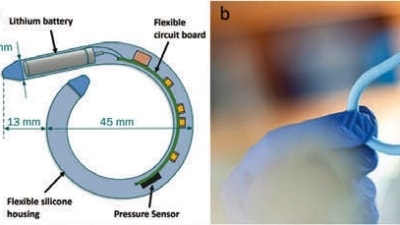
A novel aero-elastic pressure sensor, called eAir can be applied to minimally invasive surgeries and implantable sensors by directly addressing the challenges associated with existing pressure sensors.
R&D: Medical
Made with a laser-modified graphene nanocomposite material, a wearable device can detect specific glucose levels in sweat for three weeks while simultaneously monitoring body temperature and pH levels.
R&D: Wearables
A minimally invasive and smart glaucoma implant has the potential to decrease the incidence of postoperative complications. The biodegradable glaucoma implant is approximately the same size as the world’s smallest medical device known to be implanted in the human body.
R&D: Medical
The PETAL (Paper-like Battery-free In situ AI-enabled Multiplexed) sensor patch comprises of five colorimetric sensors that can determine the patient’s wound healing status within 15 minutes by measuring a combination of biomarkers.
R&D: Medical
The technology, funded by an EU Horizon 2020 project grant, shows how tracking adrenal steroid levels at high resolution and over an extended time period can provide better information about how hormone levels change across daily (circadian) and faster (ultradian) time periods.
Podcasts: Sensors/Data Acquisition
A new technology offers a minimally invasive option for neurology while improving patient outcomes.
INSIDER: Sensors/Data Acquisition
A new super flexible, self-healing and highly conductive material could significantly improve the performance of wearable technologies, soft robotics, smart devices and more.
INSIDER: Sensors/Data Acquisition
A wearable sensor monitors estradiol by detecting its presence in sweat. The researchers say the sensor may one day make it easier for women to monitor their estradiol levels at home and...
News: Regulations/Standards
The U.S. Food and Drug Administration has created a new Digital Health Advisory Committee to help the agency explore the complex, scientific and technical issues related to...
News: Sensors/Data Acquisition
BioSensics has launched Nili, a digital health platform designed to support the needs of seniors and patients living independently while minimizing the burden of caregiving. Through a...
INSIDER: Wearables
A pair of earbuds can be turned into a tool to record the electrical activity of the brain as well as levels of lactate in the body with the addition of two flexible sensors...
Videos of the Month: Medical
See the videos of the month, including an unprecedented view of gene regulation, a new composite film that improves the safety of personal protective suits, a new kind of strength-building wearable for those with restricted mobility, and more.
Products: Mechanical & Fluid Systems
Manifold for Respiratory Therapy
A turnkey manifold solution designed to optimize respiratory therapy device designs and accelerate product speed to market is available from Emerson, St. Louis, MO. The the...
Briefs: Medical
A wearable, textile-based device developed by Rice University engineers could help declutter, enhance — and, in the case of impairments — compensate for deficiencies in visual and auditory inputs by tapping the sense of touch.
R&D: Sensors/Data Acquisition
Inspired by the structure of electron-transfer chains in the mitochondria, a research group has developed a 3D mesoporous biosensing-membrane with neighborhood nanostructures that...
R&D: Wearables
A wireless device called the UroMonitor enables accurate, noninvasive monitoring of bladder pressure in patients with overactive bladder. It is the first device to enable catheter-free telemetric ambulatory bladder pressure monitoring in humans.
R&D: Sensors/Data Acquisition
A low-cost biosensor, called Neosens, will allow doctors to diagnose sepsis in a matter of minutes. Neosens works by detecting interleukin 6, a messenger that’s secreted by newborns’ immune systems in response to a host of biological conditions.
R&D: Medical
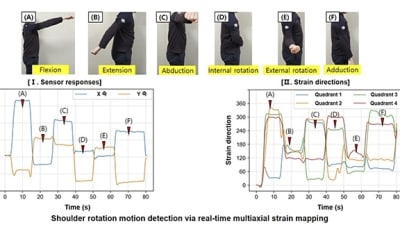
A research team has successfully overcome the limitations of soft strain sensors by integrating computer vision technology into optical sensors. The team developed a sensor technology known as computer vision-based optical strain (CVOS).


















 INSIDER: Sensors/Data Acquisition
 News: Robotics, Automation & Control
 Briefs: Materials
 Podcasts: Design
 Podcasts: Design
 Briefs: Materials

 Podcasts: Design
 Podcasts: Design
 Podcasts: Medical
 On-Demand Webinars: Manufacturing & Prototyping