Briefs: Materials
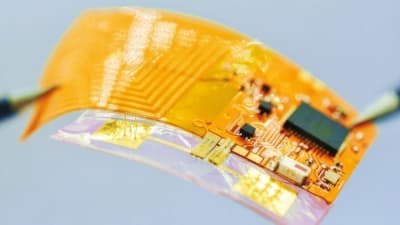
Researchers at the University of Missouri have made a significant breakthrough in their ongoing development of an on-skin wearable bioelectronic device. Zheng Yan’s lab recently added an important component to the team’s existing ultrasoft, breathable and stretchable material. The key feature: wireless charging — without batteries — through a magnetic connection.
Briefs: Robotics, Automation & Control
A team of Rice University researchers has developed an analytical model that can predict the curing time of platinum-catalyzed silicone elastomers as a function of temperature. The model could help reduce energy waste and improve throughput for elastomer-based components manufacturing.
Briefs: Materials
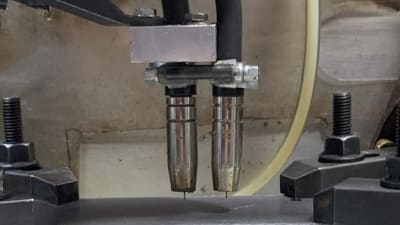
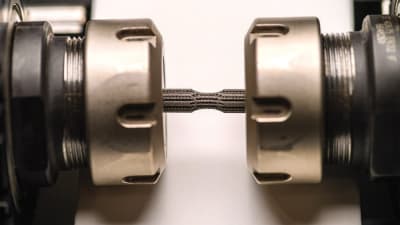
Taking a cue from the structural complexity of trees and bones, Washington State University engineers have created a way to 3D print two types of steel in the same circular layer using two welding machines. The resulting bimetallic material proved 33–42 percent stronger than either metal alone, thanks in part to pressure caused between the metals as they cool together.
Briefs: Manufacturing & Prototyping
A team of researchers from Tohoku University and Okinawa Institute of Science and Technology (OIST) has achieved significant advancement in the field of microfluidics, allowing for precise and efficient manipulation of fluids in three-dimensional microscale environments.
Briefs: Manufacturing & Prototyping
Their device, which is only a few centimeters in size, can be manufactured at scale in batches and then incorporated into a mass spectrometer using efficient, pick-and-place robotic assembly methods.
Briefs: Manufacturing & Prototyping
3D printed microscopic particles — so small that to the naked eye they look like dust — have applications in drug and vaccine delivery, microelectronics, microfluidics, and abrasives for intricate manufacturing. Researchers at Stanford University have introduced a more efficient processing technique that can print up to 1 million highly detailed and customizable microscale particles a day.
Briefs: Medical
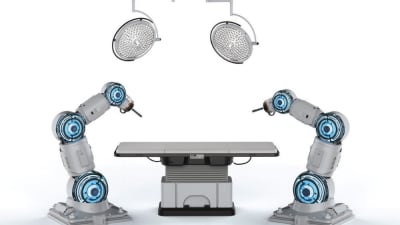
This article highlights the steps designers should take when specifying their motor and motion system for use in surgical robot applications.
Briefs: IoMT
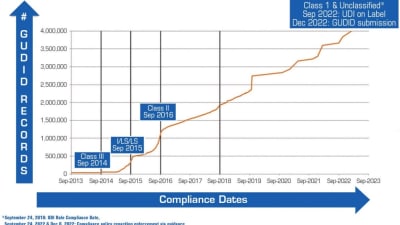
September 2023 marked the 10-year anniversary of the day the FDA’s Unique Device Identification (UDI) requirement first took effect. In that time, UDI went from an idea to a framework to a law; its GUDID database now uniquely identifies and holds data on more than 4 million medical devices and is the foundation for thousands of daily lookups and transactions.
Briefs: Electronics & Computers
Part 1 of this article , which ran in March 2023, looked at the general structure, design variants, and system design of ultrasonic medical handpieces. Part 2 now reviews driver design, special applications, drive electronics, and failure mechanisms.
Briefs: Wearables
The new contact lenses contain microsensors that monitor changes in IOP over a period of several hours, sending the data collected wirelessly so it can be analyzed by an ophthalmologist and a diagnosis given.
Briefs: Wearables
University of North Carolina at Chapel Hill scientists created a new drug-delivery system, called the Spatiotemporal On-Demand Patch (SOP), which can receive commands wirelessly from a smartphone or computer to schedule and trigger the release of drugs from individual microneedles.
Briefs: Wearables
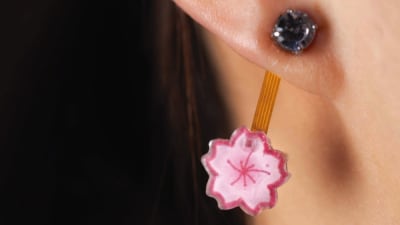
University of Washington researchers introduced the Thermal Earring, a wireless wearable that continuously monitors a user’s earlobe temperature. In a study of six users, the earring outperformed a smartwatch at sensing skin temperature during periods of rest.
Briefs: Design
Part 1 of this article looks at the general structure, design variants, and system design of ultrasonic medical handpieces. In a future issue, Part 2 will examine driver design, special applications, drive electronics, and failure mechanisms.
Briefs: Materials
Some people do not go the dentist out of fear, thereby risking a worsening of untreated tooth damage. However, some dental practices offer patients a gentle alternative: The Wand – STA System from Milestone Scientific.
Briefs: Robotics, Automation & Control
Creating robots from flexible materials allows them to contort in unique ways, handle delicate objects, and explore places that other robots cannot. More rigid robots would be crushed by the deep ocean’s pressure or could damage sensitive tissues in the human body, for example.
Briefs: Wearables
Researchers have used a soft, wearable robot to help a person living with Parkinson’s walk without freezing. The robotic garment, worn around the hips and thighs, gives a gentle push to the hips as the leg swings, helping the patient achieve a longer stride.
Briefs: Medical
The work could lead to better infection control in many common surgeries, such as hip and knee replacements, that are performed daily around the world. Bacterial colonization of the implants is one of the leading causes of their failure and bad outcomes after surgery.
Briefs: Robotics, Automation & Control
Developing assistive robots is a challenging research area, especially when integrating these systems into human environments such as homes and hospitals. To tackle these challenges, the Human-Machine Interaction & Innovation (HMI2) Lab at Santa Clara University is creating a versatile intelligent robot.
Briefs: Test & Measurement
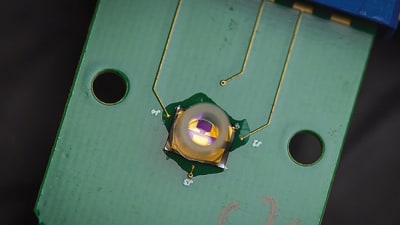
Optical parametric oscillator (OPO) lasers test optical fibers and components to characterize the spectral response of optical components. Now, these tunable pulsed lasers are being used to facilitate a range of tests at different wavelengths to qualify and quantify the performance of optical components such as fiber optic strands, filters, lenses, and coated mirrors.
Briefs: Materials
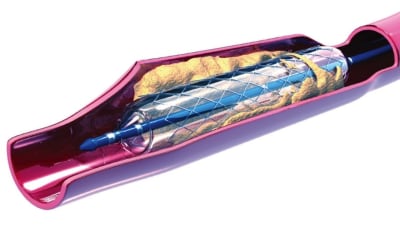
The process of manufacturing high-quality and reliable balloon catheters is critical to a number of advanced medical treatments for patients including balloon angioplasty, stent and drug delivery, transcatheter aortic valve implantation, atherectomy, renal denervation, and laser balloon angioplasty.
Briefs: Wearables
Parag Chitnis, PhD, of George Mason University led a team that developed a wearable ultrasound system that can produce clinically relevant information about muscle function during dynamic physical activity.
Briefs: Mechanical & Fluid Systems
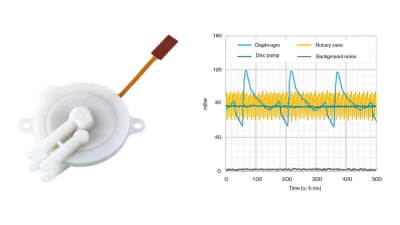
As the demand for smaller, less intrusive — sometimes even wearable — products grow, engineers must meet these expectations without compromising on pump system performance.
Briefs: Robotics, Automation & Control
A beating heart makes for a formidable surgical arena, but a new robotic catheter could someday equip surgeons to operate in the cardiac environment with greater ease.
Briefs: AR/AI
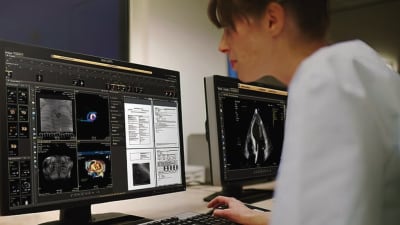
Royal Philips is integrating AI in its cardiac ultrasound devices and across cardiac care to help improve clinical confidence and increase efficiency. The portable Philips Ultrasound Compact System 5500 CV includes an AI-powered automation tool (the automated strain quantification) to assess the function of the heart’s left ventricle, a key indicator of heart health.
Briefs: Medical
An international team of researchers has developed a handheld, noninvasive device that can detect biomarkers for Alzheimer’s and Parkinson’s diseases. The biosensor can also transmit the results wirelessly to a laptop or smartphone.
Briefs: Green Design & Manufacturing
By choosing specialty thermoplastics, device manufacturers can help reduce the environmental impact of their products while gaining plastic's well-known benefits of expanded design freedom and streamlined, high-volume production of parts compared to metal alternatives.
Briefs: Design
A research team has developed a new approach that integrates a minimally invasive, painless microneedle platform capable of absorbing the cell-surrounding, biomarker-containing fluid from deeper layers of the skin with an ultra-sensitive, single-molecule detection method (Simoa) that detects often rare, yet relevant biomarkers with higher sensitivity than conventional methods.
Briefs: Electronics & Computers
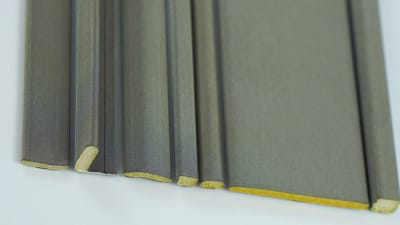
The article explores the role of high-attenuation shielding in ensuring EMC in medical devices, highlighting Tech Etch's 2400 and 2500 series fabric over foam as examples to effectively block EMI in sensitive medical electronics.
Briefs: Manufacturing & Prototyping
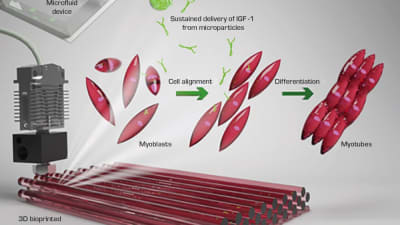
An advancement in 3D bioprinting of native-like skeletal muscle tissues has been made by scientists at the Terasaki Institute for Biomedical Innovation (TIBI).















 INSIDER: Medical
 Features: AR/AI
 INSIDER: Medical
 INSIDER: Software
 Podcasts: Medical
 Features: Design

 Podcasts: Design
 Podcasts: Medical
 On-Demand Webinars: Communications
 Podcasts: Medical
 Podcasts: Manufacturing & Prototyping