
Each year, an estimated one million people suffer from painful bedsores in US hospitals across the country. These wounds are the result of long-term confinement to a bed or wheelchair, and often become seriously infected or develop gangrene.
Not only are bedsores incredibly painful, but they can also be deadly, linked to a four-fold increase in death, with a hospital mortality rate of 23 to 37 percent. Compounding the problem, patients who develop bedsores also experience a five-time longer hospital stay, putting them at much greater risk of developing other ailments. Then, of course, there are financial implications. Conservative estimates peg the cost of bedsores in US hospitals at $55 billion per year. Information on costs and estimates was extracted from the National Decubitus Foundation’s report of “Cost Savings Through Bedsore Avoidance.”
Finding a way to prevent bedsores before they start is a high priority for hospitals, nursing homes, and long-term care facilities, as well as bed manufacturers. Conventional means of studying possible solutions typically involve long prototyping processes and the use of human test subjects, who are asked to lie in a bed for an extended period to see if they develop a bedsore.
In order to determine a better, less invasive method of testing, Senior Engineer Mark Carlson and his team at MSC Software, Newport Beach, CA, have developed a simulation test bed—both literally and figuratively—to assess the impact of potential bed designs on bedsore formation. Their method was determined within a matter of hours instead of months, with no risk to human health.
The simulation combined forces from several software programs, including the non-linear finite element solution capabilities in MSC Marc, the multi-body dynamics analysis power of MSC Adams, and the 3D post-processing visualization provided by EnSight from Computational Engineering International (CEI Inc.), Apex, NC. The combined analysis was able to uncover critical, previously unattainable insights into the bedsore problem, which can help equipment manufacturers build better beds that can help prevent bedsores from forming in the first place.
More than Skin Deep
One of the critical challenges in studying bedsore development is understanding how, where, and why they develop. Anecdotally, Carlson and his team knew that the buttocks and heels are the primary locations for bedsore formation. Bed manufacturers have been experimenting for years with different types of bed surfaces, foam materials, positioning/angling, and other parameters to help better distribute the stresses caused by pressure and gravity across the body.
The problem is, conventional testing typically involves two methods that have some limitations. First, manufacturers ask human test subjects to lie on a pressure-sensitive pad that indicates how the contact patches manifest externally on the surface of the skin. Researchers have long theorized that bedsores are more than just a surface problem—they actually manifest under the skin, deep in the tissues of the flesh, muscles, and even bone interfaces. Second, lab tests using body part molds in a compression test machine can study the forces applied by those parts onto the bed, but only for those specific, individual parts—just the heel or the torso, for example. This kind of test makes no consideration for the changes, sometimes dramatic, that could occur when entire human bodies of varying sizes and anthropometric characteristics are positioned across the entire bed.
Hidden Insights Revealed
To study the problem more holistically, the engineering team developed an advanced co-simulation solution that not only allowed researchers to study the problem more thoroughly, but also much faster, to accelerate material and equipment design innovation, testing, and market delivery.
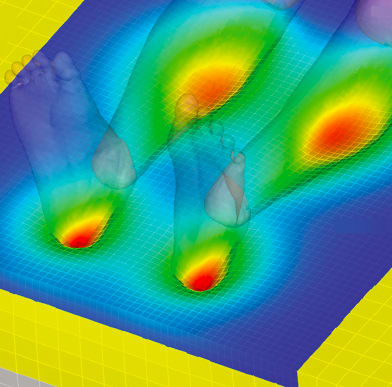
Carlson began with Adams to simulate the rigid component geometry of the human body, using the Life Mod™ plug-in ( www.lifemodeler.com/products/lifemod ) from Life Modeler of San Clemente, CA, to model the anthropometric data for various parts, sizes, and characteristics of the human body from the pre-loaded Life Modeler geometry database. The researchers were able to then simulate the effects of bed settling due to gravity across 15 different body segments, accounting for accurate range of motion calculations, as well as the other complex dynamics and kinematics present within various human joints. (See Figure 1)
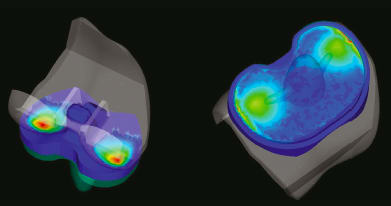
But, gravity settling is only part of the equation—understanding the contact patches and associated stresses caused by those loading conditions in relationship to the bed was the next step. Using the nonlinear finite element solver Marc, the team was able to develop a mathematical model of the bed, including simulation of a wide array of foam materials, foam layering configurations, and other properties. In addition, the team was able to create its own simulated foam materials and configurations for scenario testing. (See Figure 2)
The Co-Sim solution, running the two solvers simultaneously to include the complex physical contact interactions, along with accurate representation of the human motion, was critical to understanding the complete picture of the conditions under which bedsores develop, even beneath the skin’s surface. More importantly, the team was able to better understand, as well as practically quantify, the sensitivities of attribute combinations, and evaluate how even small changes in bed design, positioning, foam material, and other parameters could have significant effect on contact stresses, even into the deep tissue layers below the surface. With the time synchronous co-simulation solution, the team was able to test hundreds of combinations, with varying anthropometric characteristics, bed geometries, and complex foam materials in very short order. (See Figure 3)
A Clearer Picture

The engineering team used CEI’s EnSight 3D visualization software to view the separate data sets created by Marc and Adams concurrently.
“Looking at Adams only, you’d see the human body sinking into nothingness, and with Marc, you’d see the finite elemental deformations in the bed—the contact points—but no body. Once we time-synced the two and imported the results into EnSight, we got a clear picture of the combination of both data sets at once,” Carlson said. “EnSight is so flexible and easy to use, that we can also plot data at the same time as we visualize, look at each data set separately, or combine them into a single, immersive 3D view.” In addition to EnSight, the team used CEI’s EnLiten file viewer to share the 3D simulations with others who may not have EnSight. Carlson says the ability to demonstrate the research and results in a visually compelling way that everyone can access makes a tremendous impact in understanding and humanizing the results.
“The enhanced communication we achieved with EnSight and EnLiten is huge,” he said. “I can send someone a full 3D EnLiten model, which they can study on their own, interact with, manipulate views and angles, and turn parts and plots off. It’s free and they can use it independently of the simulation and visualization software.”
A Positive Prognosis
With the research enabled through the Marc/Adams co-simulation, hospital bed and other equipment manufacturers can gain much greater visibility into what’s going on internally with the body in relationship to external forces and how to solve related challenges.
“This capability is like installing sensors inside the body and on the surface that the body is resting on to get a picture of how the two interact. That just wasn’t possible before,” Carlson said. “And, it’s so much faster and less expensive than building prototypes, bringing in real people for testing and exposing them to the risk of complications, and then having to go back to the drawing board for every variable change. With Marc, Adams, and EnSight working together, we can set up several variations to run simultaneously and have results the same day, versus waiting weeks or months for physical test or clinical trial results.”
This article was written by Mark Carlson, Solutions Specialist, MSC Software, Newport Beach, CA, and Kara Gray, Freelance Writer. For more information on MSC Software, visit http://info.hotims.com/61059-165 . For more information on Computational Engineering International (CEI Inc.), Apex, NC, visit http://info.hotims.com/61059-184 .