

Engineers at Washington University, St. Louis, Mo, say that they have developed algorithms that can identify weak spots in tendons, muscles, and bones prone to them tearing or breaking. Their technology may one day help pinpoint minor strains and tiny injuries in the body’s tissues long before bigger problems occur.
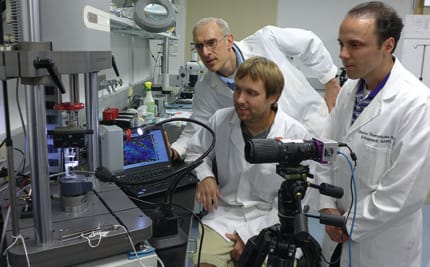
Since tendons are constantly stretching as muscles pull on them, small cracks or tears can result and lead to major injuries. Understanding how these tears and cracks develop over time is important for diagnosing and tracking injuries.
The team combined mechanical engineering fundamentals with image-analysis techniques to create algorithms that were tested using different materials and in animal models.
In one experiment, they sprayed a pattern of dots on plastic wrap, stretched it, and tracked the dots. As the wrap is pulled and stretched, tears begin to form. The new algorithm allowed them to find the places where the tears were beginning to form and to track them as they extended.
One of the new algorithms is 1,000 times more accurate than older methods at quantifying very large stretches near tiny cracks and tears, their research showed. And a second algorithm has the ability to predict where cracks and failures are likely to form.
Extra accuracy is critical for quantifying large strains, they said. Commercial algorithms that estimate strain often are much less sensitive, and detect noise that can arise from the algorithm itself rather than from the material being examined. The new algorithms can distinguish the noise from true regions of large strains.
In the long run, they want to use the algorithms to prevent additional injuries following surgery to repair knees, shoulders and other tissues. They also said it may be possible some day to predict problems before they occur.