Briefs: Medical
In the big picture of medical equipment sustainability, sensors play an important role. That’s right, something so miniature can have quite the impact on maintaining and improving sustainability — from the product design phase to use in equipment in the home. Read on to learn more.
Features: Wearables
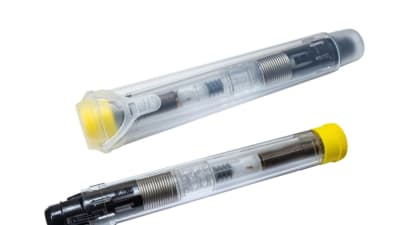
Innovative reusable drug-delivery devices are transforming the administration of high-dose biologics by enabling self-administration of challenging drug formulations. These devices support high viscosity and larger injection volumes, enhancing patient comfort and adherence. Read on to learn more.
Features: Packaging & Sterilization
The pharmaceutical industry’s pivot toward sustainability reflects a broader movement in global business practices where environmental responsibility is not just a choice but a business imperative. Read on to learn more.
Features: Electronics & Computers
Therapeutic ultrasound opens up numerous new fields of application for the treatment of neurodegenerative, cardiovascular, or cancer diseases. Read on to learn how.
Features: Test & Measurement
While mechanical testing may play a small role in the total scope of CDMO competencies, a poorly equipped solution can result in significant issues with time management, data integrity, and root cause analysis. Investing in highly capable testing systems should be considered a long-term investment and serve to showcase a commitment to quality for potential clients. Read on to learn more.
From the Editor: Medical
At the end of June, FDA released a draft guidance that is designed to facilitate and streamline development of stand-alone devices and combination products by improving the consistency of drug-delivery performance information included in applications and submissions. Read on to learn more about it.
Trivia: Robotics, Automation & Control
What robotic device was finally available for therapy in just the last 10 years?
Blog: Regulations/Standards
The global landscape for medical technology, biotechnology, and life sciences is on the cusp of seismic change.
Podcasts: AR/AI
Exploring advances and innovations in assistive robotics.
INSIDER: Lighting
Certain types of light have proven to be an effective, minimally invasive treatment for cancers located on or near the skin when combined with a light-activated drug. But deep-seated cancers,...
INSIDER: Medical
Scientists have developed an innovative wearable fabric that is flexible but can stiffen on demand. Developed through a combination of geometric design, 3D printing, and robotic...
Podcasts: Robotics, Automation & Control
Exploring how robotics are enhancing precision and minimizing invasiveness of surgical procedures.
News: Manufacturing & Prototyping
Flambeau Medical, a full-service contract manufacturing organization serving the medical device and life sciences industries, has added a new industrial 3D printer to expand its rapid...
INSIDER: Wearables
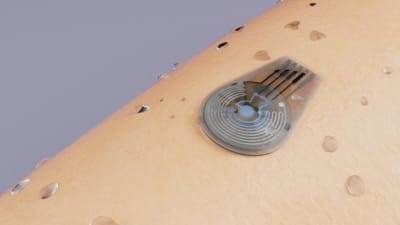
Scientists have developed a plaster that measures body biomarkers that can indicate health or disease through sweat, paving the way for a new noninvasive and effective way...
INSIDER: Wearables
Maintaining bodily water balance is essential for survival. Although sweat serves as a key indicator of physical and mental health, existing wearable technologies can only monitor...
INSIDER: Medical
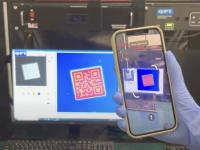
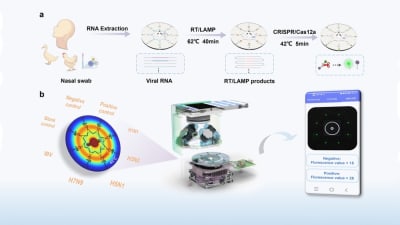
A spatial encoding of centrifugal microfluidic disc integrates a smartphone-controlled (SEDphone) platform for detecting influenza virus subtypes.
Blog: Electronics & Computers
Researchers have demonstrated a new method that leverages artificial intelligence (AI) and computer simulations to train robotic exoskeletons to autonomously help users save energy while walking, running, and climbing stairs.
Products: IoMT
See the product of the month: Linxens' NFC tag that is integrated directly into the polymer matrix of the medical device.
Videos of the Month: Imaging
See the videos of the month, including one on research that pioneers transformative approaches to intuitively control prosthetic devices; one on how medical professionals can map the radiation dose within the body, giving them new data to guide treatments in real time; one on a new smart material that is activated by both heat and electricity; and one on what bats can teach us about co-existing with viruses and preventing severe disease.
From the Editor: Medical
This editorial was written by Ivor Campbell, Chief Executive of Callander, UK-based Snedden Campbell, a specialist recruitment consultant for the medical technology industry. He talks about who holds the key to the future of public health diagnostics. Read on to learn more.
Global Innovations: Medical
Ultrasound-based wireless power transfer is becoming a more attractive option to power implanted biomedical devices because it could overcome many of the limitations and challenges facing other wireless charging approaches. Now, a new study has shown that the shape of the implanted receiver can significantly increase the efficiency of power harvesting from the ultrasound beam.
From the Editor: Robotics, Automation & Control
From the Editor discusses Robocath -- a company that designs, develops, and markets innovative robotic solutions to treat cardiovascular and neurovascular diseases -- and how it has published a new report exploring current and future expectations for the use of robotics in interventional medicine. Read on to learn more.
Products: Tubing & Extrusion
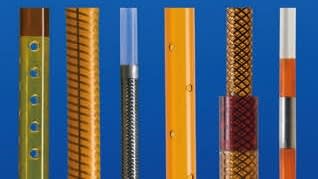
See what the product focus is on this month: tubing from Putnam Plastics Corp., Microlumen, Sigma-Netics, and Junkosha.
Products: Software
See the new products and services, including mdi Consultants' software penetration testing, Sandvik Coromant's, two new PVD insert grades, Air Logic's robust innovation in low cracking force in-line non-return valves, Thomson Industries' miniature metric precision ball screw, Kollmorgen's updated AKD2G servo drive, and more.
Briefs: Medical
Engineers have developed a wearable ultrasound patch that can offer continuous, noninvasive monitoring of blood flow in the brain. The soft and stretchy patch can be comfortably worn on the temple to provide three-dimensional data on cerebral blood flow — a first in wearable technology.
Briefs: Medical
The proposed novel approach holds promise for enhancing the thermoelectric performance of CNT materials from yarns to films and bulk structures.
Briefs: Medical
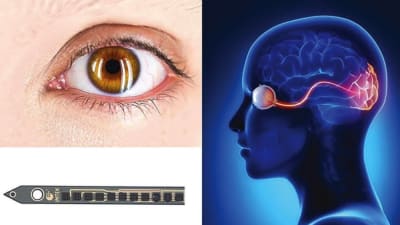
By sending electrical impulses via an implant to the visual cortex of the brain, an image can be created, and each electrode would represent one pixel.
Briefs: Robotics, Automation & Control
A new report from Clarivate Plc, London, UK, offers a predictive analysis of high-growth medical technology markets poised to generate over $1 billion in value or achieve double-digit growth within the next five years. The report, “Medical Technologies to Watch in 2024” underscores critical areas of significant investment. Read on to learn more.






















 INSIDER: Medical
 INSIDER: Sensors/Data Acquisition
 Features: Electronics & Computers
 Podcasts: Design
 INSIDER: Wearables
 Podcasts: Medical

 Podcasts: Medical
 On-Demand Webinars: Manufacturing & Prototyping
 Podcasts: AR/AI
 Podcasts: Materials