Design & Testing

Markets

What are the major medical device markets? Find out here. Our news and videos focus on essential sectors, including prosthetics, drug delivery, and rehabilitation.

Stories

43,108
108,115,156
0
840
30
INSIDER: Medical
Engineers Control Metal Deformation
Researchers at Purdue University discovered a simple way to control a type of metal deformation known as sinuous flow. Supressing the deformation could reduce the energy required to process metals and lead to more efficient machining.
INSIDER: Medical
Engineers Develop Better Brain-Controlled Prostheses
An interdisciplinary team led by Stanford electrical engineer Krishna Shenoy has developed a technique to make brain-controlled prostheses more precise. The prostheses analyze the neuron sample and instantly make dozens of corrective adjustments to the estimate of the brain's electrical pattern.
Features: Materials
Most orthopedic implant manufacturers still rely heavily on traditional coatings for their implants, such as sintered bead and plasma-sprayed metallic and hydroxyapatite (HA) coatings. These...
Feature Image
R&D: Robotics, Automation & Control
Engineers Put New Spin on Spider Silk
Researchers at the Massachusetts Institute of Technology have produced samples of strong, resilient spider silk. The spun samples could lead to a variety of biomedical materials, including sutures and scaffolding for organ replacements.
Briefs: Robotics, Automation & Control
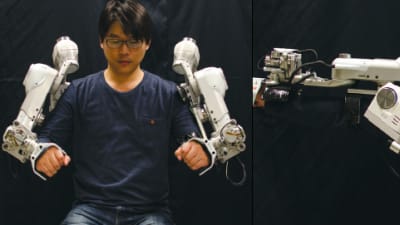
Exoskeleton provides precise therapy while tracking data. A team of engineers at The University of Texas at Austin have developed a first-of-its kind, two-armed, robotic rehabilitation exoskeleton that,...
Feature Image
Briefs: Medical
Gold coating could reduce scarring. A team of scientists from Lawrence Livermore National Laboratory, Livermore, CA, working with other researchers at the University of California, Davis, say that...
Feature Image
INSIDER: Robotics, Automation & Control
Device Maintains Donor Liver Health Outside Body
A sterile medical device preserved the health of a deceased donor liver and allowed the organ to repair itself. The liver was then successfully transplanted to a 43-year-old patient in Ontario. The device, which mimics human physiological functions, is part of a Phase 1 clinical trial at UHN's...
INSIDER: Medical
'Ratchet' Nanostructures Change Color of Light
Researchers at the University of Delaware have received a $1 million grant from the W.M. Keck Foundation to develop new nanostructures that act like a ratchet, combining the energy of two red photons of light into a single, higher-energy blue photon. The light-changing technology could improve solar...
INSIDER: Sensors/Data Acquisition
'Slip-Stick' Hydrogel Controls Liquid Motion
A smart hydrogel coating from Georgia Institute of Technology creates “stick-slip” control of capillary action. By placing the material inside of glass microtubes, capillary forces are altered and draw water differently. The researchers' discovery could provide a new way to control microfluidic...
News: Medical
Addressing Challenges in Manufacturing Technologies
There’s no doubt that additive manufacturing (AM), including emerging 3D printing technologies, is booming. Despite its promise though, AM still has far to go to in understanding the impact of subtle differences in manufacturing methods on the properties and capabilities of resulting materials....
INSIDER: Medical
Researchers Reveal How Neurons Control Muscle Movement
New research from Stanford University sheds light on how neurons control muscle movement. The findings could be applied to create better brain-controlled prosthetic devices, such as robotic arms.
INSIDER: Medical
Graphene Production Breakthrough Supports Artificial Skin Development
Using high-quality, low-cost graphene, researchers from the University of Exeter have created a transparent, flexible touch-sensor that could enable the development of artificial skin.
R&D: Medical
Larger Implantable Devices Avoid Immune-System Rejection
By using larger spherical components, Massachusetts Institute of Technology researchers have found a way to reduce the immune system from rejecting biomedical implant devices. The bigger spheres are better able to maintain their function and avoid scar-tissue buildup.
R&D: Medical
Device Enables Sensations in Prosthetic Hands
A Washington University team developed a novel device that may allow individuals to feel hot and cold temperatures through a prosthetic technology. If the invention works as planned, upper-limb amputees who use motorized devices would be able to feel various sensations through the prosthetic, which...
R&D: Medical
3D Microbattery Offers On-Chip Integration
By combining 3D holographic lithography and 2D photolithography, researchers from the University of Illinois at Urbana-Champaign have demonstrated a 3D microbattery suitable for large-scale on-chip integration with microelectronic devices. Applications for the holographically patterned battery include...
INSIDER: Medical
Students' Designs Give New Look to Prosthetics
A new technique developed by Kansas State University students allows individuals to personalize their prosthetic with new "skins." The covers are made from flexible resins and plastics.
R&D: Medical
Researchers Create Silicone Microspheres from Mist
Using misting technology found in household humidifiers, University of Illinois chemists developed a new method to create silicone microspheres. The tiny spheres could have applications in targeted medicine and imaging.
R&D: Medical
New Manufacturing Method Produces Low-Cost Nanofibers
Researchers at the University of Georgia have found a low-cost way to manufacture extraordinarily thin polymer strings. The nanofibers can be used to create advanced wound dressings, regenerate tissue, and deliver drugs directly to the site of an infection.
INSIDER: Medical
Researchers Print Three-Dimensional Cellulose Objects
Using a 3D bioprinter, a group of engineers at Chalmers University of Technology have created objects made entirely by cellulose. The additive manufacturing process could be used to build patient-specific implants, new sensors, and wound dressings that communicate with healthcare workers.
INSIDER: Medical
Nanowire Implants Offer Remote-Controlled Drug Delivery
Using nanowires, Purdue University researchers has created a new implantable drug-delivery system that can be wirelessly controlled. The nanowires respond to an electromagnetic field generated by a separate device, which can be used to release a pre-loaded drug. The engineering team says that...
INSIDER: Medical
New Foam Could Improve Prosthetic Comfort
Changchun "Chad" Zeng from Florida State University's High Performance Materials Institute (HPMI) has developed a new auxetic foam. Prosthetic socks made from the foam will help amputees adjust prosthetic devices to their specific limb shape and volume.
INSIDER: Materials
Heart-Powered Electronics
Researchers at the University of Illinois at Urbana-Champaign have created thin, flexible electronic devices that efficiently harvest the mechanical energy from natural motions of the human body. In addition to advances in materials processing to enable fabrication of these thin film devices, accurate analytical models...
INSIDER: Medical
Soft Robotic Glove Improves Patients' Grasping Ability
A robotic glove built by a team of engineers at the Wyss Institute for Biologically Inspired Engineering and Harvard John A. Paulson School of Engineering and Applied Sciences (SEAS) could assist patients suffering from loss of hand motor control.
INSIDER: Medical
Hydrogel Accelerates Healing Process
An injectable hydrogel from the UCLA Henry Samueli School of Engineering and Applied Science helps skin wounds heal more quickly. An instant scaffold created by the material allows new tissue to latch on and grow within the cavities formed between linked spheres of gel.
INSIDER: Medical
Electronic Devices Self-Destruct When Heated
University of Illinois engineers have created heat-activated self-destructing electronic devices. A radio-controlled trigger remotely prompts the process on demand.
INSIDER: Medical
Researchers Create Single-Molecule Diode
Columbia Engineering researchers have designed a new technique to build a single-molecule diode. Their results achieved rectification ratios as high as 250, fifty times higher than earlier designs.
INSIDER: Medical
Neuroprosthetic Device Enables Intuitive Control of Robotic Arm
Through a clinical collaboration between Caltech, Keck Medicine of USC, and Rancho Los Amigos National Rehabilitation Center, a man paralyzed from the neck down can use a robotic arm to perform a fluid hand-shaking gesture, drink a beverage, and even play "rock, paper, scissors." The...
INSIDER: Mechanical & Fluid Systems
Device Captures Circulating Tumor Cells
A microfluidic device called the Cluster-Chip, developed by a team of scientists at Massachusetts General Hospital, is the first designed specifically to capture clusters of two or more rare circulating tumor cells (CTCs), rather than single cells. The ability to isolate intact clusters, they say, can enable...
INSIDER: Medical
3D Bioprinting to Attempt Nerve Cell Regeneration
Researchers at Michigan Technological University, Houghton, recently acquired a 3D bioprinter with which they plan to “print” synthesized nerve tissue. The key, they say, is developing the right “bioink” or printable tissue. One of the team member’s research on cellulose nanocrystals as...

Ask the Expert

John Chandler on Achieving Quality Motion Control

Feature Image

FAULHABER MICROMO brings together the highest quality motion technologies and value-added services, together with global engineering, sourcing, and manufacturing, to deliver top quality micro motion solutions. With 34 years’ experience, John Chandler injects a key engineering perspective into all new projects and enjoys working closely with OEM customers to bring exciting new technologies to market.

Inside Story

Inside Story: Trends in Packaging and Sterilization

Feature Image

Eurofins Medical Device Testing (MDT) provides a full scope of testing services. In this interview, Eurofins’ experts, Sunny Modi, PhD, Director of Package Testing; and Elizabeth Sydnor, Director of Microbiology; answer common questions on medical device packaging and sterilization.

Videos