Markets

Implants & Prosthetics

Learn more about the materials and properties of today's advanced implants and prosthetics. Examples include cardiac pacemakers, defibrillators, and orthopedics.

Latest Briefs & News

43
115
0
0
30
Global Innovations: Materials
RMIT researchers have created an experimental 3D printed diamond–titanium device that generates electricity from flowing liquid and receives wireless power through tissue making it possible to remotely sense changes in flow. Read on to learn more about it.
Feature Image
INSIDER: Medical
In their keynote, Drew Davis and Eric Nickel explore how the rise of 3D printing and scanning technologies have transformed healthcare. They will talk about how and...
Feature Image
Briefs: Medical
A research team at RCSI University of Medicine and Health Sciences has developed a 3D printed implant to deliver electrical stimulation to injured areas of the spinal cord offering a potential new route to repair nerve damage. Read on to learn the details of the 3D-printed implant and how it performs in lab experiments.
Feature Image
Briefs: Imaging
A research team led by Prof. Jinho Chang at DGIST has developed an ultrasound-based wireless charging technology capable of rapidly and efficiently charging the batteries of implantable medical devices. The technology has achieved world-class energy efficiency, fully charging a commercial battery within two hours, even inside the human body. Read on to learn more.
Feature Image
Blog: Sensors/Data Acquisition
In this Q&A with Medical Design Briefs, Michael Klitzke, principal system architect at TE Connectivity, discusses how advances in sensor miniaturization, packaging,...
Feature Image
R&D: Medical
Researchers have created a groundbreaking prototype for a new kind of leadless pacemaker designed for both children and adults. The innovative micropacemaker would be the first fully leadless system to be placed in the pericardial space surrounding the heart. Read on to learn more.
Feature Image
R&D: Medical
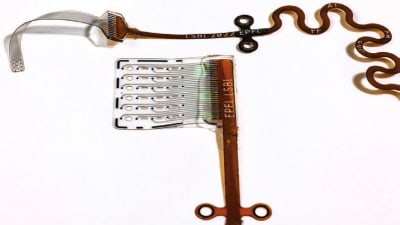
Researchers have developed a soft, thin-film auditory brainstem implant. The device uses micrometer-scale platinum electrodes embedded in silicone, forming a pliable array just a fraction of a millimeter thick. This novel approach enables better tissue contact, potentially preventing off-target nerve activation and reducing side effects. Read on to learn more.
Feature Image
Products: Medical
See where the product focus is this month: Tubing, including TekniPlex Healthcare's PTA/PTCA balloon catheter tubing solutions; Kent Elastomer Products' biopharmaceutical tubing that can replace thermoplastic elastomers and is designed to reduce emissions related to single-use tubing by as much as 50 percent; cut-to-length and slit peelable heat shrink tubing from Junkosha; and more.
Feature Image
Global Innovations: Materials
A team from the GIGA (Cardiology Laboratory) and the CESAM (Centre de recherche sur les macromolécules – CERM) at the University of Liège has developed PHOx, a thermoplastic elastomer without isocyanate PU (NIPU), which is therefore less toxic to produce and much better tolerated by the human body. Read on to learn more.
Feature Image
Trivia: Medical
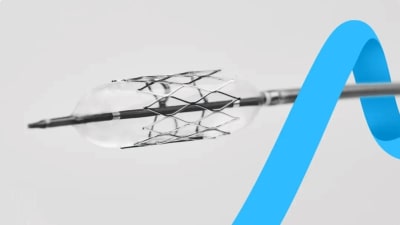
What is the first FDA-approved cardiac stent specifically designed to grow and expand with infants and young children?
Feature Image
Trivia: Design
What implantable system was the first to university-developed medical device to receive FDA 510(k) clearance?
Feature Image
News: Medical
Five leading companies in the medical device industry have launched the PRIME project — a strategic initiative dedicated to advancing the consistency, scalability, and performance of...
Feature Image
Global Innovations: Medical
A team at EPFL’s Laboratory for Soft Bioelectronic Interfaces has developed a soft, thin-film auditory brainstem implant. The device uses micron-scale platinum electrodes embedded in silicone, forming a pliable array just a fraction of a millimeter thick. Read on to learn more.
Feature Image
INSIDER: Medical
Researchers have created a groundbreaking prototype for a new kind of leadless pacemaker designed for both children and adults. The innovative micropacemaker would be the first fully...
Feature Image
News: Robotics, Automation & Control
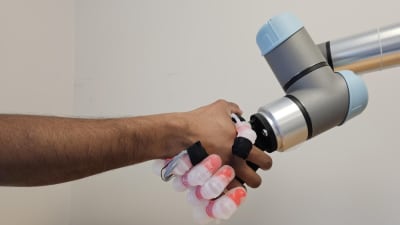
Johns Hopkins University engineers have developed a pioneering prosthetic hand that can grip plush toys, water bottles, and other everyday objects like a human, carefully conforming and adjusting its grasp to avoid damaging or mishandling whatever it holds.
Feature Image
R&D: Robotics, Automation & Control
Engineers have developed a pioneering prosthetic hand that can grip plush toys, water bottles, and other everyday objects like a human, carefully conforming and adjusting its grasp to avoid damaging or mishandling whatever it holds. Read on to learn more.
Feature Image
R&D: Medical
Research engineers are developing smart implants that can both monitor and promote healing in fractured bones. Read on to learn more.
Feature Image
Briefs: Manufacturing & Prototyping
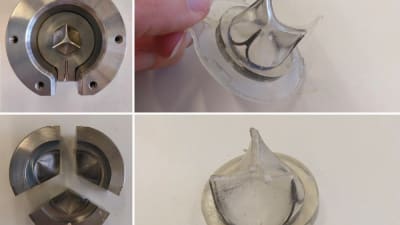
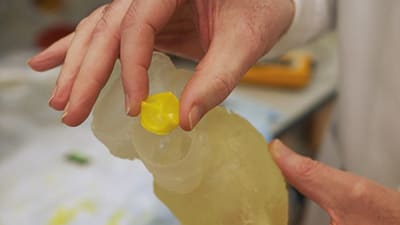
Georgia Tech researchers have created a 3D-printed heart valve made of bioresorbable materials and designed to fit an individual patient’s unique anatomy. Once implanted, the valves will be absorbed by the body and replaced by new tissue that will perform the function that the device once served. Read on to learn more.
Feature Image
Global Innovations: Medical
Zwitterions sound likes a distant cousin of Twitter (X), but in fact they are a common macromolecule found in human cells. Scientists at the University of Sydney are also now using zwitterions to create materials that could stop blood clots from forming in medical devices and implants. Read on to learn more.
Feature Image
R&D: Medical
Researchers are developing soft sensor materials based on ceramics. Such sensors can feel temperature, strain, pressure, or humidity, for instance, which makes them interesting for use in medicine, but also in the field of soft robotics. Read on to learn more.
Feature Image
Briefs: Medical
Researchers at the University of California, Irvine and New York’s Columbia University have embedded transistors in a soft, conformable material to create a biocompatible sensor implant that monitors neurological functions through successive phases of a patient’s development. Read on to learn more.
Feature Image
Briefs: Medical
Researchers at University of Galway have developed a way of bioprinting tissues that change shape as a result of cell-generated forces, in the same way that it happens in biological tissues during organ development. The breakthrough science focused on replicating heart tissues, bringing research closer to generating functional, bioprinted organs. Read on to learn more.
Feature Image
News: Medical
FDA has approved Medtronic’s BrainSense™ Adaptive deep brain stimulation (aDBS) and BrainSense™ Electrode Identifier (EI) for the treatment of Parkinson’s disease. Medtronic...
Feature Image
Briefs: Materials
Published in the journal Scientific Reports, researchers have created realistic, skin-like replicas made of Ecoflex, a type of silicone rubber that can potentially serve as a platform to evaluate risks of bacterial infections from intravenous catheters and test wearable sensors, among other biomedical applications. Read on to learn what the study found.
Feature Image
Briefs: Materials
In a paper published in Angewandte Chemie International Edition, researchers at Duke University have invented a new solvent-free polymer for DLP printing. Besides eliminating the shrinkage problem, the lack of solvent also results in improved mechanical properties of the part while maintaining the ability to degrade in the body. Read on to learn more.
Feature Image
Products: Medical
Voting for Medical Design Briefs’ 30th Annual Readers’ Choice Product of the Year Awards is now closed.
Feature Image
R&D: Medical
Researchers have now developed the first hydrogel implant designed for use in fallopian tubes. This innovation performs two functions: one is to act as a contraceptive, the other is to prevent the recipient from developing endometriosis in the first place or to halt the spread if they do. Read on to learn more.
Feature Image
R&D: Medical
A new bioink has been designed for engineering human skin constructs using norbornene-pullulan-based hydrogels. The researchers introduced a novel photocrosslinkable bioink designed for engineering human skin constructs, based on thiol-norbornene-pullulan (N-PLN) formulations combined with various crosslinkers. Read on to learn more.
Feature Image
Briefs: Medical
Researchers at EPFL have developed the first high-performance, miniaturized brain-machine interface (MiBMI), offering an extremely small, low-power, highly accurate, and versatile solution. Read on to learn about it.
Feature Image

Ask the Expert

Dan Sanchez on How to Improve Extruded Components
Feature Image

Improving extruded components requires careful attention to a number of factors, including dimensional tolerance, material selection, and processing. Trelleborg’s Dan Sanchez provides detailed insights into each of these considerations to help you advance your device innovations while reducing costs and speeding time to market.

Inside Story

Inside Story: Trends in Packaging and Sterilization
Feature Image

Eurofins Medical Device Testing (MDT) provides a full scope of testing services. In this interview, Eurofins’ experts, Sunny Modi, PhD, Director of Package Testing; and Elizabeth Sydnor, Director of Microbiology; answer common questions on medical device packaging and sterilization.
Videos