

A safe, non-invasive method for forming images through clothing of large groups of people, in order to search for concealed weapons either made of metal or not, has been developed. A millimeter wavelength scanner designed in a unique, ring-shaped configuration can obtain a full 360° image of the body with a resolution of less than a millimeter in only a few seconds. Millimeter waves readily penetrate normal clothing, but are highly reflected by the human body and concealed objects. Millimeter wave signals are non-ionizing and are harmless to human tissues when used at low power levels.
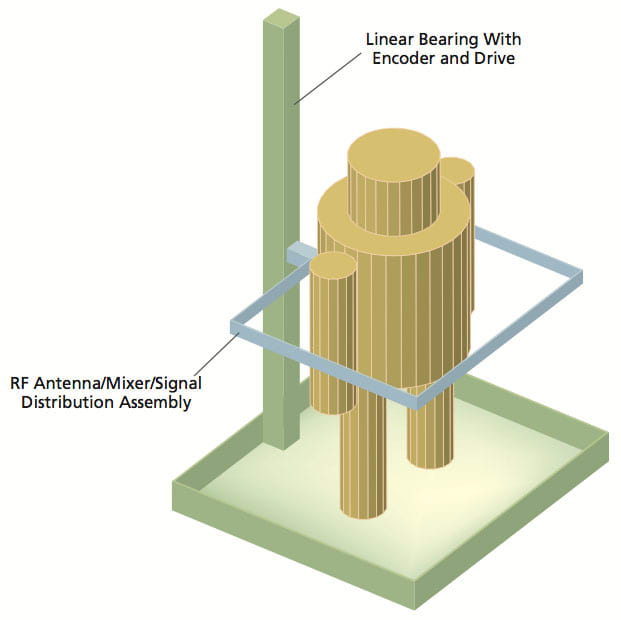
The imager (see figure) consists of a thin base that supports a small-diameter vertical post about 7 ft (≈2.13 m) tall. Attached to the post is a square-shaped ring 2 in. (≈5 cm) wide and 3 ft (≈91 cm) on a side. The ring is oriented horizontally, and is supported halfway along one side by a connection to a linear bearing on the vertical post. A planar RF circuit board is mounted to the inside of each side of the ring.
Each circuit board contains an array of 30 receivers, one transmitter, and digitization electronics. Each array element has a printed-circuit patch antenna coupled to a pair of mixers by a 90° coupler. The mixers receive a reference local oscillator signal to a subharmonic of the transmitter frequency. A single local oscillator line feeds all 30 receivers on the board. The resulting MHz IF signals are amplified and carried to the edge of the board where they are demodulated and digitized. The transmitted signal is derived from the local oscillator at a frequency offset determined by a crystal oscillator.
One antenna centrally located on each side of the square ring provides the source illumination power. The total transmitted power is less than 100 mW, resulting in an exposure level that is completely safe to humans. The output signals from all four circuit boards are fed via serial connection to a data processing computer. The computer processes the approximately 1-MB data set into a three-dimensional image in a matter of seconds.
The innovation is to configure the receiver array in a ring topology surrounding the scanned object. The ring is then scanned vertically to cover the necessary two-dimensional surface. This fabrication of the ring is made possible by using planar antenna and circuit technology. A planar circuit board serves as a medium for both antennas and signal-processing components. Using this technique, parts counts are kept low, and the cost per element is a small fraction of a waveguide-based system.
This work was done by Todd C. Gaier and William R. McGrath of Caltech for NASA’s Jet Propulsion Laboratory. For more information, download the Technical Support Package (free white paper) at www.medicaldesignbriefs.com/briefs . NPO-42662
This Brief includes a Technical Support Package (TSP).
RF Device for Acquiring Images of the Human Body
(reference NPO-42662) is currently available for download from the TSP library.
Don't have an account?
Overview
The document outlines a technical support package from NASA's Jet Propulsion Laboratory (JPL) detailing an innovative RF device designed for acquiring images of the human body through clothing. This device utilizes a unique ring-shaped antenna array and planar circuit technology, which significantly reduces the number of RF components required, making the system simpler and more cost-effective.
The primary motivation behind this development is the need for a safe, rapid, and non-invasive method to detect concealed weapons, such as guns or explosives, which pose a threat in public spaces like airports and transit stations. Traditional metal detectors are ineffective against non-metallic materials, necessitating a new approach to ensure public safety.
The proposed millimeter-wave scanner operates by generating full 360-degree images of a person in less than 10 seconds. Millimeter waves can penetrate normal clothing while being highly reflective off the human body and concealed objects, allowing for effective imaging without physical contact. The system is designed to be non-ionizing and harmless to human tissues at low power levels, addressing safety concerns associated with radiation exposure.
The imager consists of a thin base supporting a vertical post approximately 7 feet tall, with a square-shaped ring measuring 3 feet on each side. Each side of the ring houses a planar RF circuit board containing an array of 30 receivers, one transmitter, and digitization electronics. The mixers on the circuit boards receive a reference local oscillator signal, which is used to process the incoming signals into a 3-dimensional image. The entire system is designed to be portable and can be easily set up for use in various environments.
In comparison to existing imaging technologies, such as large and complex linear waveguide-based systems, this new device is more compact and easier to produce. The document emphasizes the potential for mass production and the application of this technology in various fields beyond security, including medical imaging and other commercial uses.
Overall, this RF device represents a significant advancement in imaging technology, combining efficiency, safety, and practicality to address pressing security challenges in public spaces.