
Inside this issue
Overview
The December 2025 issue of Medical Design Briefs serves as a comprehensive Winter Resource Guide aimed at providing medtech engineers, product developers, and industry leaders with expert insights into components, materials, manufacturing strategies, and innovations shaping next-generation medical devices. As the medtech ecosystem faces rapid transformation driven by evolving technology demands and supply chain complexities, this issue delivers in-depth editorial content and curated technical analysis across multiple key technology sectors relevant to medical device innovation.
Opening with a focus on contract manufacturing, the magazine highlights how this sector is reinventing itself to meet the new demands of customization, shortened timelines, and the balancing act between high-mix and high-volume production models. The feature, “Built to Adapt: Rethinking Contract Manufacturing for a New Era,” explores how contract manufacturers are revolutionizing operational approaches and adopting flexible production capabilities to better support diverse and rapidly evolving customer needs. This theme of agility in manufacturing resonates throughout the issue, emphasizing the critical role of adaptable supply chains and processes in medtech product development.
The electronics segment addresses two pivotal challenges currently shaping medical electronics engineering. First, it explores the development of compact, energy-efficient electronic drug-delivery pens, detailing advancements that enable smaller form factors while maintaining precise dose delivery and power management. Second, it examines the persistent volatility of the global electronics supply chain, analyzing how OEMs are adjusting sourcing strategies to navigate component shortages, geopolitical tensions, and logistic constraints. These features equip device manufacturers with strategic perspectives for maintaining resilience and innovation in electronic subsystem design amidst global uncertainty.
Rising opportunities in IV disposables emerge as a significant market trend. The issue presents analysis on how medtech OEMs can capitalize on expanding demand for intravenous therapy disposables, driven by increased usage in hospitals and homecare settings. This section highlights innovations in materials and design improvements that enhance patient comfort, device reliability, and cost efficiency, positioning IV disposables as a promising growth area within the medtech landscape.
Advanced materials continue to be a recurring theme. The magazine provides detailed coverage on polyimide tubing innovations that support next-generation medical devices—offering superior mechanical properties, chemical resistance, and biocompatibility essential for increasingly complex fluid management and minimally invasive applications. Another materials-focused article introduces new surface-active antimicrobial coatings designed to elevate infection control standards. These cutting-edge coatings represent a leap forward by actively preventing microbial adhesion and biofilm formation, contributing to safer medical environments and device longevity.
Complementing materials innovation, the issue discusses OEM toll processing advancements that enable higher-value product fabrication with improved quality control and scalable manufacturing processes. This editorial provides guidance on outsourcing strategies that allow OEMs to leverage specialized capabilities without compromising product integrity or timelines.
In manufacturing equipment and automation, readers gain insight into how radial grinding technology is being utilized to mitigate leak failures—a critical reliability parameter in device manufacturing. The issue also delves into custom motion control solutions that enhance medical equipment design by enabling precise, programmable automation. These advancements empower manufacturers to increase throughput, improve device consistency, and support more complex functionalities inherent in modern medical devices.
Addressing regulatory and quality concerns, the December 2025 issue offers an important feature on mitigating biocompatibility risks arising from material and supplier changes. This article underscores the necessity for rigorous evaluation processes and robust supplier management practices to ensure device safety and regulatory compliance, especially as supply chains evolve and new materials are introduced.
Industry thought leadership is integrated through interviews and additional content, such as an exclusive conversation with Suresh Sainath, Chief Technology Officer at Zeus. Sainath reflects on Zeus’s over six decades of contributions to medical device innovation, emphasizing the company’s pioneering approach to pushing technical boundaries and shaping future trends in critical life-saving therapies.
Addressing the growing intersection of connectivity and security, the issue highlights a 60-minute on-demand webinar focused on securing connected medical devices. Featuring experts from Allegro Software and InnoPhase IoT, the webinar explores the latest cyberthreats and vulnerabilities in connected healthcare devices, along with best practices for safeguarding patient data and device integrity, a paramount concern as healthcare increasingly embraces IoT-enabled systems.
Additional departmental content includes invitations to participate in voting for the Reader’s Choice Product of the Year, reflecting an engaged audience and community recognition of standout medtech innovations.
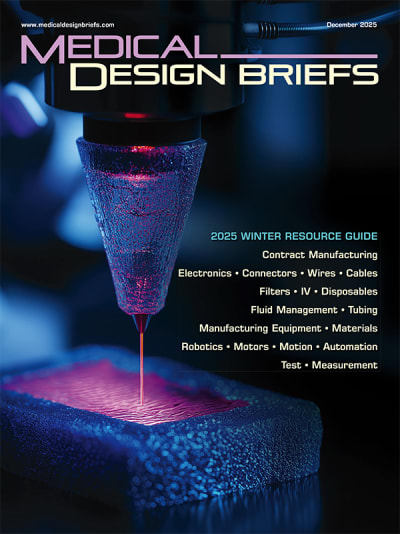
Visually and conceptually, the magazine cover symbolizes regenerative medicine innovation with an image depicting lab-grown grafts produced using a glowing bio-ink, underscoring themes of cutting-edge biomedical engineering and tissue technologies.
Overall, the December 2025 Medical Design Briefs Winter Resource Guide is a multi-faceted, expert-curated compendium offering practical guidance, strategic insights, and forward-looking analysis. It supports medtech professionals navigating a rapidly evolving industry landscape characterized by accelerated technological development, supply chain instabilities, heightened regulatory scrutiny, and expanding market opportunities. By addressing critical engineering challenges across contract manufacturing, electronics, disposables, materials, manufacturing equipment, automation, and biocompatibility risk mitigation, this issue equips readers with the knowledge and tools necessary to design, produce, and commercialize the next generation of medical devices that improve patient outcomes worldwide.
Features
-
Articles
4 Built to Adapt: Rethinking Contract Manufacturing for a New Era
14 Engineering Compact, Energy-Efficient Electronic Drug-Delivery Pens
18 Navigating the Ebb and Flow of the Global Electronics Supply Chain
26 IV Disposables: A Rising Opportunity for Medtech OEMs
31 Advances in Polyimide Tubing for Next-Generation Medical Devices
44 Mitigating Leak Failures Using Radial Grinding Equipment
46 Elevating Antimicrobial Coatings to a New Standard: Introducing Surface-Active Systems
49 OEM Toll Processing Advances High-Value Products
56 Automation: How Custom Motion Control Transforms Medical Equipment Design
64 Mitigating Biocompatibility Risks from Material and Supplier Changes in Medical Devices