
The purpose of this study was to determine the effect of atomic oxygen (AO) exposure on the hydrophilicity of nine different polymers for biomedical applications. Atomic oxygen treatment can alter the chemistry and morphology of polymer surfaces, which may increase the adhesion and spreading of cells on Petri dishes and enhance implant growth. Therefore, nine different polymers were exposed to atomic oxygen and water-contact angle, or hydrophilicity, was measured after exposure. To determine whether hydrophilicity remains static after initial atomic oxygen exposure, or changes with higher fluence exposures, the contact angles between the polymer and water droplet placed on the polymer’s surface were measured versus AO fluence. The polymers were exposed to atomic oxygen in a 100-W, 13.56-MHz radio frequency (RF) plasma asher, and the treatment was found to significantly alter the hydrophilicity of non-fluorinated polymers.
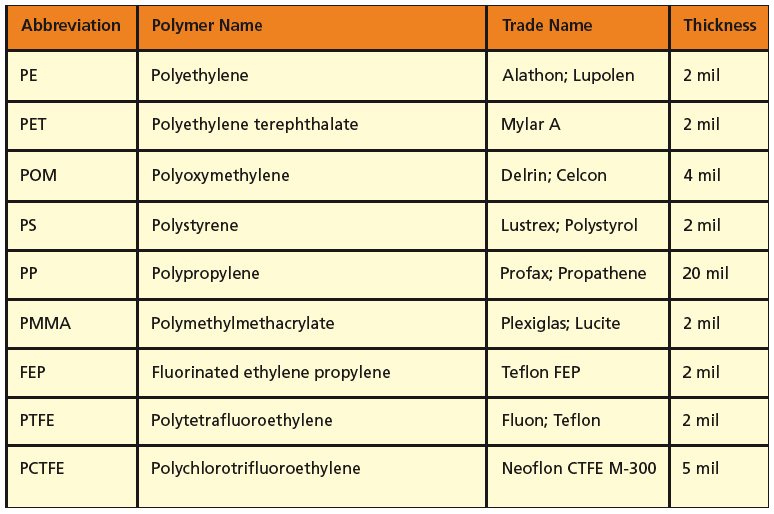
It was determined that after the shortest atomic oxygen exposure (fluence of 2.07 × 10¹⁸ atoms/cm2), non-fluorinated polymer samples became significantly more hydrophilic than their pristine counterparts. This may be due to either surface texture changes or oxidation functionality surface changes. Despite long-term exposure (fluence of 5.16 × 10²⁰ atoms/cm2), the water contact angles remained relatively unchanged after the initial exposure. This implies that increasing the atomic oxygen fluence after an initial short exposure did not further affect the hydrophilicity of the polymers. Rather, polymers were affected by a very short exposure (19 atoms/cm2). This indicates that oxidation functionality is more likely the contributor to increased hydrophilicity than texture, as texture continues to develop with fluence. The water contact angles of fluorinated polymers were found to change significantly less than non-fluorinated polymers for equivalent atomic oxygen exposures, and two of the fluorinated polymers became more hydrophobic.
Significant decreases in the post-exposure water contact angle were measured for non-fluorinated polymers. The majority of change in water contact angle was found to occur with very low fluence exposures, indicating potential cell culturing and other biomedical benefits with very short treatment time.
This work was done by Kim de Groh of Glenn Research Center; Lauren Berger and Lily Roberts of Hathaway Brown School; and Bruce Banks of Alphaport.
Inquiries concerning rights for the commercial use of this invention should be addressed to
NASA Glenn Research Center
Innovative Partnerships Office
Attn: Steve Fedor
Mail Stop 4–8
21000 Brookpark Road
Cleveland
Ohio 44135.
Refer to LEW-18386-1.
This Brief includes a Technical Support Package (TSP).
Use of Atomic Oxygen for Increased Water Contact Angles of Various Polymers for Biomedical Applicati
(reference LEW-18386-1) is currently available for download from the TSP library.
Don't have an account?
Overview
The document is a Technical Support Package from NASA, detailing research on the use of atomic oxygen to enhance the water contact angles of various polymers for biomedical applications. Authored by Lauren Berger and Lily Roberts from Hathaway Brown School, along with Kim de Groh and Bruce Banks from Glenn Research Center, the report is identified as NASA/TM—2007-214925 and was published in August 2007.
The primary focus of the research is to investigate how atomic oxygen, which is prevalent in low Earth orbit, can modify the surface properties of polymers. This modification is significant for biomedical applications, as it can influence the interaction between materials and biological systems. The study aims to increase the hydrophilicity of certain polymers, which can lead to improved cell adhesion and spreading—critical factors in tissue engineering and other medical technologies.
The document outlines the methodology used in the research, including the exposure of various polymer samples to atomic oxygen and the subsequent measurement of their water contact angles. By analyzing these angles, the researchers can determine how the surface properties of the polymers change, which is essential for understanding their potential applications in biomedical fields.
Additionally, the Technical Support Package serves as a resource for disseminating the findings of this research under NASA's Commercial Technology Program. It emphasizes the importance of making aerospace-related developments accessible for broader technological, scientific, or commercial applications. The report also provides contact information for further inquiries, including the Glenn Technology Transfer Office, which can assist with additional information regarding research and technology in this area.
The document is part of NASA's Scientific and Technical Information (STI) program, which plays a crucial role in archiving and disseminating NASA's research findings. It highlights the agency's commitment to advancing aeronautics and space science while ensuring that valuable information is available for public and commercial use.
In summary, this Technical Support Package presents significant findings on the effects of atomic oxygen on polymer surfaces, with implications for enhancing biomedical materials. The research contributes to the understanding of material properties in space environments and their potential applications in improving medical technologies.