
Inside this issue
Overview
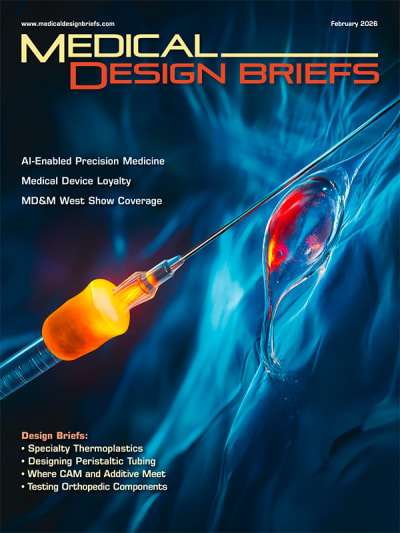
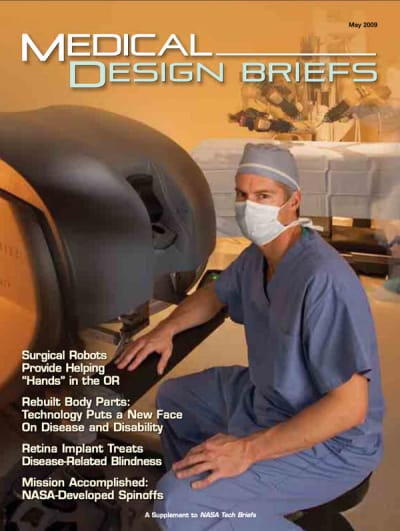
The May 2009 issue of Medical Design Briefs presents a comprehensive overview of the latest innovations in medical technology, focusing on advancements that enhance patient care and surgical procedures. This edition is particularly notable for its emphasis on surgical robotics, custom implants, and the development of artificial retinas, showcasing how these technologies are revolutionizing the medical field.
Key Features
-
Surgical Robots: The issue opens with a feature on surgical robots, highlighting systems like the da Vinci™ Surgical System from Intuitive Surgical. This robotic platform allows surgeons to perform minimally invasive procedures with enhanced precision and control. The system includes a surgeon's console, a patient cart with robotic arms, and a high-resolution 3D vision system. The article discusses how robotic assistance leads to reduced patient pain, minimal scarring, and shorter recovery times, while providing surgeons with better visualization and dexterity during operations.
-
Rebuilt Body Parts: Another significant feature discusses the advancements in creating custom implants using digital medical modeling. This technology enables the rapid production of patient-specific body parts, tailored to individual anatomical needs. The article emphasizes the efficiency and speed of these processes, which can significantly improve surgical outcomes and patient satisfaction. The integration of advanced materials and manufacturing techniques is also explored, showcasing how these innovations are reshaping the landscape of reconstructive surgery.
-
Retina Implants: The issue also covers the development of artificial retinas, particularly a project by Argonne National Laboratory. This technology aims to restore vision for individuals suffering from disease-related blindness. The article details the mechanisms behind the retina implant, which works by converting light into electrical signals that can stimulate the remaining healthy cells in the retina. This breakthrough represents a significant step forward in treating degenerative eye diseases and improving the quality of life for affected patients.
Additional Innovations
Beyond the main features, the magazine includes several tech briefs that highlight various medical innovations:
Three-Dimensional Optical Coherence Tomography: This imaging technique provides high-resolution images of biological tissues, enhancing diagnostic capabilities in ophthalmology and other fields.
-
Wireless Electronic Medical Record Applications: The issue discusses the development of handheld applications that facilitate real-time access to patient records, improving efficiency and communication in healthcare settings.
-
Microfluidic Technologies: Innovations in microfluidic mixing technology and biomarker extraction are presented, showcasing their potential for universal health sensors and rapid diagnostic tests.
-
Trans-Skull Ultrasound Scanners: This technology is explored for its application in diagnosing conditions like rhino-sinusitis, offering a non-invasive imaging alternative.
Industry Insights
The editorial section provides insights into the broader implications of these technologies for the medical industry. It emphasizes the importance of continuous innovation in improving patient safety, reducing healthcare costs, and enhancing the overall quality of care. The magazine also highlights the role of NASA and its partnerships in driving medical advancements, showcasing how technologies developed for space exploration are finding applications in healthcare.
Conclusion
The May 2009 issue of Medical Design Briefs serves as a vital resource for engineers, managers, and professionals in the medical design and development sector. By focusing on cutting-edge technologies such as surgical robots, custom implants, and artificial retinas, the magazine illustrates the transformative potential of these innovations in improving patient outcomes and advancing medical practices. The inclusion of various tech briefs further enriches the content, providing readers with a well-rounded understanding of the current trends and future directions in medical technology.
Overall, this issue not only informs but also inspires professionals in the field to embrace innovation and continue pushing the boundaries of what is possible in medical design and technology.
Features
-
Articles
Surgical Robots Provide Helping “Hands” in the OR
Rebuilt Body Parts: Technology Puts a New Face On Disease and Disability
-
Applications
-
Mission Accomplished
Tech Briefs
-
Three-Dimensional Optical Coherence Tomography
Isolation of Precursor Cells From Waste Solid Fat Tissue
Benchtop Antigen Detection Technique Using Nanofiltration and Fluorescent Dyes
Wireless, Handheld Electronic Medical Record Application
Identification of Bacteria and Determination of Biological Indicators
Further Development of Scaffolds for Regeneration of Nerves
Chemically Assisted Photocatalytic Oxidation System
Open-Access, Low-Magnetic-Field MRI System for Lung Research
Microfluidic Mixing Technology for a Universal Health Sensor
Microwell Arrays for Studying Many Individual Cells
Convergence Nanoparticles for Multi-Modal Biomedical Imaging
Trans-Skull Ultrasound Scanner for Diagnosis of Rhino-Sinusitis
Microfluidic Extraction of Biomarkers Using Water as Solvent
Identifying and Inactivating Bacterial Spores