
ong NASA’s research goals is increased understanding of factors affecting plant growth, including the effects of microgravity. Impeding such studies, traditional light sources used to grow plants on Earth are difficult to adapt to spaceflight, as they require considerable amounts of power and produce relatively large amounts of heat. As such, an optimized experimental system requires much less energy and reduces temperature variance without negatively affecting plant growth results.
Ronald W. Ignatius, founder and chairman of the board at Quantum Devices Inc. (QDI) of Barneveld, WI, proposed using light-emitting diodes (LEDs) as the photon source for plant growth experiments in space. The Wisconsin Center for Space Automation and Robotics, a NASA-sponsored research center, teamed with QDI to determine whether an LED system could provide the necessary wavelengths and intensities for photosynthesis, and the resultant system proved successful.
NASA subsequently identified another need that could be addressed with the use of LEDs: astronaut health. A central concern in astronaut health is maintaining healthy growth of cells, including preventing bone and muscle loss and boosting the body’s ability to heal wounds — all adversely affected by prolonged weightlessness. Thus, having determined that LEDs can be used to grow plants in space, NASA decided to investigate whether LEDs might be used for photobiomodulation therapy (PBMT).
How it Works
PBMT is an emerging medical and veterinary technique in which exposure to high-intensity, wavelength-specific light can stimulate or inhibit cellular function. PBMT modulates a body’s organelles — structures within a cell (e.g., mitochondria, vacuoles, and chloroplasts) that store food, discharge waste, produce energy, or perform other functions analogous to the role of organs in the body as a whole — with wavelength- specific photon energy to increase respiratory metabolism, reduce the natural inflammatory response, accelerate recovery of injury or stress at the cellular level, and increase circulation.
A NASA Small Business Innovation Research (SBIR) contract was granted to QDI to develop an LED light source for use in a surgical environment as the photon source for its proprietary Photodynamic Therapy (PDT) treatment. An emerging cancer treatment, PDT requires high-intensity, monochromatic light to turn on the cancer-killing properties of a drug, allowing physicians to activate a drug in the tumor only.
QDI and Dr. Harry T. Whelan of the Medical College of Wisconsin based their work on QDI’s High Emissivity Aluminiferous Light-emitting Substrate (HEALS) technology, which was developed for use in the plant growth experiments in 1993. The technology was successfully applied in cases of pediatric brain tumors and the prevention of oral mucositis in pediatric bone marrow transplant patients.
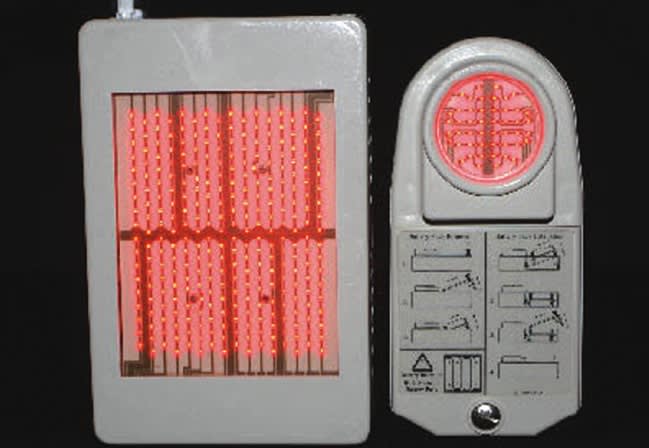
QDI then used a Defense Advanced Research Projects Agency (DARPA) SBIR contract to develop the WARP 10 (Warfighter Accelerated Recovery by Photobiomodulation) unit as a full realization of its PBMT research. WARP 10, a handheld, portable HEALS technology originally intended for military first-aid applications, received U.S. Food and Drug Administration (FDA) clearance in 2003, and a consumer version was introduced for temporary relief of minor muscle and joint pain. WARP 10 has been found to relieve arthritis, muscle spasms, and stiffness; promote relaxation of tissue; and temporarily increase local blood circulation.
In 2007, the FDA cleared the WARP 75 device, the latest iteration of the technology that began with the HEALS technology. The WARP 75 improves on the WARP 10 design, boasting 7.5 times the actual coverage area of the WARP 10, an automatic timed cycle of 88 seconds with an audible alarm, AC power, the ability to be mounted on an articulated arm, and fan cooling. System controls are located on the top panel for easy light dose delivery, and the device is placed directly against the skin where treatment is desired. The unit can be operated with one hand and remains cool to the touch during operation.
QDI is exploring other medical applications of the HEALSbased technology, including combating the symptoms of bone atrophy, multiple sclerosis, diabetic complications, Parkinson’s disease, and a variety of ocular applications. Most recently, Marshall awarded QDI another grant to study synergistic wound healing and conduct a PDT study with silver nanoclusters.
More Information
For more information on QDI’s LED-based technology, visit http://info.hotims.com/22916-173 . Learn about other NASA spinoff technologies at www.techbriefs.com/spinoff.