
Conventional periodontal probing is indeed invasive, uncomfortable for the patient, and the results can vary greatly between dentists and even for repeated measurements by the same dentist. It is a necessary procedure, though, as periodontal disease is the most common dental disease, and usually results from an increased concentration of bacteria in the pocket, or sulcus, between the gums and teeth. These bacteria produce acids and other byproducts, which enlarge the sulcus by eroding the gums and the periodontal ligaments.
By measuring the depth of the sulcus, periodontists can have a good assessment of the disease’s progress. Presently, there are no reliable clinical indicators of periodontal disease activity, and the best available diagnostic aid, periodontal probing, can only measure what has already been lost. With the development of ultrasound probing technologies, dentists can detect small increments of periodontal ligament breakdown, permitting earlier diagnosis and intervention with less costly and time-consuming therapy.
The roots of these ultrasound probes are in an ultrasound-based time-of-flight technique routinely used to measure material thickness and length at NASA’s Langley Research Center in Hampton, VA. The primary applications were for corrosion detection and bolt tension measurements. This ultrasound measurement system was adapted to the Periodontal Structures Mapping System, invented at Langley. Patented as the Ultrasonagraphic Probe (USProbe), Visual Programs Inc. of Richmond, VA, obtained an exclusive license for the system.
How it Works
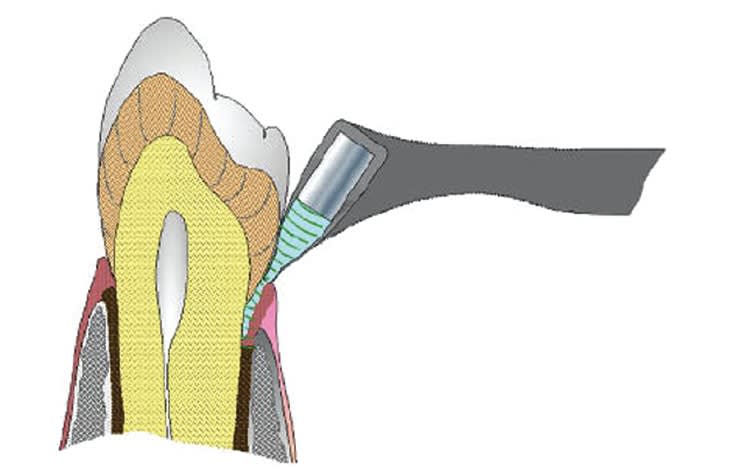
The USProbe mapping system is a noninvasive tool to make and record differential measurements of a patient’s periodontal ligaments relative to a fixed point - the boundary between the crown and root of a tooth, called the cemento-enamel junction (CEJ). The mapping system uses ultrasound to detect the top of the ligaments at various points around each tooth, and uses either ultrasound or an optical method to find the CEJ at the same points. The depth of the sulcus is calculated as the difference between these two points.
The probe used in the mouth to send and receive ultrasound signals is very small, and additional instrumentation is contained within a standard personal computer, allowing the entire measurement to be computerized. In addition, manual charting of pocket depth will be eliminated, since the data will be automatically transmitted to the computer. In addition to solving the problems associated with conventional probing, the USProbe may also provide information on the condition of the gum tissue and the quality and extent of the bond to the tooth surface.
The USProbe automatically detects, maps, and diagnoses problem areas by integrating diagnostic medical ultrasound techniques with advanced artificial intelligence. Visual Programs expects it will replace the current uncomfortable and invasive techniques.
More Information
For more information on Visual Programs’ USProbe technology, visit http://info.hotims.com/22916-174 . Learn about other NASA spinoff technologies at www.techbriefs.com/spinoff.