
Inside this issue
Overview
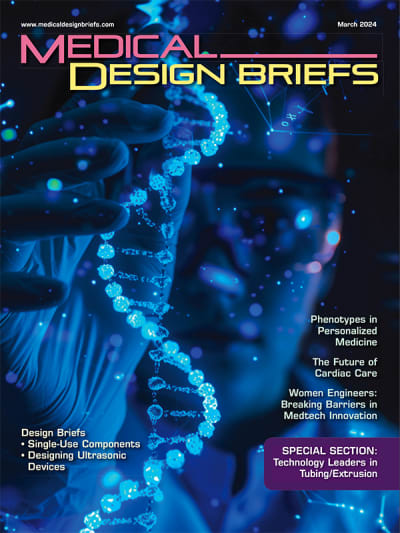
The March 2024 issue of Medical Design Briefs presents a comprehensive overview of the latest advancements and discussions in the medical device and biotechnology sectors. This edition emphasizes the importance of diversity in innovation, particularly highlighting the underrepresentation of women in STEM fields, especially within the emerging area of biotechnology AI. Under Secretary of Commerce for Intellectual Property and Director of the USPTO, Kathi Vidal, underscores the significance of studies that raise awareness about this issue, suggesting that diversifying the AI innovation ecosystem could lead to substantial economic benefits.
The issue opens with a feature titled "Breaking Barriers: Women Engineers Transforming the Landscape of Medical Device Innovation," which discusses the critical role women play in shaping the future of medical technology. It emphasizes the need for increased participation of women in STEM to enhance innovation and drive economic growth. The article suggests that fostering a more inclusive environment in universities and the biotechnology sector can yield significant value.
Another key feature is "What Is Pulsed Field Ablation and Why Is It Taking Over Electrophysiology?" This article delves into the innovative technique of pulsed field ablation (PFA), which is gaining traction in the treatment of cardiac arrhythmias. PFA offers a less invasive alternative to traditional ablation methods, potentially leading to improved patient outcomes and reduced recovery times. The article discusses the technology's mechanisms, benefits, and its growing adoption in clinical settings.
The issue also explores "Precision and Personalized Medicine: The Role of Phenotypes," which highlights the importance of understanding individual phenotypes in developing targeted medical interventions. This approach allows for more effective treatments tailored to the unique characteristics of patients, enhancing the efficacy of medical devices and therapies.
In the Design Briefs section, readers are introduced to innovative products and technologies. One notable entry is the development of a "Magic Wand for Pain-Free Dental Treatments." This product utilizes high-quality acrylic-based plastic for single-use components, aiming to improve patient comfort during dental procedures. Tom Cheng, responsible for product development at Milestone Scientific, describes the technology as enabling dentists to treat damaged teeth with minimal discomfort, akin to a magician's touch.
Another design brief focuses on "Designing Piezo Handpieces for Ultrasonic Surgery," which discusses advancements in ultrasonic surgical tools that enhance precision and efficiency in surgical procedures. These tools are designed to improve outcomes while minimizing patient trauma.
The issue also features several Tech Briefs that highlight cutting-edge innovations. One such brief discusses "Squishy, Metal-Free Magnets to Power Robots and Guide Medical Implants," showcasing the potential of new materials in medical applications. Another brief presents a "Soft Robotic, Wearable Device" designed to improve mobility for individuals with Parkinson's disease, illustrating the intersection of robotics and healthcare.
Additionally, the issue covers the development of "Infection-Resistant, 3D Printed Metals" for implants, which addresses the critical challenge of post-surgical infections. This innovation could significantly enhance the safety and longevity of medical implants.
AI's role in advancing assistive robotics is also explored, emphasizing how artificial intelligence can enhance the functionality and adaptability of robotic devices in healthcare settings.
The R&D Roundup section provides insights into ongoing research and development efforts across various medical fields, showcasing the latest trends and breakthroughs. The New Products & Services section highlights recent introductions to the market, offering readers a glimpse into the future of medical technology.
The issue concludes with an Advertisers Index and a special supplement on "Technology Leaders in Tubing/Extrusion," which discusses automated extrusion processes and their impact on tubing profiles during production. This section emphasizes the importance of innovation in manufacturing processes to meet the evolving needs of the medical device industry.
Overall, the March 2024 issue of Medical Design Briefs serves as a vital resource for professionals in the medical technology field, offering insights into the latest innovations, challenges, and opportunities. It emphasizes the importance of diversity in driving innovation and highlights the transformative potential of emerging technologies in improving patient care and outcomes.
Features
-
Articles
6 Breaking Barriers: Women Engineers Transforming the Landscape of Medical Device Innovation
12 What Is Pulsed Field Ablation and Why Is It Taking Over Electrophysiology?
16 Precision and Personalized Medicine: The Role of Phenotypes
20 Automated Extrusion: Changing a Tubing Profile During Production
-
R & D
27 Using Static Electricity to Enhance Biomedical Implants
27 ‘Smart Glove’ Boosts Hand Mobility
27 COVID-19 Test Produces Results in One Minute
27 Artificial Muscle Device Produces Force 34 Times Its Weight
28 Robotic Rehab Helps Stroke Patients Regain Hand Dexterity
28 Metamaterial: Stretchable Wearable Thermoelectric Energy Harvester
-
Global Innovations
42 Wearable Heart Monitor Offers More Comfort, Less Irritation
-
From the Editor
Tech Briefs
-
29 Producing a Magic Wand for Pain-Free Dental Treatments
30 Part 1: Designing Piezo Handpieces for Ultrasonic Surgery
34 Squishy, Metal-Free Magnets to Power Robots and Guide Medical Implants
35 Soft Robotic, Wearable Device Improves Walking for Individual with Parkinson’s
37 Infection-Resistant, 3D Printed Metals Developed for Implants