
Korea Research Institute of Standards and Science
Daejeon, Republic of Korea

A retina-mimicking eye phantom replicates the structural layers and micro-vascular network of the human retina. The innovation, developed by the Korea Research Institute of Standards and Science (KRISS; Lee Ho Seong, president), provides a new reference for objectively evaluating and calibrating ophthalmic imaging devices, paving the way for more accurate and reliable diagnosis of retinal diseases. A phantom refers to a tool used to evaluate, analyze, and calibrate the performance of medical imaging devices. It serves as a measurement standard, similar in concept to a crash-test dummy in automotive testing.
The retina functions much like a camera film, detecting light and transmitting visual information to the brain. In recent years, the prevalence of retinal diseases has been increasing due to factors such as aging, extensive use of electronic devices, and genetic predisposition. Because retinal tissue is difficult to restore once damaged, early diagnosis and continuous monitoring are essential for preventing vision loss.
Currently, ophthalmology clinics use various imaging techniques — such as optical coherence tomography (OCT) and fluorescein angiography (FA) — to diagnose different retinal diseases. However, the measurement results often vary across hospitals and device manufacturers, and there is no standardized reference available to evaluate or calibrate these instruments. As a result, the consistency and reliability of diagnostic outcomes have been difficult to ensure.
To address this issue, the Nanobio Measurement Group and the Medical Metrology Group at KRISS developed an artificial eye, the retina-mimicking eye phantom, which precisely reproduces the structure and function of the human retina. The phantom was designed like a ruler with marked scales, enabling accurate assessment of diagnostic device performance. When inserted into ophthalmic imaging systems, it allows objective verification and calibration of key aspects including image resolution and field of view.
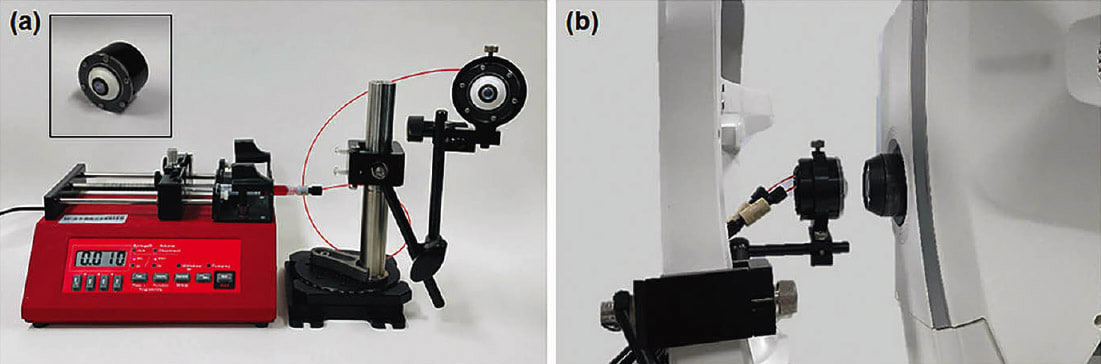
Conventional retinal phantoms have only replicated a few parts of the retinal vasculature in a simplified manner. In contrast, the phantom developed by the KRISS research team precisely reproduces all 13 structural layers of the retina, along with its curvature, microvascular networks with fluidic flow, and retinal autofluorescence. The phantom matches more than 90 percent of those of a real human retina, and its multifunctional design allows it to be applied across a wide range of diagnostic platforms, from tomographic imaging systems to angiography devices.
This achievement is expected to set a new benchmark for the standardization of medical imaging devices, enhancing the accuracy of retinal disease diagnosis and treatment monitoring. By providing a clear reference for evaluating and calibrating diagnostic instruments, medical institutions can ensure consistent and reliable test results for patients regardless of where their retinal examinations
The newly developed phantom is also expected to be widely utilized in both industry and education. Manufacturers of retinal imaging devices can use the phantom to evaluate and refine prototype performance, as well as to maintain consistent product quality during production. In addition, by using the phantom, which closely mimics the human retina, for clinical training and diagnostic education, medical professionals can further strengthen their expertise.
“As the demand for retinal disease diagnosis continues to grow, the use of AI-assisted diagnostic methods is increasing,” says Lee Sang Won, head of the Nanobio Measurement Group at KRISS. “By calibrating ophthalmic imaging systems using this phantom, we can obtain high-quality training data, which will help improve the performance of AI-based diagnostic devices.”
This research was supported by the Global TOP Strategic Research Program of the Ministry of Science and ICT (MSIT) and the Korea Medical Device Development Fund (KMDF). The results were published in Communications Engineering.
This article was written by Hye-min Kim, Global Cooperation Center. For more information, contact Lee Sang Won at