

The shift from batch to continuous bioprocessing is reshaping the way fluid handling systems are designed, specified, and validated in biopharmaceutical manufacturing. Continuous processing promises higher productivity, reduced footprint, and improved product consistency, but it also places new and sustained demands on every component in the fluid path. Among the most critical — and often underestimated — elements is peristaltic pump tubing.
In continuous bioprocessing applications, tubing is no longer required to perform reliably for hours or days, but for weeks or even months. Process cycles of up to 90 days are becoming increasingly common, and regulatory bodies such as the FDA have publicly encouraged the adoption of continuous manufacturing approaches. This has elevated tubing performance from a consumable consideration to a core design parameter.
Continuous Duty Changes the Design Criteria
Peristaltic pumps are widely used in bioprocessing because the fluid contacts only the tubing, reducing contamination risk and simplifying validation. However, the peristaltic pumping principle inherently subjects tubing to repeated mechanical stress. As rollers compress and release the tube thousands of times per hour, the material experiences cyclic fatigue, wear, and deformation.
In batch processes, tubing replacement between runs mitigates much of this risk. In continuous processing, however, tubing must deliver:
Predictable mechanical life under multiple occlusions.
Stable flow over extended operating periods.
Resistance to back streaming and loss of occlusion.
Low shear to protect shear-sensitive biologics and live cells.
Failure in any of these areas can compromise yield, introduce process variability, or force unplanned downtime — negating many of the advantages of continuous processing.
Evaluating Tubing Beyond Initial Performance
A common pitfall in tubing selection is focusing on initial flow accuracy or short-term performance. While many elastomeric and thermoplastic elastomer (TPE) tubing materials can meet early-life requirements, their behavior changes over time under load.
The referenced study systematically evaluated three weldable TPE tubing materials under controlled, accelerated conditions to better understand long-term performance trends. The goal was not only to compare average pumping life, but to examine flow stability, pressure capability, and variability between samples — factors that directly influence risk in continuous operations.
Test Methodology Reflecting Real-World Stress
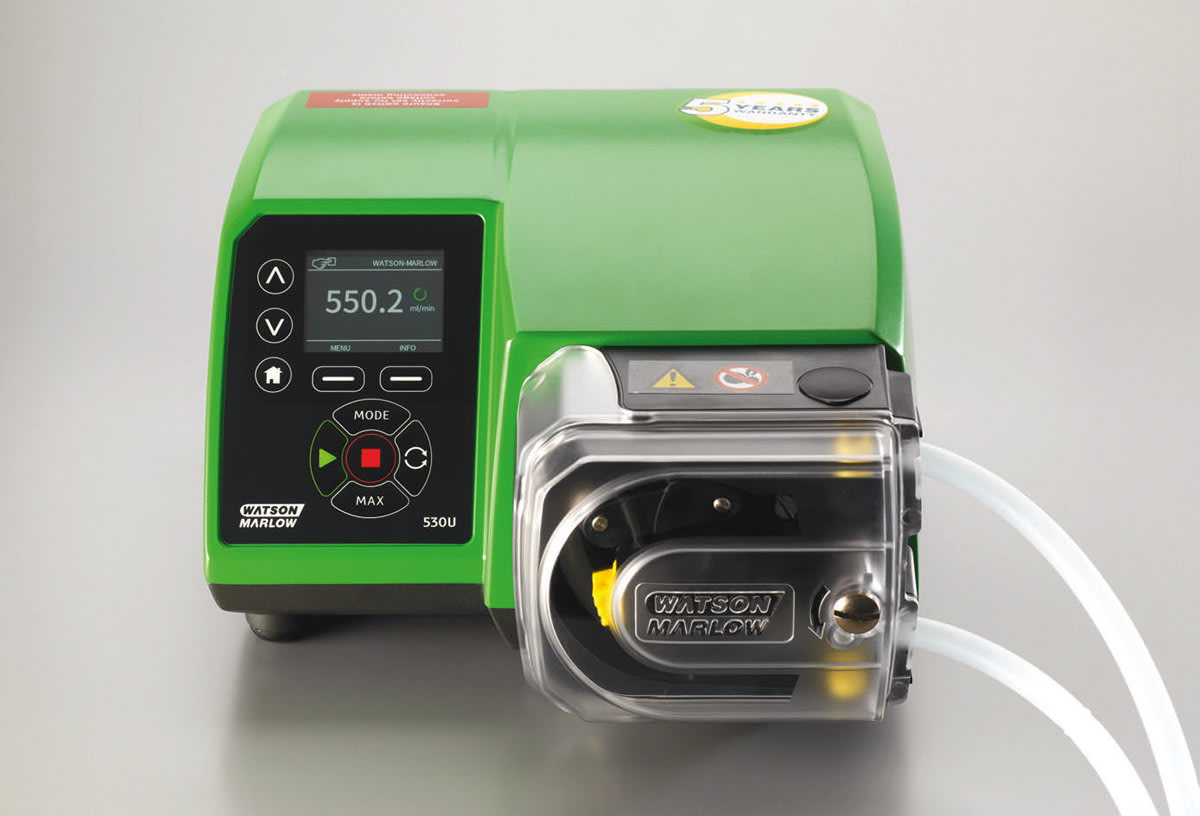
Testing was conducted using Watson-Marlow 530Du drives with 520R2 pump-heads, operating continuously at 220 rpm with a discharge pressure of 2 bar. All tubing samples shared the same dimensions (6.4 mm bore, 2.4 mm wall), and flow was automatically recorded every six seconds using calibrated flow and pressure sensors.
While the test conditions were mildly accelerated compared with typical bioprocessing environments, they were intentionally designed to generate meaningful lifetime data within a practical timeframe. Importantly, performance was evaluated not just until failure, but throughout the operational life of each tube.
Pressure Capability and Flow Retention
One of the first performance differentiators observed was the ability to maintain flow under increasing discharge pressure. As back pressure rose, significant differences emerged between tubing materials.
One material maintained consistent flow until approximately 4 bar and continued to deliver usable flow beyond that point. In contrast, competing materials showed flow degradation at much lower pressures, with consistent performance ending between 2.5 and 3 bar. From a design perspective, this matters because pressure margins in real processes are rarely static. Fouling, filter loading, or downstream restrictions can all increase system back pressure over time.
Tubing that maintains flow across a wider pressure range provides greater operational resilience and reduces the likelihood of unplanned interventions.
Peristaltic Life and Statistical Confidence
Average pumping life alone does not fully capture the risk profile of tubing in continuous use. Elastomeric materials inherently show variability in time-to-failure, meaning that two identical tubes may perform very differently under identical conditions.
To address this, the study applied Weibull statistical analysis to assess reliability and confidence levels. This approach allows designers to estimate not just how long tubing lasts on average, but how confident they can be that a minimum life will be achieved.
The results showed substantial differences between materials. One tubing demonstrated a steep Weibull slope, indicating tightly clustered failure times and high predictability. At a 90 percent confidence level, this material achieved a minimum pumping life of approximately 180 hours under the accelerated test conditions, while competitors showed dramatically lower minimum life values.
For continuous bioprocessing, this distinction is critical. Predictable performance enables risk-based validation and reduces the need for excessive safety factors or premature replacement schedules.
Flow Stability Over Time
Beyond survival, flow stability emerged as a defining performance attribute. Continuous processes rely on consistent mass balance and residence time. Even small, gradual reductions in flow can disrupt upstream and downstream unit operations.
Flow stability data showed that one tubing material maintained a consistent flow rate throughout its operational life, while others exhibited immediate and progressive flow drop. This degradation is often caused by back streaming, where incomplete occlusion allows fluid to slip past the rollers.
Back streaming can result from internal bore damage or external wall thinning, both of which reduce effective tube closure. In addition to reducing flow accuracy, back streaming introduces increased shear forces — an important consideration when handling shear-sensitive cells or proteins.
From a design standpoint, tubing that preserves occlusion geometry over time contributes directly to product quality and process robustness.
Material Selection in a Changing Supply Landscape
The study also reflects broader trends influencing tubing design decisions. The growing adoption of sterile welding and sealing has increased the use of SEBS-based TPE materials. At the same time, global silicone shortages have prompted manufacturers to reassess material strategies and reduce dependence on traditional silicone tubing.
However, as the data illustrates, not all TPEs perform equally under peristaltic conditions. Material formulation, extrusion quality, and mechanical properties all influence long-term behavior. Designers must therefore evaluate tubing based on application-specific performance data rather than material category alone.
Implications for System Designers and Process Engineers
For engineers designing continuous bioprocessing systems, tubing selection should be approached with the same rigor as pump sizing, sensor placement, or control strategy. Key considerations include:
Verified peristaltic life under representative conditions.
Statistical confidence in minimum life, not just average performance.
Demonstrated flow stability over extended operation.
Pressure capability with margin for process variability.
Incorporating these criteria early in the design phase can reduce operational risk, simplify validation, and support higher overall equipment effectiveness.
Conclusion
Continuous bioprocessing places unprecedented demands on peristaltic pump tubing. Long cycle times, regulatory expectations, and sensitivity to flow variability mean that tubing can no longer be treated as a short-term consumable.
The findings presented in the referenced white paper reinforce the need for data-driven tubing selection, emphasizing peristaltic life, flow stability, and reliability — not just initial performance. For medical OEMs involved in fluid handling design, these insights underscore a broader principle: in continuous processes, component durability and predictability are as critical as throughput and accuracy.
This article was written by Chris Palmer, PhD, Portfolio Manager, and Rebecca Govier, Product Manager, at Watson-Marlow Fluid Technology Solutions. For more information, visit here .