Briefs: Manufacturing & Prototyping
Researchers at University of Galway have developed a way of bioprinting tissues that change shape as a result of cell-generated forces, in the same way that it happens in biological tissues during organ development. The breakthrough science focused on replicating heart tissues, bringing research closer to generating functional, bioprinted organs. Read on to learn more.
Blog: Materials
Auxilium Biotechnologies has successfully deployed its 3D bioprinter aboard the ISS. The platform is the first of its kind, making history by printing eight implantable medical devices simultaneously in just two hours.
Briefs: Materials
The use of platinum-iridium (PtIr) alloys for pins and electrodes in medical devices is growing substantially in applications such as cardio and neuromodulation devices. This article focuses on PtIr applications. Read on to learn more.
R&D: Manufacturing & Prototyping
Researchers have helped create a new 3D printing approach for shape-changing materials that are likened to muscles, opening the door for improved applications in robotics as well as biomedical and energy devices. Read on to learn more.
Briefs: Manufacturing & Prototyping
Researchers at The Institute of Metal Research of the Chinese Academy of Sciences have made significant strides in the development and manufacturing of near-void-free titanium alloys using 3D printing. This achievement could lead to the production of titanium alloy materials with exceptional fatigue resistance, paving the way for broader applications of metal 3D printing materials. Read on to learn more.
Briefs: Manufacturing & Prototyping
A team has reported that they used a class of widely available polymers called thermoplastic elastomers to create soft 3D printed structures with tunable stiffness. Engineers can design the print path used by the 3D printer to program the plastic’s physical properties so that a device can stretch and flex repeatedly in one direction while remaining rigid in another. Read on to learn more.
R&D: Medical
Researchers have developed a printing process that prints strong nonmetallic materials in record time — five times faster than traditional 3D printing. The process, called SWOMP, which stands for Selective dual-wavelength Olefin metathesis 3D printing, uses dual-wavelength light, unlike the traditional printing process. Read on to learn more.
Videos of the Month: Manufacturing & Prototyping
See the videos of the month, including one on how MicroLumen engineers develop tubing that ensures precision and reliability in medical device applications; one on Carnegie Mellon University and the Mayo Clinic teaming up in the Transforming Transplant Initiative; one on a fully digital design-to-manufacturing process that has the potential to revolutionize lower limb socket production; and one on a new 3D inkjet printing system that works with a much wider range of materials.
Briefs: Materials
In a paper published in Angewandte Chemie International Edition, researchers at Duke University have invented a new solvent-free polymer for DLP printing. Besides eliminating the shrinkage problem, the lack of solvent also results in improved mechanical properties of the part while maintaining the ability to degrade in the body. Read on to learn more.
R&D: Materials
Scientists have developed an innovative wearable fabric that is flexible but can stiffen on demand. Developed through a combination of geometric design, 3D printing, and robotic control, the new technology, RoboFabric, can quickly be made into medical devices or soft robotics. Read on to learn more about it.
Briefs: Wearables
In the quest to develop lifelike materials to replace and repair human body parts, scientists face a formidable challenge: Real tissues are often both strong and stretchable and vary in shape and size. A CU Boulder-led team has taken a critical step toward cracking that code. They’ve developed a new way to 3D print material that is at once elastic enough to withstand a heart’s persistent beating, tough enough to endure the crushing load placed on joints, and easily shapable to fit a patient’s unique defects. Read on to learn more.
Products: Medical
Listen to our medical podcasts, including one on 3D printing in healthcare; one on robotics and cobots in medical device production; one on the challenges of achieving biocompatibility, meeting medical-grade standards, and navigating the regulatory landscape for 3D printed devices; and one taking a look at how printed health is transforming medicine.
R&D: Manufacturing & Prototyping
A method for 3D printing called vapor-induced phase-separation 3D printing, or VIPS-3D, can create single-material as well as multi-material objects. Read on to learn more about it.
INSIDER: Manufacturing & Prototyping
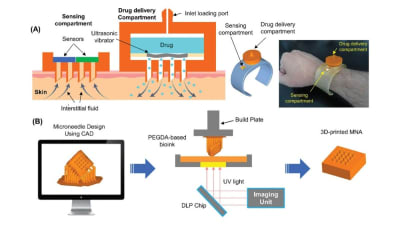
A revolutionary system combines remote health monitoring and drug delivery using 3D-printed hollow microneedles. This innovative approach promises to transform healthcare...
Podcasts: Manufacturing & Prototyping
In this season, we are taking an in-depth look at Printed Health: Transforming Medicine with Advanced Manufacturing, and this episode will focus specifically on...
Podcasts: Medical
The ethical implications of integrating robots into healthcare, discussing topics such as patient trust, privacy concerns, and the balance between human and robotic interaction in caregiving.
Briefs: Medical
In 2015, the Food and Drug Administration approved the first 3D-printed drug, Spritam (levetiracetam), for epilepsy. Several other manufacturers and drug companies are develop.ing their own ones. But the widespread adoption of 3D drug printing will require stringent quality control measures to ensure that people get the right medication and dosage. Read on to learn more about the subject.
News: Manufacturing & Prototyping
Flambeau Medical, a full-service contract manufacturing organization serving the medical device and life sciences industries, has added a new industrial 3D printer to expand its rapid...
Blog: Sensors/Data Acquisition
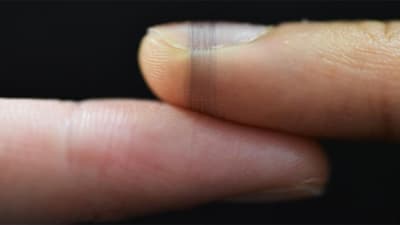
Researchers have developed a method to make adaptive and eco-friendly sensors that can be directly and imperceptibly printed onto a wide range of biological surfaces.
From the Editor: Manufacturing & Prototyping
Shipment of additive manufacturing (AM) systems for metal parts increased by 24.4 percent in 2023, according to Wohlers Associates latest report. See what Editor and Director of Medical Content Sherrie Trigg thinks about the matter.
Briefs: Manufacturing & Prototyping
Taking a cue from the structural complexity of trees and bones, Washington State University engineers have created a way to 3D print two types of steel in the same circular layer using two welding machines. The resulting bimetallic material proved 33–42 percent stronger than either metal alone, thanks in part to pressure caused between the metals as they cool together.
Briefs: Manufacturing & Prototyping
Their device, which is only a few centimeters in size, can be manufactured at scale in batches and then incorporated into a mass spectrometer using efficient, pick-and-place robotic assembly methods.
Products: Tubing & Extrusion
See which products and services the video spotlight is on, including a static testing system from Instron, the SIGMA Laser Stent and Tube Cutting System, medical micro molding services from AccuMold, sterilization solutions and lab testing and advisory services from Sotera Health, electric linear actuators from Thomson, nitinol components from Confluent Medical, and Interpower's power cords.
Videos of the Month: Materials
See the videos of the month, including one on a smart material that's activated by both heat and electricity, one on new materials and applications for medicine, one on a new 3D inkjet printing system that works with a much wider range of materials, and one on the next generation of polymers for 3D printing.
Briefs: Manufacturing & Prototyping
3D printed microscopic particles — so small that to the naked eye they look like dust — have applications in drug and vaccine delivery, microelectronics, microfluidics, and abrasives for intricate manufacturing. Researchers at Stanford University have introduced a more efficient processing technique that can print up to 1 million highly detailed and customizable microscale particles a day.
INSIDER: Medical
A method for 3D printing called vapor-induced phase-separation 3D printing, or VIPS-3D, can create single-material as well as multi-material objects. It could be useful for...
INSIDER: Manufacturing & Prototyping
Fat tissue holds the key to 3D printing layered living skin and potentially hair follicles, according to researchers who recently harnessed fat cells and supporting structures from clinically procured human...
Products: Imaging
See the new products and services, including Seminex' high-power multichip module, a new technology from Renishaw that enables users of RenAM 500 series metal additive manufacturing systems to reduce build times by up to 50 percent, and Applied Motion Products' servo series engineered for high machine performance.
From the Editor: Design
As the COVID pandemic began to drive rapid changes in healthcare, innovative manufacturers and makers around the world began using 3D printing and generative design to fill a dire need for masks, swabs, ventilator components, and other medical equipment. Read on to learn more thoughts from Sherrie Trigg, Editor and Director of Medical Content.















 INSIDER: AR/AI
 News: Robotics, Automation & Control
 INSIDER: Design
 INSIDER: Manufacturing & Prototyping
 INSIDER: Medical
 INSIDER: Mechanical & Fluid Systems

 Podcasts: Robotics, Automation & Control
 Podcasts: Design
 Podcasts: Medical
 Podcasts: Medical
 On-Demand Webinars: Communications
 Podcasts: AR/AI