
In recent years, metal additive manufacturing has emerged as a transformative technology, impacting traditional manufacturing processes across industries. Its ability to create complex geometries and customized parts with unprecedented precision has propelled it to the forefront of innovation in engineering and design. However, when compared to traditional manufacturing techniques, materials produced through 3D printing often exhibit inferior fatigue properties under cyclic loading conditions. This discrepancy significantly limits their widespread application as structural load-bearing components. The challenge lies in addressing the poor fatigue properties commonly attributed to the presence of micro voids induced during the current printing process procedures. Improving the fatigue performance of 3D printed materials and components has thus become a crucial research focus.
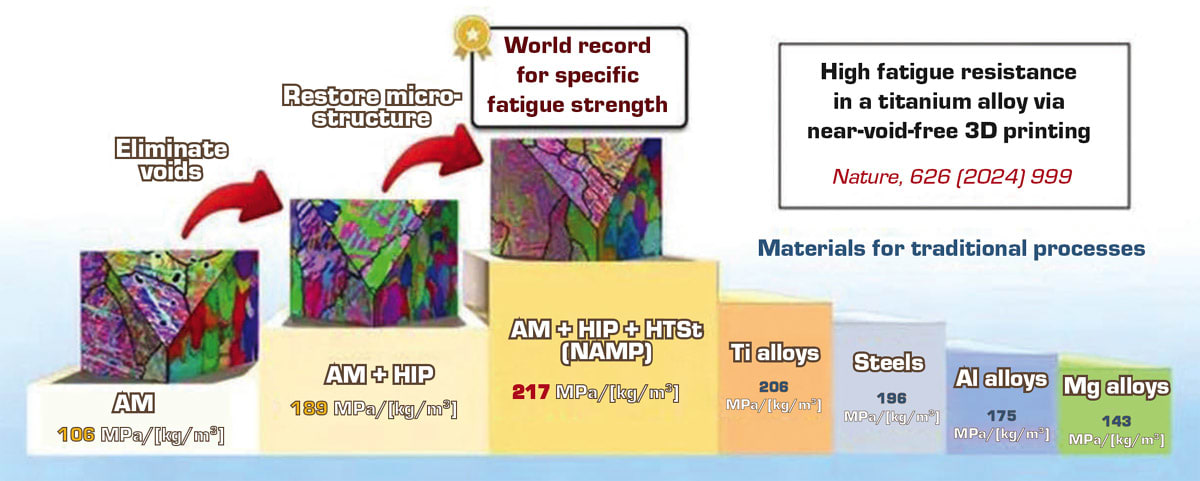
Researchers at The Institute of Metal Research (lMR) of the Chinese Academy of Sciences (CAS) have made significant strides in the development and manufacturing of near-void-free titanium alloys using 3D printing. This achievement could lead to the production of titanium alloy materials with exceptional fatigue resistance, paving the way for broader applications of metal 3D printing materials. Their research, titled “High fatigue resistance in a titanium alloy via near-void-free 3D printing,” was published in the journal Nature.
Scientists successfully rebuilt an approximate void-free AM microstructure in Ti-6Al-4V titanium alloy by developing a net-AM processing technique (NAMP, net-additive manufacturing process) through an understanding of the asynchronism of phase transformation and grain growth. They identify the fatigue resistance of such AM microstructures and show that these microstructures lead to a high fatigue limit of around 1 GPa, exceeding the fatigue resistance of all AM and forged titanium alloys as well as that of other metallic materials. Scientists confirm the high fatigue resistance of net-AM microstructures and the potential advantages of AM processing in producing structural components with maximum fatigue strength, which is beneficial for further application of AM technologies in engineering fields.

Researchers used the metal laser powder bed fusion (LPBF) printer BLT-S320 (build dimension(250 × 250 × 400 mm) to achieve the successful production of near-void-free titanium alloy components, thereby validating the feasibility and efficacy of the proposed methodology and novel techniques.
In recent years, a surge in scientific exploration surrounding metal additive manufacturing has prompted numerous universities and research institutions to delve into pioneering studies on new processes, materials, and innovative applications. BLT collaborates with numerous universities and research institutions both domestically and internationally to drive cutting-edge research in metal additive manufacturing and its applications in the engineering field. To date, BLT has helped more than 220 universities and research institutions at home and abroad in achieving numerous groundbreaking research milestones on an international scale.
This article was written by Gloria Linlin Du, Digital Marketing Manager, BLT, Xian City, China. For more information on BLT, visit here or email