
Joining severed vessels is a recurring problem in trauma and surgery. The basic technology of joining vessels using sutures has been available for centuries, but remains a slow and tedious process. A complete system for micro-anastomosis of vessels was developed that involves a laser in a clinically useful form factor, and a novel albumen stent to support the vessel during the surgery.
The novel laser uses two wavelengths, each with its own power setting. A red aiming beam (1 mW at 0.639 microns) creates a spot on the vessel wall, allowing the surgeon to target specific areas. A 1.9-micron beam is then fired at 300 mW to bond the damaged area. The result is a strong, watertight junction.
Photothermal bonding is attractive because no highly reactive chemical species are involved. To deliver light to a tissue, the light must be absorbed by water. A 1.9-micron emission uses only low power levels, and the penetration depth of 100 microns is sufficient to generate a physically robust bond, but too low to damage healthy tissue underneath.
The novel stent is made from human albumen, concentrated to 38% instead of the more customary 25%, because 38% is optimal for laser welding. The albumen provides both support and glue for the repair. It is necessary to closely match the diameter of the stent with the vessel to be repaired. This leads to a close alignment of the vessel edges, which improves and speeds healing. These stents are biodegradable – any non-irradiated albumen will dissolve in freely flowing blood within a minute.
Possible improvements are to use a green light as opposed to red in the aiming beam. This will provide a greater contrast on the vessel wall. Using an LED instead of a coherent light beam would reduce speckling, and allow the unit to run cooler.
This work was done by Dennis McCal of nLIGHT Photonics Corp. and Scott Prahl of the Oregon Medical Laser Center for the Air Force Office of Scientific Research. For more information, download the Technical Support Package (free white paper) at www.medicaldesignbriefs.com/briefs. AFRL-0134
This Brief includes a Technical Support Package (TSP).
Dual optics/ultrasound imaging and contrast media for the detection and characterization of prostate cancer
(reference AFRL-0134) is currently available for download from the TSP library.
Don't have an account?
Overview
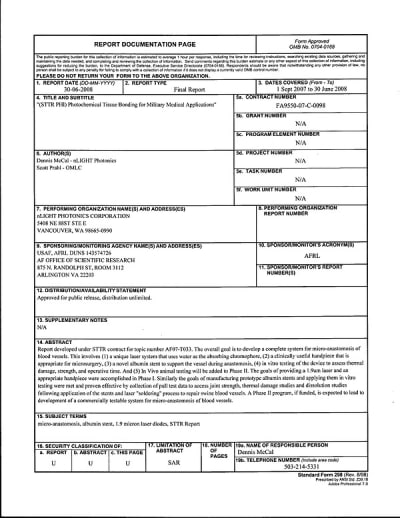
The document is a final report on a project titled "Photochemical Tissue Bonding for Military Medical Applications," developed under the Small Business Technology Transfer (STTR) program. The report, dated June 30, 2008, outlines the objectives, methodologies, results, and future directions of the project, which focuses on improving micro-anastomosis techniques for blood vessels.
The primary goal of the project was to create a comprehensive system for micro-anastomosis, which is crucial in surgical procedures involving blood vessels. The project involved several key components: a unique laser system that utilizes water as the absorbing chromophore, an ergonomic handpiece suitable for microsurgery, and a novel albumin stent designed to support the vessel during the anastomosis process.
In Phase I of the project, the team successfully developed a 1.9-micron laser capable of exceeding the required power output of 300 mW, achieving over 600 mW, which proved to be more effective for surgical applications. The handpiece was designed to be user-friendly for surgeons, and prototype albumin stents were manufactured and subjected to in vitro testing. These tests assessed thermal damage, joint strength, and the dissolution properties of the stents after being used in conjunction with the laser "soldering" process on swine blood vessels.
The report highlights the successful collection of data from pull tests and thermal damage studies, demonstrating the effectiveness of the developed system. The results indicated that the combination of the laser and albumin stents could potentially lead to improved surgical outcomes in vascular procedures.
Looking ahead, the report outlines plans for a Phase II program, which, if funded, would include in vivo animal testing to further validate the system's efficacy and safety. The ultimate aim is to develop a commercially viable system for micro-anastomosis that can be utilized in clinical settings.
In summary, this report details significant advancements in the field of surgical technology, particularly in the area of vascular surgery, and sets the stage for future developments that could enhance surgical techniques and patient outcomes in military and civilian medical applications.