
In 1985, a team of engineers at the Space Telescope Science Institute in Baltimore began developing software to manage various tasks for the Hubble Space Telescope. In the early phases of development, the complexity of scheduling different tasks became clear when the engineers realized Hubble’s power restrictions.
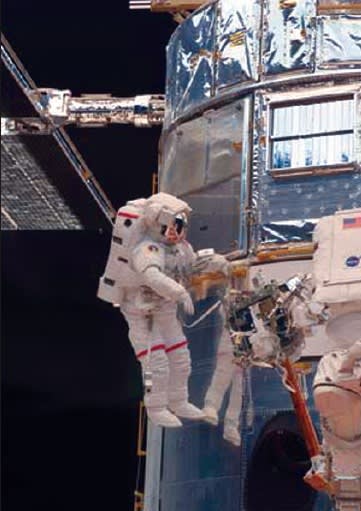
When it first became operational, Hubble functioned under a variety of scheduling restraints. For example, in order to conserve energy, it could have only two scientific instruments operating at one time. This was further complicated by the length of time it took to move the instruments into position. Changing Hubble’s orientation to a new target was a slow process, and the instruments could take up to 24 hours to shift from standby to operative modes. Further complicating the schedule was the fact that certain tasks only operated during specific times, needing protection from (or exposure to) direct sunlight, or requiring specific angles, locations, or other conditions.
In order to compensate for these scheduling constraints, Hubble’s software team de signed a knowledge-based system that worked around these scheduling conflicts using a variety of methods, such as backward and forward chaining — logical arguments used to design computer systems and software.
Hubble team member Don Rosenthal helped develop the scheduling system, refining the algorithms in the programming and consequently increasing the telescope’s efficiency. After working on Hubble, Rosenthal acquired intellectual property rights to the scheduling technology. He cofounded Allocade (Menlo Park, CA) in 2004. Using Rosenthal’s experience with Hubble’s software, Allocade created its On-Cue software suite, which optimizes ever-changing hospital schedules.
How it Works
On-Cue is a software solution system that helps hospital departments handle dynamic rescheduling issues by allocating resources and managing disruptions in real time for inpatient and outpatient imaging procedures. In the past, staff made these adjustments through numerous phone calls, whiteboards, handwritten notes, and faxes, which caused delays and frustration for both patients and staff.
By automating the rescheduling process, Allocade helps hospitals manage frequent changes more efficiently. The emergency, transport, and radiology departments have immediate access to the latest schedules, and the system alerts staff to pending tasks with instant messages and other visual cues. When there is an unexpected flood of emergency procedures, for instance, the system can reallocate staff and resources.
In order to reschedule radiology procedures, On-Cue pulls data from, and synchronizes with, a facility’s radiology information, picture archiving, and communication systems. It can then direct patient data to the best resource, automatically rescheduling procedures and having information readily available. The system displays live updates on monitors in high-traffic areas, which allows staff to track patient status and procedures quickly.
On-Cue, which is compatible with standard personal computers and existing intranets, also provides the ability to balance loads between different machines, and makes specific recommendations when re scheduling, taking into consideration various department and hospital policies and constraints.
Allocade offers the On-Cue system in three modules: the On-Cue Navigator Optimization Engine, On-Cue Communicator, and On-Cue Aviator Workstation Software Client. As the core technology, Navigator is the optimizer that adjusts to new schedules as needs arise. Communicator is in charge of collecting and displaying information to clinical areas and updating displays in real time, enabling staff to make decisions on patient care efficiently. Aviator tracks all resources, connecting information from the other two modules in a snapshot view. Allocade can also adjust the On-Cue system to specific workflow preferences and can pull data from existing feeds.
Where it Stands
One of the first customers for Allocade’s system was the California Pacific Medical Center (CPMC) in San Francisco. Prior to adopting the On-Cue software, CPMC had two weeks of backlog in its computerized tomography (CT) department. Schedules changed constantly, and staff began to realize that traditional tracking methods simply wasted too much time. The radiology department was thrown into chaos when the inevitable emergency procedures would take precedence over scheduled procedures, and other departments had no way of efficiently tracking changes to their patients’ visits to radiology.
CPMC adopted the On-Cue software for beta testing in 2006. The medical center soon reported noticeable improvements to efficiency, including a 12% increase in procedure volume, 35% reduction in staff overtime, and significant reductions in backlog and technician phone time. Allocade began shipping the full commercial version of On- Cue for CT departments in January 2008, and now offers versions for both outpatient and inpatient magnetic resonance imaging (MRI), ultrasound, interventional radiology, nuclear medicine, positron emission tomography (PET), radiography, radiography-fluoroscopy, and mammography. Customers can buy the software for just a few departments or as a software suite for an entire radiology department.
More Information
For more information on the On-Cue software system, visit http://info.hotims.com/28049-144 .