
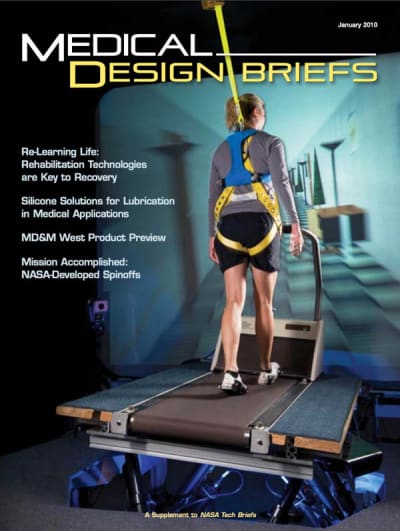
Inside this issue
Overview
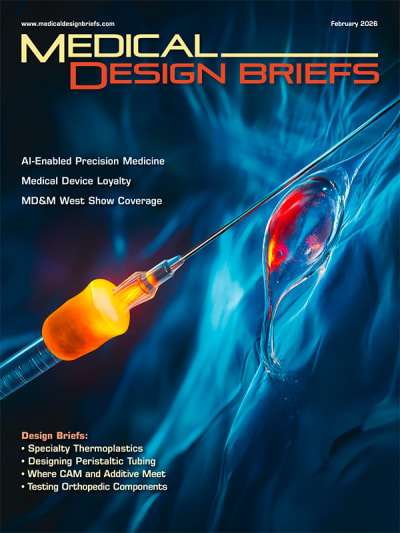
The January 2010 issue of Medical Design Briefs presents a comprehensive overview of advancements and innovations in medical technology, focusing on rehabilitation technologies, silicone solutions, and notable NASA-developed spinoffs. This edition serves as a valuable resource for professionals in the medical device industry, offering insights into the latest trends and products.
Key Features
-
Rehabilitation Technologies: The issue opens with a feature titled "Re-Learning Life: Rehabilitation Technologies are Key to Recovery," which discusses the importance of rehabilitation technologies in aiding recovery for patients with various conditions. It highlights innovative systems designed to help individuals regain balance and mobility, particularly those affected by neurological disorders. The Adaptability Training System, developed by NASA and the National Space Biomedical Research Institute, is showcased as a prime example. This system utilizes a treadmill mounted on a movable base, combined with virtual reality elements, to create challenging balance scenarios for users. Such technologies not only benefit astronauts adapting to new gravity environments but also have significant applications in rehabilitation for patients with balance disorders.
-
Silicone Solutions for Medical Applications: Another important article focuses on the use of silicone in medical applications, particularly its role in lubrication. Silicone materials are praised for their biocompatibility, durability, and versatility, making them ideal for various medical devices. The article discusses how silicone solutions can enhance the performance and longevity of medical instruments, thereby improving patient outcomes.
-
NASA-Developed Spinoffs: The magazine also features a section on "Mission Accomplished: NASA-Developed Spinoffs," which explores how technologies originally developed for space exploration have been adapted for medical use. This includes advancements in imaging technologies, materials science, and other fields that have direct applications in healthcare. The article emphasizes the collaborative efforts between NASA and medical researchers to translate aerospace innovations into practical medical solutions.
Technical Briefs
The issue includes several technical briefs that delve into specific innovations and research findings:
-
Edge Phantom Measures Sharpness of X-Ray Detectors: This brief discusses a new phantom designed to assess the sharpness of x-ray detectors, which is crucial for ensuring high-quality imaging in medical diagnostics.
-
Paracellular Drug Delivery Through Baker’s Yeast Microcapsules: This research explores a novel method for drug delivery using microcapsules made from baker's yeast, potentially improving the efficacy of treatments.
-
Vibrating Quartz Sensor Characterizes Liquid Samples: A new vibrating quartz sensor is introduced, which can characterize liquid samples with high precision, offering benefits for various medical applications.
-
Reducing Field Distortion in Magnetic Resonance Imaging: This brief addresses techniques to minimize field distortion in MRI, enhancing image quality and diagnostic accuracy.
EPR Imaging at a Few Megahertz Using SQUID Detectors: The use of superconducting quantum interference devices (SQUIDs) for electron paramagnetic resonance (EPR) imaging is discussed, highlighting its potential for non-invasive imaging techniques.
-
A Constant-Force Resistive Exercise Unit: This innovation focuses on a new exercise unit designed to provide constant resistance, which can be beneficial for rehabilitation and physical therapy.
-
Fluorogenic Cell-Based Biosensors for Monitoring Microbes: The development of biosensors that can detect microbial activity in real-time is presented, showcasing advancements in infection control and monitoring.
-
An Alternative Approach to Combination Vaccines: This brief discusses new strategies for developing combination vaccines, which could streamline immunization processes and improve public health outcomes.
-
GUI to Facilitate Research on Biological Damage from Radiation: A graphical user interface (GUI) designed to assist researchers in studying biological damage caused by radiation is introduced, emphasizing its importance in medical research.
-
On-Demand Urine Analyzer: The introduction of a portable urine analyzer that provides immediate results is highlighted, which could revolutionize diagnostics in various healthcare settings.
-
Advanced Liquid-Cooling Garment Using Highly Thermally Conductive Sheets: This innovation focuses on a garment designed to regulate body temperature, which could have applications in both medical and athletic fields.
-
Engineering Devices to Treat Epilepsy: The issue also covers advancements in devices engineered to treat epilepsy, showcasing the ongoing efforts to improve the quality of life for patients with this condition.
-
More-Realistic Digital Modeling of a Human Body: The development of more accurate digital models of the human body is discussed, which could enhance training and simulation for medical professionals.
New Products and Advertisers
The magazine concludes with a section on new products and an advertisers index, providing readers with information on the latest offerings in the medical device market. Notable mentions include Watson-Marlow’s ultra-compact peristaltic pump, which is designed for medical and diagnostics OEMs, showcasing the ongoing innovation in medical technology.
Conclusion
Overall, the January 2010 issue of Medical Design Briefs serves as a vital resource for professionals in the medical field, offering insights into cutting-edge technologies and research that are shaping the future of healthcare. The combination of rehabilitation technologies, silicone applications, and NASA spinoffs illustrates the dynamic nature of medical innovation and its potential to improve patient care and outcomes.
Features
-
Mission Accomplished
Hubble Software Manages Hospital Schedules
Noninvasive Test Detects Cardiovascular Disease
Planetary Imaging Technology Aids Enzyme Screening
Tech Briefs
-
Edge Phantom Measures Sharpness of X-Ray Detectors
Paracellular Drug Delivery Through Baker’s Yeast Microcapsules
Vibrating Quartz Sensor Characterizes Liquid Samples
Reducing Field Distortion in Magnetic Resonance Imaging
EPR Imaging at a Few Megahertz Using SQUID Detectors
A Constant-Force Resistive Exercise Unit
Fluorogenic Cell-Based Biosensors for Monitoring Microbes
An Alternative Approach to Combination Vaccines
GUI To Facilitate Research on Biological Damage From Radiation
Advanced Liquid-Cooling Garment Using Highly Thermally Conductive Sheets