
Smart X-Ray Source
Mark Eaton, CEO; Dr. Ronald Hellmer; Dr. Shuo Cheng; Hugo Leon; and Dr. Leif Fredin
Stellarray, Austin, TX
Since the discovery of X-rays 110 years ago, affordable X-ray sources have all been point source X-ray tubes, in which x-rays are generated at a single spot on an anode by a single electron beam accelerated at high voltage across a vacuum gap. Generation of X-rays from a single spot, even in rotating anode tubes, limits the flux they can deliver, because most of the e-beam energy will be absorbed in that spot. The tube is huge in relation to the spot and X-ray exposures from multiple angles or locations. Computed tomography (CT) or tomosynthesis requires rotating the tube along with its power supply and cooling system. This requires a massive, highly-engineered steel gantry to support the source assembly, which accounts for most of the bulk and much of the cost of CT systems. This is what keeps the better radiographic imaging technology out of reach for most of the world’s population and away from the point of medical care.
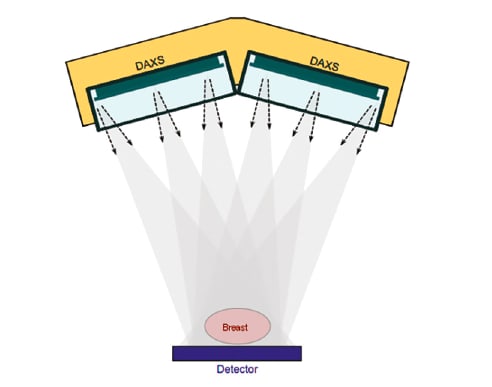
In CT and medical imaging, this means the image can be made using one or more smart source panels curved together, with no mechanical gantry, opposite a flat panel X-ray detector array. Fully sealed panels were made for stationary digital breast tomosynthesis, in which electronic speeds will prevent motion blurring, and 2D array imaging will add further perspective to the image. The technology can be of best benefit in imaging applications in which motion artifacts, flexibility in addressing patterns or system size are issues, which would include breast tomosynthesis, preclinical small animal CT, cardiac CT, and any kind of portable tomographic imaging. (See Figure 1)
Most of the world’s people have no access to tomographic X-rays, if indeed they have access to any kind of X-ray imaging at all. Getting this technology out to people in developing countries, and even to some in the US, will require a complete change from current approaches based on large, complex hardware, closed software architectures, and elaborate bundled system sales. Stellarray is aiming to develop low-cost, truly portable CT systems that can fit into a wheeled suitcase, and will work with software developers for open architecture systems.
For more information, visit http://contest.techbriefs.com/medical_winner .