
A concept for a magnetic resonance imaging (MRI) system that would utilize a relatively weak magnetic field provides for several design features that differ significantly from the corresponding features of conventional MRI systems. Notable among these features are a magnetic- field configuration that reduces (relative to the conventional configuration) distortion and blurring of the image, the use of a superconducting quantum interference device (SQUID) magnetometer as the detector, and an imaging procedure suited for the unconventional field configuration and sensor.
MRI using magnetic fields weaker than those of conventional MRI offers several advantages, including cheaper and smaller equipment, greater compatibility with metallic objects, and higher image quality because of low susceptibility distortion and enhanced spin-lattice-relaxation-time contrast. SQUID MRI is being developed into a practical MRI method for applied magnetic flux densities of the order of only 100 μT.
In conventional MRI, it is required that all of the magnetic moments precess around the same axis defined by an applied static, homogeneous magnetic field. One of the problems in developing low-magnetic-field-strength MRI arises from the relationship among image resolution, image-acquisition time, and the gradient of the magnetic field. In general, the resolution (that is, the reciprocal of the smallest size of an image feature that can be resolved) is proportional to the strength of the magnetic-field gradient and the image-acquisition time. Because of fundamental properties of a magnetic field, an image-position-encoding gradient necessarily entails undesired concomitant field components proportional to the image-position-encoding gradient. These components are undesired because they cause distortion or blurring of the image. The distortion can be reduced by weakening the gradient so that the total field variation in the magnetic field is a small fraction of the static homogeneous field. However, in weakening the gradient, one must either accept lower resolution or else increase image-acquisition time to retain resolution.
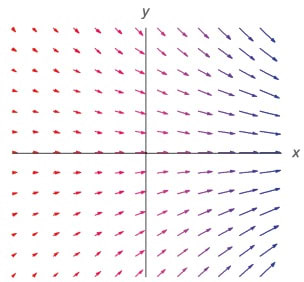
According to the present concept, it should be possible to reduce distortion to a very low (in principle, negligible) level while using a low-strength magnetic field, without sacrificing resolution and without need for excessively long image-acquisition time. There would be no applied static, homogeneous field because in MRI, it is not required that all the magnetic moments precess about the same axis. The encoding magnetic field, B, would be configured to lie in the x,y plane of x,y,z Cartesian coordinate system: the field would be given by
B = B0ex/a[x̂cos(y/a) – ŷ sin(y/a)]
where x̂and ŷ are unit vectors along the x and y axes and B0 and a are arbitrary constants to be chosen by design (see figure). Inasmuch as the strength of this field is given by |B| = B0ex/a , this field would encode position along the x axis as a function of resonance frequency. Although x would be a nonlinear (specifically, a logarithmic) function of resonance frequency, it would be possible, through suitable choice of the arbitrary constants, to reduce the deviation from linearity and the concomitant spatial variation of resolution over the image region to tolerable levels.
A close approximation of the magnetic field described above could be generated by electric currents flowing axially on a z-oriented circular cylinder having a length much greater than its radius. The current density (K) needed to generate the magnetic field is a known continuous function of the azimuthal angle (θ). In practice, the required continuous current density K(θ) would be approximated by use of multiple discrete wires positioned at suitable angular intervals and driven by suitable currents. To encode position along an axis at an angle α with respect to the x axis in the x,y plane so that back projection reconstruction could be used, one would shift the current-density pattern by electronically changing the pattern of drive currents to make it approximate K(θ + α).
In SQUID MRI, the magnetic moments are prepolarized in a strong magnetic field separate from the encoding field. In a system according to the present concept, the prepolarizing magnetic field would be oriented along the z axis. The prepolarizing magnetic would then be turned off so rapidly that immediately afterward, the magnetic moments would remain polarized and would start to precess about the x,y-oriented encoding magnetic field. The sensing loop of the SQUID magnetometer would be placed to detect the z component of magnetization.
This work was done by Byeong Ho Eom, Konstantin Penanen, and Inseob Hahn of Caltech for NASA’s Jet Propulsion Laboratory. For more information, download the Technical Support Package (free white paper) at www.techbriefs.com/tsp under the Bio-Medical category.
In accordance with Public Law 96-517, the contractor has elected to retain title to this invention. Inquiries concerning rights for its commercial use should be addressed to:
Innovative Technology Assets Management
JPL
Mail Stop 202-233
4800 Oak Grove Drive
Pasadena, CA 91109-8099
E-mail: This email address is being protected from spambots. You need JavaScript enabled to view it.
Refer to NPO-44593, volume and number of this NASA Tech Briefs issue, and the page number.
This Brief includes a Technical Support Package (TSP).

Reducing Field Distortion in Magnetic Resonance Imaging
(reference NPO-44593) is currently available for download from the TSP library.
Don't have an account?
Overview
The document presents a novel approach to Magnetic Resonance Imaging (MRI) developed by researchers at NASA's Jet Propulsion Laboratory. This new MRI concept addresses significant challenges associated with imaging in low magnetic fields, particularly the issues of image distortion and blurring caused by concomitant fields that accompany encoding magnetic field gradients.
Traditional MRI systems rely on a static homogeneous magnetic field, which can lead to image distortion when encoding gradients are applied. The proposed method eliminates these distortions by relaxing the constraints of uniaxial spin precession and the linearity of field gradients typically found in conventional MRI systems. This innovative field configuration allows for improved image quality and faster acquisition times, making it particularly advantageous for low-field MRI applications, which are generally cheaper, smaller, and more compatible with metallic objects.
The document outlines the technical challenges faced in low-field MRI, such as long image acquisition times and low resolution due to small image encoding magnetic field gradients. It emphasizes that while small gradients can reduce distortion, they also lead to longer acquisition times and lower resolution. The new approach allows for the reduction of distortion from concomitant fields regardless of the strength of the gradient field, thus enhancing the overall imaging process.
Additionally, the document discusses practical implementation aspects, noting that the resolution change within the imaging cylinder can be linearized and that only a small number of coil pairs are necessary for typical MRI resolution. The technique also allows for three-dimensional or slice-selective encoding, which can be achieved with minimal concomitant field effects.
Overall, this research represents a significant advancement in MRI technology, with potential applications extending beyond medical imaging to various technological and scientific fields. The findings are part of NASA's Commercial Technology Program, aimed at making aerospace-related developments available for broader use. The document serves as a technical support package, providing insights into the innovative methods for reducing field distortion in MRI, ultimately contributing to improved imaging capabilities in low magnetic fields.