

The 23rd annual Create the Future Design Contest for engineers, students, and entrepreneurs worldwide, sponsored by COMSOL, Inc., and Mouser Electronics, drew innovative product ideas from engineers and students from countries from around the world. The Medical category itself received many innovative entries from 21 countries. Analog Devices and Intel were supporting sponsors, and Zeus sponsored the Medical category. The contest, which was established in 2002, recognizes and rewards engineering innovations that benefit humanity, the environment, and the economy. This article introduces the Medical Category finalist.
Blood Viscosity: The Next Vital Sign — A Wearable Breakthrough in Trauma, Sepsis, and Vascular Health
Nilesh Salvi
Jinglu Tan
University of Missouri,
Columbia, MO
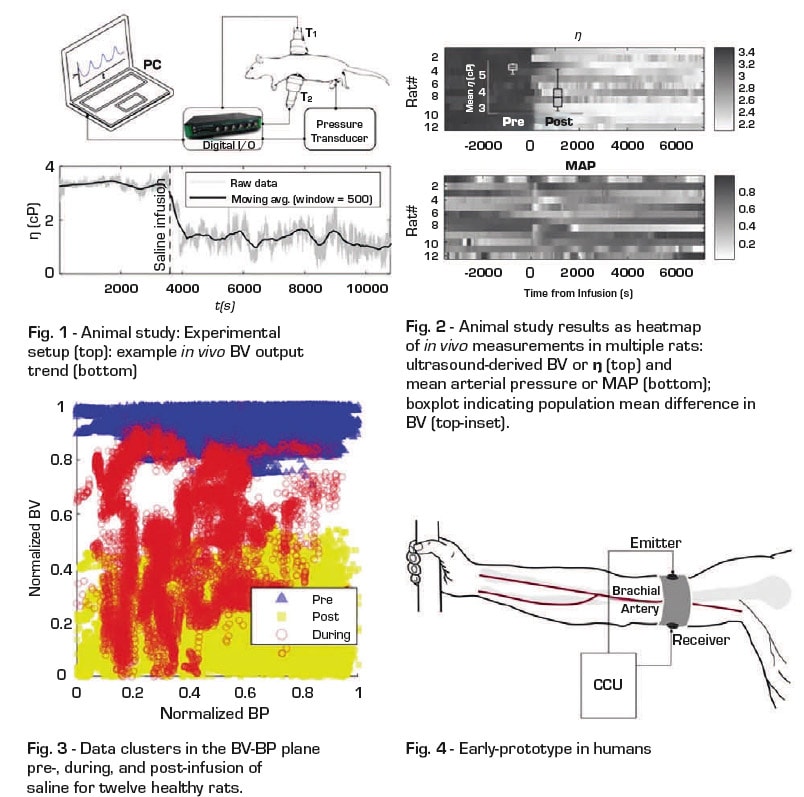
This category-defining innovation is the first real-time, wearable blood viscosity (BV) monitoring device. This breakthrough fills a long-standing void in trauma, burn, and sepsis care by delivering continuous, noninvasive insights into the body’s fluid and vascular dynamics. Unlike traditional vitals, BV reflects the blood’s resistance to flow — capturing subtle, early physiologic shifts caused by dehydration, systemic inflammation, coagulation changes, and vascular leakage.
The platform is built on a patented ultrasound-based sensing method, originally developed and validated in animal models, with tight correlation to gold-standard viscometers. It uses compact, rugged off-the-shelf components and is engineered for scalability and low-cost production. Integrating cuffless blood pressure (BP), the system creates a hemodynamic dashboard: dynamic BV–BP patterns reveal whether resuscitation is on track, failing, or overshooting. This combination unlocks unprecedented diagnostic resolution, enabling smarter fluid management, triage precision, and downstream therapeutic decisions. Early validation in rats shows distinctive viscosity trends, even when BP remains unchanged, with cluster analysis revealing patterns unique to BV that BP alone cannot detect — highlighting the untapped value of BV as a vital parameter. Human trials are next, in collaboration with leading burn care centers. The software-driven architecture accelerates regulatory readiness and enables integration with next-gen autonomous resuscitation systems.
This device redefines physiologic monitoring — it introduces a novel lens into the body’s dynamic response to trauma and disease by uncovering real-time blood flow resistance patterns and volume status, enriching clinical understanding of vascular health and systemic stress. For sepsis, the device detects early-stage coagulopathy and fluid shifts before traditional signs emerge. During COVID-19, BV could have guided personalized anticoagulation or predicted clotting complications earlier. Long-term, this technology could transform drug development for cardiovascular disease and metabolic syndrome by establishing viscosity as a biomarker of vascular health and drug response. For the military, it enhances survivability in the golden hour post-injury; for civilians, it introduces a new frontier in personalized critical care.
The commercial roadmap targets emergency care, remote monitoring, and digital health markets. With its unique ability to generate previously invisible physiological insights, blood viscosity is poised to become the next vital sign — redefining standards of care, unlocking new therapeutic strategies, and saving lives across multiple settings.
For more information, visit here .
Finalists were selected from the seven categories: Aerospace & Defense; Automotive/Transportation; Electronics; Energy, Power & Propulsion; Manufacturing & Materials; Medical; and Robotics & Automation. In addition to product ideas at the concept or prototype stage, contestants could submit designs for commercial products introduced to the market within the last 12 months.
A competition among the finalists from all categories took place November 7, at which the grand prize winner was selected by a panel of judges. The grand prize winner receives $25,000, while the first-place winner in each category receives a Hewlett-Packard workstation computer. Congratulations to all who entered. All of the entries can be seen here .