

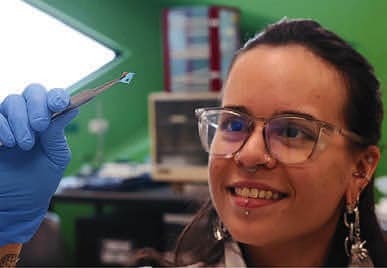
Scientists have produced a new, powerful electricity-conducting material that could improve wearable technologies, including medical devices. The new technique uses hyaluronic acid applied directly to a gold-plated surface to create a thinner, more durable film, or polymer, used to conduct electricity in devices like biosensors. It could lead to major improvements in the function, cost, and usability of devices like touchscreens and wearable biosensors.
The method, called tethered dopant templating, enabled the researchers to create a robust way of making a conductive polymer that is flexible and durable. It can conduct electricity as well as metals and is easily reproduced, making it scalable. Applying the hyaluronic acid directly to the gold gave scientists total control over the material’s conductive properties, its shape, and appearance.
The resulting material, called 2D PEDOT, is invisible to the naked eye. Researchers say it is vastly more powerful than similar materials, ideal for smart, sensor-based devices, including medical devices.
Not only did the polymers form when tethered directly to the gold, but that the polymers were thinner, more powerfully conductive, and almost foolproof to reproduce. (Image credit: La Trobe University)
For more information, visit here .