
Inside this issue
Overview
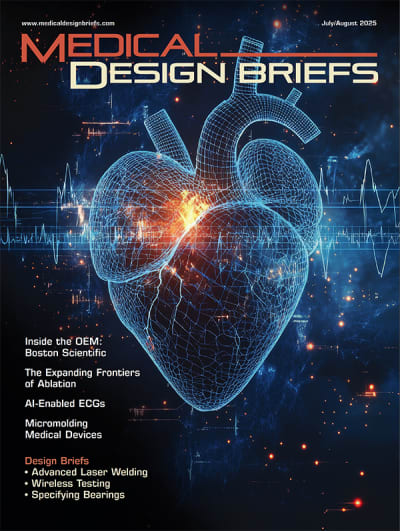
The July/August 2025 issue of Medical Design Briefs focuses on emerging innovations in medical technology, particularly in the fields of ablation therapies and wireless medical devices. The issue highlights the ongoing trends toward less-invasive procedures and enhanced selectivity in treatment methods, as well as the challenges faced by medical device manufacturers in integrating wireless technology.
Emerging Innovations in Ablation
Ablation therapies are evolving with two major themes: the push for less-invasive procedures and the development of more selective and effective treatment approaches.
-
Less-Invasive Procedures: The medical community is increasingly favoring techniques that minimize patient recovery time and improve outcomes. Innovations in this area include:
- Intraluminal Ablation Catheters: These devices utilize coolant circulation to protect surrounding tissues while creating precise ablation zones.
- Expandable RF Needles: These needles expand mechanically around the target tissue, which shortens procedure times and enhances the durability of the therapy.
- Integrated Sensors: Advanced sensor systems are being developed to identify target tissues, assess therapy success in real-time, and reduce the risk of complications.
-
Enhanced Selectivity and Efficacy: New advancements aim to improve tissue selectivity and controllability in ablation techniques. Notable innovations include:
- Expanding PFA Applications: Pulsed-field ablation (PFA), which has gained attention for its effectiveness in cardiac therapies, is being adapted for non-cardiac applications. Researchers are exploring tissue-specific electric susceptibilities to minimize collateral damage and side effects.
- Steerable Probes: These probes allow clinicians to direct energy precisely to diseased tissues while avoiding healthy structures, adjusting in real-time to eliminate the need for repositioning electrodes during procedures.
Wireless Medical Devices
The issue also delves into the role of portable wireless medical devices, which are essential for patient monitoring, infusion, and diagnosis. While manufacturers excel at designing these devices, they often lack expertise in wireless technology integration. This gap can lead to underperformance, resulting in poor connections, delays in clinical notifications, and potential device failures. Such failures can trigger product recalls and compliance violations, damaging customer trust.
As the adoption of wireless technology increases, the landscape becomes more complex, transitioning from simple electronic components to highly integrated modules that support multiple wireless protocols, including 5G, Wi-Fi, and Bluetooth Low Energy. The article emphasizes the importance of addressing critical questions during the design process to ensure the reliability and effectiveness of wireless medical products.
Production Testing and Quality Assurance
The issue also discusses the importance of production testing in balancing quality and cost. Effective testing strategies involve checking the minimum functional performance of devices and testing multiple units simultaneously to reduce costs and expedite time to market. Key components of successful testing include:
- Hardware Test Equipment: This equipment must be capable of scaling from laboratory settings to manufacturing environments.
- Automated Software Tools: User-friendly yet advanced software can streamline RF testing, minimizing development and execution times.
Addressing Cardiovascular Disease
The issue highlights the urgent need for scalable, AI-powered solutions to tackle the growing prevalence of cardiovascular disease (CVD). As healthcare providers seek to enhance care efficiency, integrating innovative technologies can help meet the needs of an increasing patient population at risk for CVD. The article suggests that solving the CVD problem may become more achievable through these advancements.
Conclusion
Overall, the July/August 2025 issue of Medical Design Briefs provides a comprehensive overview of the latest trends and challenges in medical device innovation. It emphasizes the importance of less-invasive ablation techniques, the integration of wireless technology in medical devices, and the need for effective production testing. As the healthcare landscape continues to evolve, the insights shared in this issue serve as a valuable resource for medical device designers and manufacturers aiming to improve patient care and outcomes.
This issue not only showcases the advancements in technology but also underscores the critical role of collaboration between healthcare providers and manufacturers in addressing the pressing challenges in modern medicine.
Features
-
Articles
6 Inside the OEM: Boston Scientific to Focus on Cardiology Innovation
10 Micro Solutions, Major Advances: Micromolding Fuels the Next Generation of Medical Devices
14 Cracking the Code of Cardiac Care: How AI-Enabled ECG Could Solve Key Challenges in CVD Diagnosis
19 Burn, Freeze, Shock, or Shear: The Expanding Frontiers of Ablation Therapies
-
R & D
22 Paper-Based Diagnostic Provides Rapid Disease Detection
22 Pipette Activates Individual Neurons
22 A Chip with Natural Blood Vessels
22 Long-Lasting 3D Printed Wearable Transforms Health Monitoring
-
Global Innovations
-
From the Editor
4 From the Editor: U.S. Tariffs Cast Shadow Over Promising Growth of Pulsed Field Ablation Devices
Tech Briefs
-
25 Medical Device Makers: Ask These 7 Questions for an Effective Wireless Test Program
28 Common Pitfalls When Specifying Bearings for Medical Devices
31 Fiber Computer Allows Apparel to Run Apps and “Understand” the Wearer