INSIDER: Medical
A biomedical engineer at UNSW Australia uses semiconductor technology to view organs of the human body, down to the level of a single cell. The imaging technology, developed by optical and industrial measurement manufacturer Zeiss, was originally created to scan silicon wafers for defects.
Videos: Test & Measurement
The Sahara Desert is a near-uninterrupted brown band of sand across the northern third of Africa. The Amazon rain forest is a dense green mass of jungle that covers northeast...
News: Manufacturing & Prototyping
Altair expects to better support the use of additive manufacturing (AM), or 3D printing, by releasing new OptiStruct solver capabilities for topology optimization. The...
INSIDER: Medical
A team of investigators at Children’s Hospital Los Angeles and the University of Southern California have developed an implantable micropacemaker designed for use in a fetus. The micropacemaker, designated a Humanitarian Use Device by the US Food & Drug Administration (FDA), will...
Briefs: Sensors/Data Acquisition
There exists an unmet need for rapid, sensitive, and field-stable assays for pathogen detection. Bacillus anthracis is the causative agent of anthrax poisoning. This Gram-positive bacterium secretes a tripartite toxin including a cell-binding protective antigen (PA), and the...
Briefs: Sensors/Data Acquisition
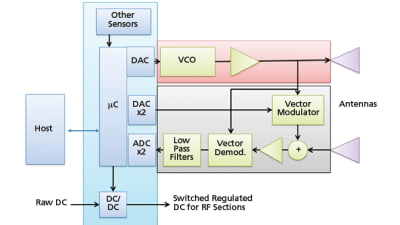
Existing implementations of continuous wave (CW) radar are not packaged appropriately for use as part of a heartbeat detection system for disaster search and rescue. They use separately packaged microwave...
Mission Accomplished: Manufacturing & Prototyping
Anyone who remembers the Micro Machines line of toys might be surprised to learn that the tiny model vehicles are positively gargantuan compared with actual micromachine...
Briefs: Sensors/Data Acquisition
A system has been developed using sound to detect problems on rovers or other remote platforms autonomously. It consists of a sensor array of microphones and...
Briefs: Mechanical & Fluid Systems
High-performance inertial sensors, such as ring laser gyroscopes or fiber optic gyroscopes, have sufficient performance to enable “dead reckoning” navigation for adequate periods of time. Smaller microelectromechanical system (MEMS) inertial sensors, such as MEMS gyroscopes and MEMS...
Briefs: Aerospace
The proposed concept uses sensors to detect high-temperature plasma ingestion during entry through a breach in the thermal protection system (TPS) caused by a micrometeoroid orbital debris (MMOD) impact. It uses consumables usually available on human-rated spacecraft such as...
Briefs: Sensors/Data Acquisition
Acompact shock-sensing device, which employs an innovative light sheet generator, has been created. The device may be used either as a solo aerodynamic shock detector or in combination with a scanning mode shock sensor....
Briefs: Materials
Physical and chemical properties of nanomaterials are known to be significantly different from those having larger crystallites (i.e. bigger than nano), but...
Briefs: Energy
A highly reflective, white conductive coating system was developed using a layered approach with a combination of commercially available white conductive pigments within a conductive binder system. The top coating is a space-stable, radiation-resistant, highly reflective...
Briefs: Materials
Gas-distribution layers (GDLs) are water-management structures used in fuel cells and electrolyzers. GDLs are critical components that prevent flooding of the fuel cell electrode by product water, thus preserving open channels for reactant gas to reach the electrode....
Briefs: Green Design & Manufacturing
As crewed space missions extend beyond low Earth orbit, the need to reliably recover potable water is critical. Aboard the International Space Station (ISS), the water is recycled from cabin humidity condensate, urine distillate, and hygiene wash wastes. In spacecraft cabin air environments,...
Briefs: Mechanical & Fluid Systems
An alignment guide and a mounting interface for two of the repair tools on orbit during the Hubble Space Telescope Servicing Mission 4 (see SM4) were developed. This design can be installed in a timely manner, and was specifically developed for a worksite with minimal access and minimal visual line-of-sight to the...
Briefs: Aerospace
The current MK-III carbon-graphite/epoxy Hard Upper Torso (HUT)/hatch assembly represented an 8.3 psi (≈57 kPa) technology demonstrator model of a zero pre-breathe suit. In this configuration, the MK-III suit weighed about 120 lb (≈54 kg). Since future lunar/planetary suits will need...
Briefs: Aerospace
The objective of this work was to develop an innovative deployable boom/structure technology that is ultra-lightweight (<30-grams/meter potential), and has extremely compact stowage volume (>100:1 compaction ratio), broad scalability (no size limits envisioned), high deployed frequency, high...
Briefs: Mechanical & Fluid Systems
Ring seals are used in rotating union applications where a fluid flow or hydraulic pressure signal is transferred from a static reference frame to a rotating component, such as a shaft, for the purpose of providing lubrication and/or a hydraulic signal to a component(s) in a rotating frame of reference. Ring seals are...
Briefs: Mechanical & Fluid Systems
Two vacuum chambers were used in tandem to perform a launch depressurization test. The test article was mounted in a 10-ft (≈3 m) Vertical Vacuum Chamber (Chamber 248-10). The 25-ft (≈7.6-m) Space Simulator (Chamber 150-25) was rough-pumped and...
Briefs: Propulsion
A micro-electrofluidic-spray propulsion (MEP) system was built on a micro scale, in which arrays of hundreds of nano-thrusters are etched on silicon wafers like ICs, only a centimeter on a side. Many dozens of these thruster chips can be...
Briefs: Robotics, Automation & Control
Sample return missions have the ability to vastly increase scientific understanding of the origin, history, current status, and resource potential of solar system objects including asteroids,...
Articles: Mechanical & Fluid Systems
The technologies NASA develops don’t just blast off into space. They also improve our lives here on Earth. Life-saving search-and-rescue tools, implantable medical devices, advances in commercial aircraft safety,...
Who's Who: Green Design & Manufacturing
Emily Wilson developed a miniaturized laser heterodyne radiometer (mini-LHR) to measure the emissions of carbon dioxide and methane from melting permafrost. Wilson’s...
Articles: Photonics/Optics
In Formula 1 and other autosports, weight reduction is critical to competitive advantage. A few grams saved here and a few more saved there can add up to significant savings. There is also a move...
Articles: Transportation
The SAE World Congress, presented by SAE International, assembles the best talent in the automotive industry. Experts, management teams, engineers, and executives gather to collaborate and address current...
Application Briefs: Aerospace
Reverse engineering and inspection software Verisurf Software Anaheim, CA 714-970-1683 www.verisurf.com
In spaceflight, the first eight minutes are critical. This is when...
NASA Spinoff: Manufacturing & Prototyping
NASA Technology
In the early 1960s NASA scientists were trying to work around a major problem for orbiting spacecraft: how to move fuel into an engine without the benefit of gravity. A...
Briefs: Test & Measurement
The work described here is part of the U.S. Air Force-sponsored Operational Based Vision Assessment (OBVA) program that has been tasked with developing a high-fidelity flight...








 INSIDER: Medical
 Features: Medical
 Features: Materials
 From the Editor: Medical
 INSIDER: Medical
 Features: AR/AI

 Podcasts: Medical
 Podcasts: Medical
 Podcasts: Design
 On-Demand Webinars: Manufacturing & Prototyping
 Podcasts: AR/AI
 Podcasts: Green Design & Manufacturing
