Watch this video to learn more about the AstroAnt rover being tested in Lanzarote, in the Canary Islands. The test is part of the MIT Media Lab’s collaboration with Castrol and in preparation for...
Researchers at the University of California, Irvine and New York’s Columbia University have embedded transistors in a soft, conformable material to create a biocompatible sensor implant that monitors...
The electronics industry is approaching a limit to the number of transistors that can be packed onto the surface of a computer chip. So, chip manufacturers are looking to build up rather than out.
Existing computer systems have separate data processing and storage devices, making them inefficient for processing complex data like AI. A Korea Advanced Institute of Science and...
On the first episode of Season 7 of the Aerospace & Defense Technology podcast, Dom Koenig, Marketing Manager, Kairos Autonomi, explains how the UxV/35 standard could be used to lower the cost of designing and manufacturing drones in the future.
The Create the Future Design Contest recognizes and rewards engineering innovations that promise a better tomorrow. In this special report, learn about the amazing winners chosen in 2024 from hundreds...
At CES 2025, we sat down with Moritz Neukirchner, senior director of strategic product management for software-defined vehicles for Elektrobit, to talk about his excitement for SDVs and why...
This is the first article in a new section of Aerospace & Defense Technology called “Manufacturing Spotlight,” where we will cover some of the latest machines, tools, and other technologies being used by aerospace and defense industry design and manufacturing engineers. The first topic in this new section is “Machines,” specifically the computer numerical control machines. Read on to learn more.
The failure of electromechanical drives has been placing, and continues to place, the reliability of many computer-based systems in use in the aerospace and defense industries at risk. Read on to learn how the industry can ameliorate this.
See the new products, including EIZO Rugged Solutions' Condor VC300xX, an XMC form factor Ultra High-Definition (UHD) video capture card for C5ISR applications; new R&S NRPxE power sensors from Rohde & Schwarz; Q-Tech Corporation's new AXTAL GHz Series of high-performance/ultra-low noise/high-frequency crystal oscillators and modules; Concurrent Technologies' TR MDx/6sd, which is a compute intensive rugged Plug In Card; Samtec's LL043 Series Nitrowave™ high-performance microwave cable assembly; and more.
Leonardo, 2Excel and the Ministry of Defence recently announced that the flight test aircraft ‘Excalibur’ Flight Test Aircraft (FTA) has successfully completed its first phase of modification and flight testing. The milestone saw Excalibur, now equipped with new side and belly pods, assessed for stability during flight. Read on to learn more.
STMicroelectronics has signed a new collaboration agreement with French quantum computing startup Quobly to produce quantum processor units at scale. This collaboration is set to make large-scale quantum computing feasible and cost-effective. Read on to learn more.
In December, the Federal Aviation Administration and the European Union Aviation Safety Agency certified the updated high-pressure turbine hardware durability kit for the CFM LEAP-1A engines that power Airbus A320neo family aircraft. Read on to learn more about the durability kit.
Anduril Industries is trying to define the next frontier of autonomous maritime operations. Just as the Dive-LD set a new global standard for Large-Diameter Autonomous Undersea Vehicles (LD-AUV), the Dive-XL, Anduril’s commercial Extra-Large Autonomous Undersea Vehicle (XL-AUV), is setting a new global standard for what is possible for vehicles of this size. Read on to learn more.
The Office of Naval Research Global TechSolutions program — which sponsors the development of rapid prototype solutions based on direct requests from Sailors and Marines — worked with scientists and engineers from the Naval Research Laboratory and the U.S. Army’s Engineering Research and Development Center to create the latest advancement in surf observation technology. Read on to learn more.
Dr. Frank Narducci, Chair of the NPS Department of Physics, and his Ph.D. student U.S. Navy Cmdr. Jens Berdahl, are nearing completion of the first phase of construction in what will be a superlatively precise atomic-based instrument. Read on to learn more about it.
An innovation, known as the single-point nozzle adapter, or SN, removes two-thirds of the time and steps required to take a fuel sample from multiple fuel sources, such as trucks and mobile stations. It also removes almost any chance of direct exposure, from spillage or spray to the hazardous chemicals that make up the fuel. Read on to learn more.
As part of the Nano4 EARTH initiative, a national challenge launched by the White House and the National Nanotechnology Initiative, researchers are exploring how innovations at the nanoscale can lead to groundbreaking solutions for a more sustainable future. Read on to learn more about it.
Researchers at the German Aerospace Center have developed a new approach to networked communications that could theoretically occur on the Moon or in environments on Earth where conventional communications are unavailable. Read on to learn more.
British soldiers have successfully trialed for the first time a game-changing weapon that can take down a swarm of drones using radio waves for less than the cost of a pack of mince pies. The Radio Frequency Directed Energy Weapon (RFDEW) development system can detect, track and engage a range of threats across land, air and sea. Read on to learn more about it.
By leveraging cutting-edge additive manufacturing techniques and shape memory alloys, researchers have created an antenna that can change its shape based on its temperature. This technology has transformative potential in a wide range of military, scientific and commercial applications. Read on to learn more.
The University of Notre Dame opened its new Large Mach 1 Quiet Wind Tunnel — the first and only hypersonic research facility of its kind — in November 2024. Notre Dame researchers describe the new facility as serving several immediate purposes, including to help address hypersonic testing backlogs at Department of Defense (DoD) facilities. Read on to learn more about it.
See the product of the month: Darveen Co.'s SPC-9000 Series IP66 stainless steel touch panel PCs, which are specifically designed to meet high hygiene standards, making them ideal for food processing, pharmaceutical, and chemical industries, and humid or hot kitchen environments.
See the product of the month, LEMO's expanded current range of high-voltage connectors that offer 5 kV on 26 or 34 contacts within a compact Ø 18 mm design.
Improving extruded components requires careful attention to a number of factors, including dimensional tolerance, material selection, and processing. Trelleborg’s Dan Sanchez provides detailed insights into each of these considerations to help you advance your device innovations while reducing costs and speeding time to market.
Inside Story: Trends in Packaging and Sterilization
Eurofins Medical Device Testing (MDT) provides a full scope of testing services. In this interview, Eurofins’ experts, Sunny Modi, PhD, Director of Package Testing; and Elizabeth Sydnor, Director of Microbiology; answer common questions on medical device packaging and sterilization.
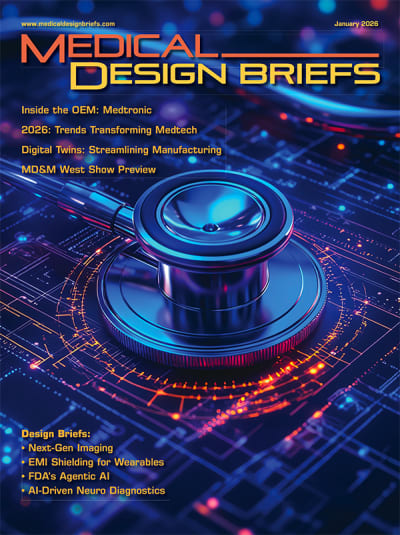










 INSIDER: Medical
 Features: Medical
 Features: Materials
 From the Editor: Medical
 INSIDER: Medical
 Features: AR/AI

 Podcasts: Medical
 Podcasts: Medical
 Podcasts: Design
 On-Demand Webinars: Manufacturing & Prototyping
 Podcasts: AR/AI
 Podcasts: Green Design & Manufacturing
