
Inside this issue
Overview
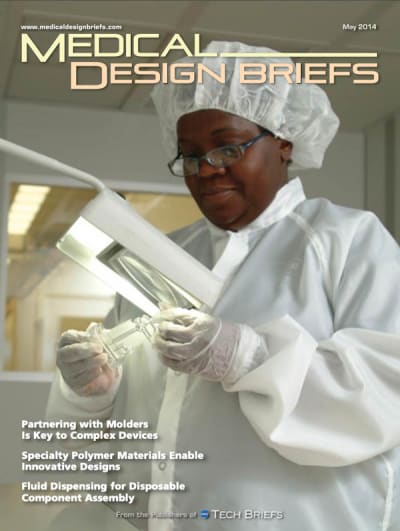
The May 2014 issue of Medical Design Briefs presents a comprehensive overview of advancements and considerations in the medical device industry, focusing on innovative technologies, design strategies, and collaborative practices essential for successful product development.
Key Features and Articles:
-
Tips for Successful Phase-Out of AK-225: The issue opens with practical advice for manufacturers transitioning away from the AK-225, a specific medical device or component. This article emphasizes the importance of planning and communication among stakeholders to ensure a smooth transition and minimize disruptions in production.
-
Micro-Volume Fluid Dispensing: A feature article discusses the growing demand for micro-volume fluid dispensing technologies in the assembly of disposable medical components. This technology is crucial for applications requiring precise fluid handling, such as in drug delivery systems and diagnostic devices. The article highlights innovations that enhance accuracy and efficiency in fluid dispensing processes.
-
Specialty Absorbable Polymer Materials: The issue explores the use of specialty absorbable polymers in medical device platforms. These materials are gaining traction due to their ability to dissolve in the body, reducing the need for surgical removal. The article discusses various applications, including sutures and drug delivery systems, and the benefits of using these materials in terms of patient safety and comfort.
-
Collaborative Relationships with Molders: Another significant article emphasizes the importance of collaboration between medical device original equipment manufacturers (OEMs) and mold builders. The tight tolerances required for plastic medical device components, especially those handling fluids or gases, necessitate effective communication and partnership to achieve optimal results. The article outlines strategies for fostering these relationships to enhance product quality and innovation.
-
Advancements in Particle Beam Cancer Therapy: The magazine also covers advancements and challenges in particle beam cancer therapy, a cutting-edge treatment option that targets tumors with high precision. The article discusses the technology's potential benefits, including reduced damage to surrounding healthy tissue, and the ongoing research aimed at overcoming existing challenges in its implementation.
Innovative Detection Methods: The issue features a brief on using shrink wrap as a method to detect infectious diseases. This innovative approach could streamline the process of identifying pathogens, thereby improving response times in clinical settings.
-
Signaling Implantable Electronics: An article discusses the development of implantable electronics that can signal to dissolve after a predetermined period. This technology has significant implications for temporary medical devices, allowing for less invasive procedures and improved patient outcomes.
-
Desktop Human for Toxicity Screening: The magazine introduces the concept of a 'Desktop Human,' a tool designed to aid in toxicity screening. This innovative approach could revolutionize how medical devices are tested for safety and efficacy, providing a more efficient and ethical alternative to traditional methods.
-
Calculating Helium for Pediatric Radiotherapy: A technical brief addresses the calculations necessary for using helium in pediatric radiotherapy, highlighting the importance of precise dosimetry in ensuring effective treatment while minimizing risks to young patients.
Departments and Additional Content:
The issue includes various departments such as Global Innovations, R&D Roundup, and Mission Accomplished, which provide insights into ongoing research, successful projects, and emerging trends in the medical device field. The New Products section showcases the latest offerings in medical technology, reflecting the industry's dynamic nature.
Conclusion:
Overall, the May 2014 issue of Medical Design Briefs serves as a valuable resource for professionals in the medical device industry. It highlights the critical role of innovation, collaboration, and advanced materials in developing effective medical solutions. The articles provide practical insights and forward-thinking strategies that can help manufacturers navigate the complexities of medical device design and production, ultimately leading to improved patient care and outcomes.
Features
-
Articles
Tips To Make Your AK-225 Phase Out Successful
Micro-Volume Fluid Dispensing for Disposable Medical Component Assembly
-
R & D
Repairing Broken Bones with Silk Implants
Bioplastic Could Transform Manufacturing
Robotic Drumming Prosthesis Aids Creativity and Control
Pressure Sensor for Bladder Control
A Graphene-Metal Sandwich Could Improve Electronics
Stanford Scientists Working to improve Astronauts' Heart Health
-
Global Innovations
-
From the Editor
-
Applications
Specialty Absorbable Polymer Materials Enable Innovative Medical Device Platforms
Collaborative Relationships with Molders Key to Creating Effective Fluid-Handling Components
-
Mission Accomplished
Tech Briefs
-
Using Shrink Wrap to Detect Infectious Disease
Advances and Challenges in Particle Beam Cancer Therapy
High-Density, Homogenous Bacterial Spore Distributions on Test Surfaces
Signaling Implantable Electronics to Dissolve
Products
-
DriveSure Brushless DC Gear Motor
Ultrasonic Generator for Spray Processes
Bantam Mini Compression Springs
Affinity MediSpec™ Cable Assembly Solutions
XPMF03 Miniature Pressure Transducer
Lined, Variable-Pitch, Coil-Reinforced Shaft Technology
IRP40.50 Miniature Infrared Touch Probe
PEEK Engineered Surface Tubing
EMH350 Series of 350 Watt AC-DC Power Supplies
PFC600PCX ATX/EPS Power Supply
Multistax Premium Configurable Power Supplies
LED644 Miniature Dosing Subsystem
iShot QN43H 7mm Diameter Color Micro Camera
Flow Meters with Interchangeable Scales
Expanded Sterilizable Medical Materials
Xilinx All Programmable FPGA Mezzanine Carriers
CYROLITE Protect 2 Multipolymer Compound
Polyurethane-Based Adhesive for Wound Care
Two New Metal Materials for Additive Manufacturing
Photo Etching Precision Parts from Polyester
DXRxi Raman Imaging Microscope
Rotary Ball Spline for Robotics
PRODUCT OF THE MONTH: ValveMate 9000 Precision Valve Controller