
Inside this issue
Overview
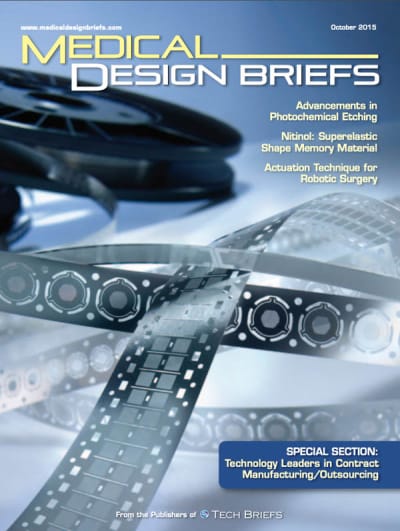
The October 2015 issue of Medical Design Briefs presents a comprehensive overview of advancements and innovations in the medical design and manufacturing sector. This edition is particularly focused on cutting-edge technologies, materials, and techniques that are shaping the future of medical devices and equipment.
Key Highlights:
-
Advancements in Photochemical Etching: The issue delves into the process of photochemical etching, a technique that allows for the precise manufacturing of intricate metal components used in medical devices. This method is highlighted for its ability to produce high-quality parts with tight tolerances, which are essential for the functionality and reliability of medical instruments. The article discusses various applications of photochemical etching in the medical field, emphasizing its advantages over traditional machining methods, such as reduced waste and improved design flexibility.
-
Nitinol: Superelastic Shape Memory Material: A significant feature of this issue is the exploration of Nitinol, a nickel-titanium alloy known for its unique superelastic and shape memory properties. The article explains how Nitinol is revolutionizing the design of medical devices, particularly in minimally invasive surgeries. Its ability to return to a predetermined shape when heated makes it ideal for stents, guidewires, and other implantable devices. The discussion includes insights into the material's biocompatibility and its growing applications in various medical fields, including cardiology and orthopedics.
Actuation Techniques for Robotic Surgery: The magazine also covers innovative actuation techniques that are enhancing the capabilities of robotic surgical systems. These advancements are crucial for improving precision and control during surgical procedures. The article reviews different types of actuators, including electric, pneumatic, and hydraulic systems, and their respective advantages in robotic applications. The integration of these technologies is paving the way for more sophisticated surgical robots that can perform complex tasks with greater accuracy and less invasiveness.
-
Technology Leaders in Contract Manufacturing/Outsourcing: A special section of the magazine is dedicated to highlighting technology leaders in contract manufacturing and outsourcing. This segment provides insights into how leading OEMs (Original Equipment Manufacturers) are leveraging partnerships with specialized manufacturers to enhance their product offerings. The article discusses the benefits of outsourcing, such as cost reduction, access to advanced technologies, and the ability to scale production quickly. It also features profiles of key players in the industry, showcasing their capabilities and contributions to the medical device market.
-
User Experience and Compliance: The issue emphasizes the importance of user experience in medical device design. It discusses how manufacturers are increasingly focusing on ergonomics and usability to ensure that devices are not only effective but also easy to use for healthcare professionals and patients alike. Compliance with medical standards and regulations is also a critical theme, as the industry faces stringent requirements to ensure safety and efficacy. The article provides practical tips for manufacturers on how to navigate these challenges while maintaining a focus on innovation.
-
Innovative Product Features: Throughout the magazine, various advertisements and product literature highlight innovative features of new medical devices. For instance, the issue showcases medical-grade foot switches designed by Steute, which are tailored for use in surgical environments. These switches are engineered to enhance user experience and comply with medical standards, reflecting the ongoing trend of integrating user-friendly designs with advanced technology.
Conclusion:
The October 2015 issue of Medical Design Briefs serves as a valuable resource for professionals in the medical design and manufacturing industry. It not only highlights the latest technological advancements but also addresses the challenges and opportunities that come with innovation in this rapidly evolving field. By focusing on materials like Nitinol, manufacturing techniques such as photochemical etching, and the importance of user experience, this edition provides a well-rounded perspective on the future of medical devices. As the industry continues to advance, the insights shared in this issue will be instrumental for engineers, designers, and manufacturers aiming to stay at the forefront of medical technology.
Features
-
Articles
An Overview of Nitinol: Superelastic and Shape Memory
Advancements in Photochemical Etching Technology Provide Benefits to Medical Device Manufacturers
-
R & D
Tiny Mechanical Wrist Supports Needlescopic Surgeries
Novel Fibers Maintain Electrical Resistance When Stretched
Low-Cost Prosthetic Knee Mimics Walking Motion
Lightweight Metal Foam Blocks Radiation
-
Global Innovations
-
From the Editor
-
Technology Leaders
Smaller, Smarter, Electronic, Connected: The Next Generation of Drug-Delivery Devices
Tech Briefs
-
3D and 4K Technology Offer Precise Visualization
Regaining Leg Control with Spinal Stimulation
3D-Printing 10 Materials at Once
Products
-
Product of the Month: MCST 3601 Drive Electronics for Stepper Motors
Clearflo Ag-47 Antimicrobial Tubing
2000X Ultrasonic Assembly Systems
FIT Slide Bush and Shaft Assemblies
Ultrasonic Tube Drawing System
Universal Temperature Sensor IC
High Resolution Motion Feedback Encoders