
Inside this issue
Overview
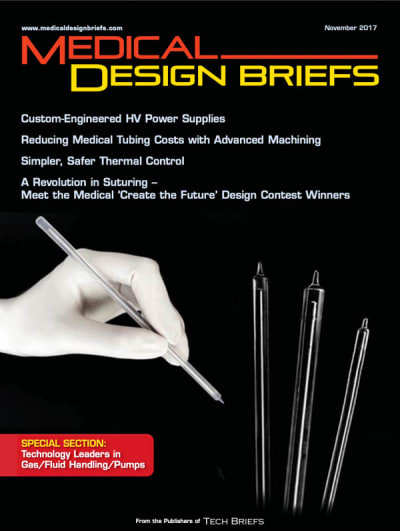
The November 2017 issue of Medical Design Briefs presents a comprehensive overview of innovations and advancements in the medical device industry. This edition features a variety of articles, columns, and technical briefs that highlight cutting-edge technologies, design contests, and industry insights.
Key Features
-
Revolutionary Suturing Technology: One of the standout features of this issue is the coverage of the 2017 Create the Future Design Contest winner, which introduces a novel toolset designed for arterial microvascular anastomosis. This innovative tool, used in conjunction with the Synovis GEM Coupler, aims to replace traditional vessel suturing methods. It facilitates rapid anastomosis of arteries ranging from 1.5 to 4 mm in diameter, significantly reducing costs and time in the operating room (OR). This advancement is particularly noteworthy for its potential to improve surgical outcomes and efficiency.
-
Custom Engineered HV Power Supplies: The magazine discusses custom-engineered high-voltage (HV) power supplies tailored for high-performance applications. These power supplies are crucial for various medical devices, ensuring reliability and efficiency in their operation. The article emphasizes the importance of these supplies in enhancing the performance of medical technologies.
-
Advanced Machining and Automation: Another feature highlights how advanced machining and automation techniques are being employed to reduce costs associated with medical device tubing. The article explores the impact of these technologies on manufacturing processes, leading to more cost-effective production without compromising quality.
-
Molecular Thermostat: The issue also introduces a molecular thermostat that simplifies thermal control in medical devices. This innovation promises to enhance safety and stability in heating applications, which is critical in various medical settings.
-
IEC 62304 Implementation: A detailed article on implementing IEC 62304, the international standard for medical device software development, is included. This piece provides insights into ensuring that medical device software is safe and effective, addressing the growing importance of software in medical technology.
-
Micro Welding Options: The magazine features a comparison between Nd:YAG and fiber lasers for micro welding applications. This discussion aids manufacturers in choosing the best option for their specific needs, highlighting the advantages and limitations of each technology.
Technical Briefs
The issue includes several technical briefs that present recent innovations and research findings:
3D-Printing Materials for Wound Care: This brief discusses new 3D-printing materials that offer safer options for wound care, showcasing the potential of additive manufacturing in healthcare.
-
Rapid Zika Diagnosis: A new test that rapidly diagnoses Zika virus infections is highlighted, reflecting the ongoing efforts to improve diagnostic capabilities in response to emerging health threats.
-
Gecko-Inspired Adhesives: An innovative adhesive inspired by gecko feet is presented, which outperforms current methods in various applications, including medical devices.
-
Lightweight Prosthetic Hands: The introduction of a low-density polymer that reduces the weight of prosthetic hands is discussed, emphasizing the importance of comfort and usability for patients.
-
Smart Foam for Concussion Detection: A helmet smart foam that signals potential concussions in real-time is featured, showcasing advancements in sports safety technology.
Special Section: Gas/Fluid Handling and Pumps
The magazine includes a special section dedicated to technology leaders in gas and fluid handling and pumps. Key articles in this section cover:
-
Choosing the Right Fluid Dispensing Pump: Guidance on selecting appropriate fluid dispensing pumps for various medical applications, focusing on accuracy and precision.
-
Valveless Fluid Control Designs: An exploration of valveless designs that offer enhanced accuracy and precision in fluid control, which is critical in many medical devices.
Departments and Additional Content
The issue also contains regular departments such as R&D Roundup, New Products & Services, and an Advertisers Index, providing readers with a well-rounded view of the current landscape in medical design and technology.
Conclusion
Overall, the November 2017 issue of Medical Design Briefs serves as a valuable resource for professionals in the medical device industry. It not only showcases innovative technologies and solutions but also addresses critical standards and practices that ensure safety and effectiveness in medical devices. The combination of feature articles, technical briefs, and special sections provides a comprehensive look at the advancements shaping the future of medical technology.
Features
-
Articles
Molecular Thermostat Makes Heaters Simpler, Safer and More Stable
Quartet H2O LDD Actively Cooled Lateral Surgical Fiber Optic
High-Visibility Biopsy Needles
Kid: A Telemedicine Solution for Retinopathy of Prematurity
Nd:YAG or Fiber Laser? Choosing the Best Option for Your Micro Welding Application
Custom Engineered HV Power Supplies for High- Performance Applications
Implementing IEC 62304 for Safe and Effective Medical Device Software, PART 2
2017 Winner Revolutionizes Arterial Suturing, Reducing Costs and Time in the OR
Electroactive Material for Wound Healing
Advanced Machining and Automation Reduce Medical Device Tubing Costs
-
R & D
Computational Model Designs Building Blocks for Synthetic Muscle
Researchers Design Soft, Flexible Origami-Inspired Robot
Smartphone Device Performs Optical Spectroscopy
Researchers Developing Softer, Smaller Hearing Aid
-
Global Innovations
-
From the Editor
From the Editor — Making Sure Medical Devices Play Nice Together
-
Technology Leaders
Fluid Control: Valveless Design Offers Accuracy and Precision
Tech Briefs
-
Low-Density Polymer Lightens the Load of Prosthetic Hand
3D-Printing Materials Offer Safer Option for Wound Care
Helmet Smart Foam Signals Potential Concussions in Real Time