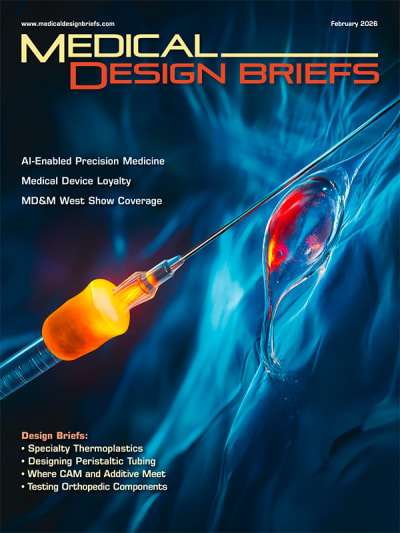

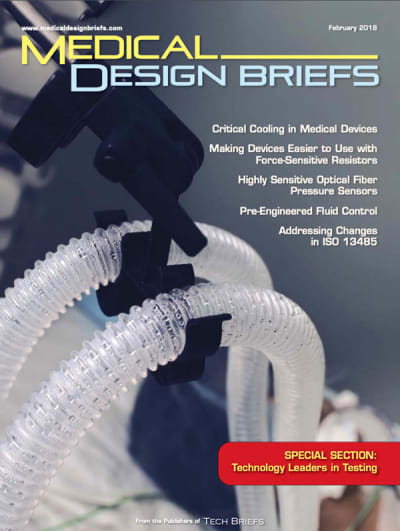
Inside this issue
Overview
The February 2018 issue of Medical Design Briefs offers a comprehensive overview of the latest advancements and considerations in the medical device industry. This edition is structured into various sections, including features, tech briefs, and special sections, each focusing on critical aspects of medical technology.
Key Features
-
Critical Cooling in Medical Devices: This article discusses the importance of effective cooling solutions in medical devices, particularly those that generate heat during operation. It highlights various cooling technologies and their applications, emphasizing the need for reliable thermal management to ensure device performance and patient safety.
-
Force-Sensitive Resistors: The use of force-sensitive resistors (FSRs) in medical devices is explored, showcasing how these components can enhance user interaction and device functionality. The article details the advantages of integrating FSRs, such as improved usability and the ability to provide real-time feedback, which can be crucial in patient monitoring and rehabilitation devices.
-
Highly Sensitive Optical Fiber Pressure Sensors: This feature presents advancements in optical fiber pressure sensors, which have significant potential in cardiology and other medical applications. The article outlines the benefits of these sensors, including their high sensitivity, small size, and ability to operate in challenging environments, making them ideal for various medical monitoring applications.
-
Pre-Engineered Fluid Control: The article discusses innovations in fluid control systems for dental and other medical applications. It emphasizes the importance of pre-engineered solutions that can streamline the design process, reduce costs, and improve the reliability of fluid management in medical devices.
-
Considerations for Specifying Ultra-Engineering Polymers: This piece provides insights into the selection of ultra-engineering polymers for extruded medical applications. It discusses the properties that make these materials suitable for medical use, such as biocompatibility, durability, and resistance to sterilization processes.
-
Gas Assist Plastic Molding: The article explains how gas assist plastic molding can be effectively utilized in medical device manufacturing. It outlines the benefits of this technique, including reduced material usage, improved part quality, and the ability to create complex geometries that are often required in medical devices.
-
Design Controls and ISO 13485: Addressing changes in ISO 13485, this article highlights the importance of design controls in the medical device development process. It discusses how adhering to these standards can enhance product quality and regulatory compliance, ultimately leading to safer medical devices.
Tech Briefs
The tech briefs section features several innovative technologies and products that are shaping the future of medical devices:
-
Nanotexturing for Bacteria-Killing Surfaces: This brief discusses a novel nanotexturing technique that creates surfaces capable of killing bacteria, which is crucial for reducing infection rates in medical environments.
-
Laser Direct Structuring for Sensor Manufacturing: This technology allows for the efficient manufacturing of sensors, enhancing their performance and reliability in medical applications.
-
MEG Technology for Epilepsy Diagnosis: The article highlights advancements in magnetoencephalography (MEG) technology, which shows promise in improving the diagnosis and treatment of epilepsy.
-
Smartphone App for Chemotherapy Monitoring: A new app designed to monitor chemotherapy patients is introduced, showcasing how mobile technology can enhance patient care and treatment adherence.
Special Section: Technology Leaders in Testing
This special section focuses on the critical area of testing in medical device development. It includes articles on:
-
Biocompatibility Evaluation: An in-depth look at ISO 18652, which provides a framework for evaluating the biocompatibility of breathing medical devices. This is essential for ensuring that devices are safe for patient use.
-
Package Engineering for Sterilization: This article discusses the engineering considerations necessary for packaging medical devices to ensure they remain sterile until use, a vital aspect of medical device safety.
Conclusion
The February 2018 issue of Medical Design Briefs serves as a valuable resource for professionals in the medical device industry. It covers a wide range of topics, from innovative technologies and materials to regulatory considerations and testing standards. The insights provided in this issue are crucial for enhancing the design, manufacturing, and safety of medical devices, ultimately contributing to better patient outcomes and advancing the field of medical technology.
This edition not only informs readers about current trends and technologies but also encourages ongoing education and adaptation in a rapidly evolving industry.
Features
-
Articles
8 Critical Cooling in Medical Devices – Part 1
12 Force-Sensitive Resistors: Making Medical Devices Easier to Use
20 Pre-Engineered Fluid Control: The Next Breakthrough in Dental System Design
25 Considerations for Specifying Ultra-Engineering Polymers for Extruded Medical Applications – Part 2
30 Making the Gas Assist Plastic Molding Process Work for Medical Applications
-
R & D
Soft Robotic Solution Aids in Surgery for One-Sided Heart Failure
Surgical Sealant Derived from Human Protein Seals Without Sutures
Dental Material Resists Plaque, Kills Microbes
Low-Cost, Battery-Powered Reader Diagnoses Jaundice
Plasmonic Biosensors Enable Development of Easy-to-Use Health Tests
Ultrasonic Sensor Allows Amputees to Control Prosthetic Fingers
3D Printing Creates Super-Soft Structures that Replicate Brain and Lungs
3D Printed Microfibers Could Provide Structure for Artificially Grown Body Part
-
Global Innovations
66 Metasurface-Based Technology Enables Safe MRIs for People with Implants
-
Technology Leaders
36 Biocompatibility Evaluation of Breathing Medical Devices: Understanding ISO 18652
Tech Briefs
-
52 Nanotexturing Creates Bacteria-Killing Spikes on Stainless Steel Surfaces
54 Laser Direct Structuring for Sensor Manufacturing
57 New Patch Aims to Turn Energy-Storing Fats into Energy-Burning Fats
59 MEG Technology Improves Diagnosis of Epilepsy
61 Smartphone App Shows Promise Monitoring Chemotherapy Patients