
Inside this issue
Overview
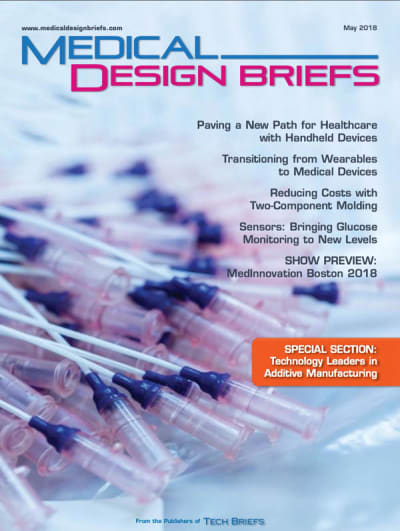
The May 2018 issue of Medical Design Briefs focuses on the latest innovations and trends in medical technology, particularly emphasizing the transition from traditional healthcare solutions to more advanced, efficient, and patient-friendly devices. This edition is designed to inform healthcare professionals, engineers, and industry stakeholders about the evolving landscape of medical devices and the implications for patient care.
Key Highlights:
-
Paving a New Path for Healthcare with Handheld Devices: The issue opens with an exploration of handheld medical devices that are revolutionizing patient monitoring and diagnostics. These devices offer portability and ease of use, allowing healthcare providers to conduct tests and monitor patients outside of traditional clinical settings. The article discusses various applications, including point-of-care testing and remote patient monitoring, which enhance accessibility and efficiency in healthcare delivery.
-
Transitioning from Wearables to Medical Devices: A significant focus of this issue is the shift from consumer-oriented wearable technology to regulated medical devices. The article outlines the challenges and opportunities in this transition, emphasizing the need for rigorous testing and compliance with medical standards. It highlights how wearables can evolve into medical devices that provide critical health data, thus improving patient outcomes and enabling proactive healthcare management.
-
Reducing Costs with Two-Component Molding: The magazine features an insightful piece on two-component molding, a manufacturing process that allows for the creation of complex medical device components in a single step. This method not only reduces production costs but also enhances the performance and reliability of medical devices. The article discusses various applications of this technology in the medical field, showcasing its potential to streamline manufacturing processes and improve product quality.
Sensors: Bringing Glucose Monitoring to New Levels: Another highlight is the advancements in glucose monitoring technologies. The issue delves into innovative sensor technologies that provide continuous glucose monitoring (CGM) for diabetic patients. These sensors offer real-time data, enabling better management of blood sugar levels and reducing the risk of complications. The article discusses the integration of these sensors with mobile applications, allowing patients to track their health data conveniently.
-
Special Section: Technology Leaders in Additive Manufacturing: This issue includes a special section dedicated to additive manufacturing, also known as 3D printing, which is making significant strides in the medical device industry. The section profiles leading companies and innovators in this field, discussing how additive manufacturing is being used to create customized implants, prosthetics, and surgical tools. The flexibility and precision of 3D printing are highlighted as key advantages that can lead to improved patient outcomes and reduced production times.
-
Research and Development Insights: The magazine features contributions from various experts, including researchers and industry leaders, who share insights on the future of medical technology. Topics include the importance of interdisciplinary collaboration in R&D, the role of artificial intelligence in healthcare, and the potential of telemedicine to enhance patient care. These discussions underscore the need for continuous innovation and adaptation in the rapidly changing healthcare landscape.
-
Funding and Support for Medical Innovations: The issue also touches on the financial aspects of medical device development, highlighting the importance of grants and funding from organizations such as the NIH and the Alfred P. Sloan Foundation. It discusses how these resources support research initiatives and help bring innovative medical solutions to market.
-
Advertisers and Industry Connections: The magazine features an advertisers index, showcasing companies that are at the forefront of medical technology. This section serves as a resource for readers looking to connect with industry leaders and explore potential partnerships or collaborations.
Conclusion:
The May 2018 issue of Medical Design Briefs serves as a comprehensive resource for professionals in the medical technology field. It provides valuable insights into the latest trends, challenges, and innovations shaping the future of healthcare. By focusing on handheld devices, the transition from wearables to medical devices, advancements in manufacturing processes, and the role of sensors in patient monitoring, this issue highlights the ongoing evolution of medical technology and its impact on patient care. As the industry continues to innovate, the information presented in this edition will be crucial for stakeholders aiming to stay ahead in a competitive and rapidly changing environment.
Features
-
Articles
10 HANDHELD AND WEARABLE DEVICES: Paving a New Path for Healthcare
14 Transitioning from Wearables to Medical Devices
21 Show Preview Medinnovation Boston 2018
22 Bringing Glucose Monitoring to New Levels through Integrated Sensor Design
25 Two-Component Molding Can Solve Medical Design Challenges and Reduce Costs
-
R & D
38 Hybrid Nanotech Device Mimics Blood-Brain Barrier
38 Noninvasive Wearable System Monitors Stomach Activity
38 Wood Carbon Sponge Could Be Future of Wearable Sensors
38 Mobile ELISA Gives Results at Point of Care
-
Global Innovations
-
From the Editor
From the Editor — Mitigating Device Misuse and Lability via Virtual Reality Training
-
Technology Leaders
28 Laser Powder Bed Fusion of Scaffolds for Orthopedic Applications: Design and Manufacturability
31 Material Advances for Additive Manufacturing of Bioresorbable Polymeric Medical Devices
Tech Briefs
-
40 Therapeutic Gel Shows Promise Against Cancerous Tumors
42 Tiny Tooth-Mounted Sensors Track Food Intake
44 Researchers Develop At-Home Pap Smear Test
45 ‘Candy Cane’ Polymer Weave Could Power Future Functional Fabrics and Devices