

In conductive hearing loss cases, 59% involve defects of the incus. For efficient restoration of hearing, the defective incus is normally removed and the mechanical link between the eardrum and inner ear is reconstructed. In cases of incus defects, the reconstruction is normally of the form of a rod, positioned to connect the malleus handle or eardrum directly to the cochlea oval window. A more promising approach to prosthesis design is to reconstruct the chain along more physiologically relevant lines. It has been shown that excellent reconstruction of the ossicular chain can be achieved using a generic incus shape. In a series of in vitro studies, it was shown that secure attachment of the prosthesis to the stapes and malleus, with ionomeric cement, could restore hearing within 10 dB of the original frequency response. This study attempts to model these in vitro findings using a finite element computer model. The goal of the study is to produce a computer model that can be used to simulate different forms of attachment to the prosthesis.

Although this is just a preliminary model, the form of the middle ear function is in approximate agreement with that found in middle ear studies in temporal bones. Differences are thought to be due to the modeling parameters used. This middle ear model did not consider inhomogeneity in the thickness of the eardrum or the flexible annulus modeled. Eardrum displacement is found to be higher than stapes displacement, as expected. The simulated stapes response matches the eardrum response quite well up to high frequency where the responses differ. This difference represents a loss of efficiency of the eardrum driving the malleus.
The model described here can be further used to predict changes that may occur through modification of the middle ear structures. The main parameters that may be investigated are mass, shape, stiffness, and position of the implant. With a better understanding of the effects of these parameters on sound transmission, implant designs could be optimized to produce transmission characteristics that are seen in the normal human ear.
This work was done by E. W. Abel and R. M. Lord of the Medical Engineering Research Institute, Department of Mechanical Engineering, at the University of Dundee, Scotland for the Army Research Laboratory. For more information, download the Technical Support Package (free white paper) at www.techbriefs.com/tsp under the Bio-Medical category. ARL-0067
This Brief includes a Technical Support Package (TSP).
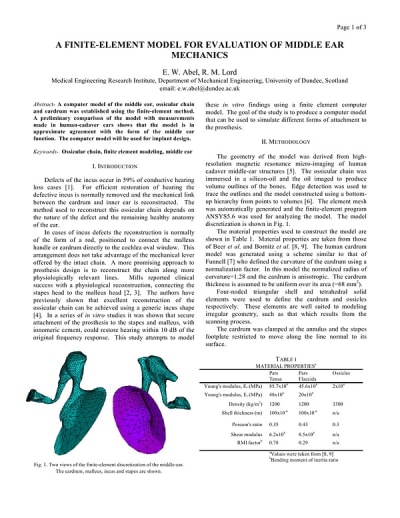
A Finite-Element Model for Evaluation of Middle Ear Mechanics
(reference ARL-0067) is currently available for download from the TSP library.
Don't have an account?
Overview
The document presents a study on a finite-element model developed to evaluate the mechanics of the middle ear, including the ossicular chain and eardrum. The research aims to enhance the understanding of sound transmission in the middle ear and to optimize implant designs for hearing restoration.
The model simulates the motion of the eardrum and stapes in response to sound stimuli, specifically at a sound pressure level of 80 dB SPL. It identifies that the frequency response function varies across the eardrum surface, with a specific point chosen to represent eardrum motion. The findings indicate that below 1 kHz, the eardrum and stapes responses are relatively flat, while a resonance peak occurs around 1.5 kHz, similar to measurements taken from temporal bones. A second resonance is noted at approximately 4 kHz, which is higher than what is typically observed in temporal bone studies.
The results show that eardrum displacement is greater than stapes displacement, which aligns with expectations. The simulated stapes response closely matches the eardrum response at lower frequencies, but diverges at higher frequencies, indicating a loss of efficiency in sound transmission. The study emphasizes that the model's parameters, such as mass, shape, stiffness, and position of implants, can be further investigated to improve sound transmission characteristics.
Displacement shapes at different frequencies are illustrated, showing that at low frequencies, the eardrum vibrates in discrete sections, while at higher frequencies, the displacement becomes more dispersed, suggesting a loss of efficiency in sound transmission. The document includes displacement plots at 1 kHz and 9.5 kHz, demonstrating the model's ability to replicate experimental patterns observed in both cat and human middle ears.
The study concludes that while the model is preliminary, it provides a foundation for predicting changes in middle ear structures and can guide future research in optimizing implant designs. The research is supported by acknowledgments to contributors and funding organizations, highlighting the collaborative effort behind this innovative work.
Overall, this document contributes valuable insights into middle ear mechanics and the potential for improving hearing restoration techniques through advanced modeling approaches.