
Maintaining adequate hydration is an important part of maintaining health, especially under extreme operational and environmental conditions where medical assistance might not be readily available. One approach to measuring the amount of fluid consumed is through the use of Fluid Intake Monitor (FIM) technologies to monitor fluid consumption. These devices can be used to ensure that warfighters consume recommended/ appropriate amounts of water, and to tailor logistical support to actual water needs, as water is expensive to transport.


Bench test results show that with the exception of the first sip, average measurement error was small. There was good consistency in the measurements from sip to sip after sip 1. While the overall reliability of the sample of FIM units showed relatively good consistency across sips, for sips 2 through 10, the accuracy of the individual units varied considerably.
The fact that, after the first sip, there is generally good consistency across sips suggests the fundamental gear design was acceptable. The relatively high error rate or overestimation on the first sip can be attributed to an initial presence of air in the hose between the water-filled bladder and the FIM. When a drinking action caused the air in the hose to move over the gears, the gears spun at high speed, resulting in an artificially high reading on the first sip.
The FIM incorporates a check valve to prevent water backflow into the drinking bladder. However, the valve is not completely airtight, allowing air to enter the hose when the system was not in active use. After the first sip, once the system was primed and water filled the entire system, this source of error was not present. In the broad scheme, the relatively small amount of error associated with the first sip, when compared to a whole bladder’s worth of water consumption, is inconsequential when monitoring warfighter water consumption.
This work was done by William J. Tharion, Anthony J. Karis, and Reed W. Hoyt of U.S. Army Research Institute of Environmental Medicine. For more information, download the Technical Support Package (free white paper) at www.techbriefs.com/tsp under the Bio-Medical category. ARL-0074
This Brief includes a Technical Support Package (TSP).
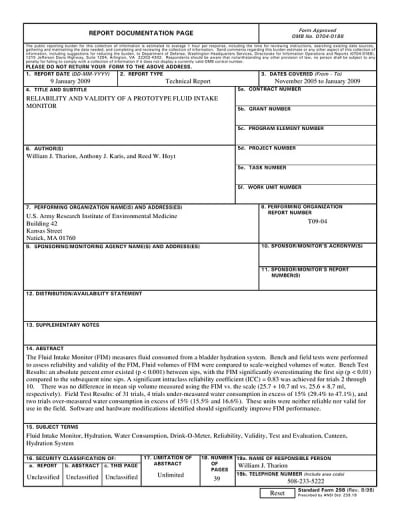
Reliability and Validity of a Prototype Fluid Intake Monitor
(reference ARL-0074) is currently available for download from the TSP library.
Don't have an account?
Overview
The document is a technical report detailing the reliability and validity of a prototype Fluid Intake Monitor (FIM) developed by the U.S. Army Research Institute of Environmental Medicine. The FIM is designed to measure fluid consumption from a bladder-type hydration system, which is crucial for maintaining optimal hydration levels, especially for Warfighters operating under extreme conditions.
The introduction emphasizes the importance of hydration for health and performance, noting that both hypohydration (too little fluid) and hyperhydration (too much fluid) can negatively impact cognitive and physical performance, and in severe cases, can lead to death. The report outlines the need for accurate hydration monitoring, particularly in challenging environments where medical assistance may not be readily available.
The study's objective was to assess the FIM's reliability and validity through bench and field tests. The bench tests involved 27 FIM units, where technicians measured fluid intake by taking sips from the device. Results indicated a significant overestimation of the first sip compared to subsequent sips, with an intraclass reliability coefficient of 0.83 achieved for trials 2 through 10. However, the FIM's performance varied, with some trials under-measuring or over-measuring fluid consumption by more than 15%.
Field tests involved 31 trials, revealing that the FIM was neither consistently reliable nor valid for field use, as it failed to accurately measure water consumption in several instances. The report suggests that software and hardware modifications are necessary to improve the FIM's performance.
The document also discusses the implications of hydration monitoring for Warfighters, highlighting the potential for the FIM to be integrated into a broader system of physiological status monitoring. This integration could enhance the ability to track hydration levels in real-time, thereby supporting better health and performance outcomes.
In conclusion, while the FIM shows promise as a hydration monitoring tool, the findings indicate that further development is needed to ensure its reliability and validity in both controlled and field environments. The report underscores the critical role of hydration in maintaining operational effectiveness and the ongoing efforts to refine technologies that support Warfighter health.