
In today’s medtech landscape, innovation isn’t just about what a device does — it’s about how reliably and cost-effectively it gets to market. As devices grow smaller, smarter, and more user-centered, materials like liquid silicone rubber (LSR) play a bigger role in enabling performance, comfort, and compliance. From implantables to connected wearables, LSR is helping engineers meet growing design and usability demands. As demand for the material grows, so do the pressures on supply chains, including launch timelines, increased regulatory scrutiny, and rising technical complexity.
That’s why selecting the right material is only part of the equation. To fully realize the benefits of LSR in high-stakes medtech applications, OEMs must also consider how LSR components are designed, manufactured, and delivered. In a manufacturing environment where disruption is the norm, building resilient LSR programs means thinking beyond performance — and laying the operational groundwork to support it.
The first step in designing a resilient LSR supply chain is to understand the strategic role the material plays in enabling safe, effective, and scalable medical technologies.
The Strategic Value of LSR in Medical Applications
LSR has earned its place in medical devices not just because it meets performance requirements, but because it consistently enables what’s next. As OEMs push toward more compact, more functional, and more patient-friendly devices, LSR brings a unique combination of material properties and processing versatility that few alternates can match.
Its value goes beyond performance. LSR helps align product innovation with manufacturing efficiency, regulatory reliability, and supply-chain resilience. Its value comes into sharper focus when factoring in how it supports key priorities across the entire device lifecycle.
Biocompatibility and Long-Term Stability. LSR is inherently nonreactive, making it ideal for applications that require prolonged contact with human tissue or fluids. Its stability under sterilization, resistance to leaching, and consistent performance in high- and low-temperature environments make it a trusted choice for devices such as implantables, wearables, and drug-delivery systems.
Miniaturization and Design Freedom. The flow properties of LSR during injection molding allow for thin walls, micro features, and complex geometries that traditional materials may struggle to achieve. This allows engineers to deliver more function in less space — a key differentiator as the market shifts toward minimally invasive, wearable, or embedded solutions.
Durability Meets Softness. LSR offers a rare balance: it’s soft and flexible, yet durable enough to maintain its form and function over time. That makes it ideal for seals, valves, and wearable interfaces — anywhere comfort and reliability need to coexist.
Overmolding and Multi-Material Integration. LSR can be overmolded onto plastics, metals, or other substrates to create sealed, multi-functional components. This opens up design efficiencies and can reduce part count, improve ergonomics and enhance usability in both disposable and reusable devices — leading to cost savings and increased reliability at scale.
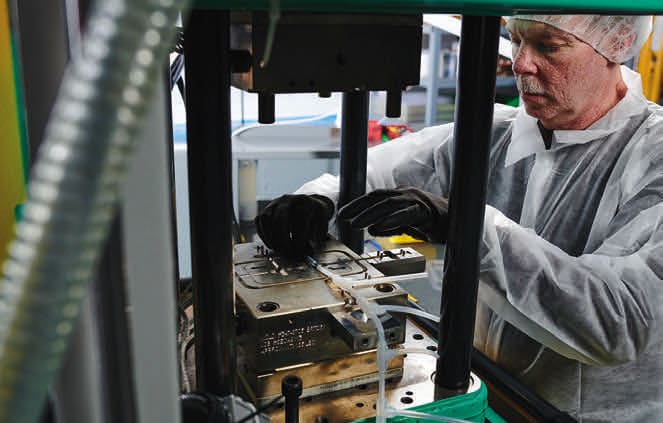
Scalable, Repeatable Manufacturing. When processed by experienced molders, LSR delivers consistent results critical for high-volume programs with tight regulatory oversight. Its fast cycle times, minimal waste and compatibility with automation make it a material built not just for prototypes, but for full-scale production. Plus, LSR’s processing advantages — short cure times, high-volume repeatability — align with the cost containment and scale up goals of today’s OEMs.
To move fast, de-risk production and realize the strategic advantage of LSR, more OEMs are relying on partnership to bring everything together.
LSR’s Promise Meets Supply-Chain Reality
Choosing LSR often isn’t a choice — it’s a necessity. However, the path from material selection to fully functional, production-ready components is far from straightforward. While LSR offers a unique balance of properties that support innovation, the processes required to injection mold, assemble, and validate LSR components are complex and unforgiving.
Manufacturing with LSR often involves multiple stakeholders: design engineers, mold builders, materials suppliers, injection molders, and assembly partners. Each adds value but also introduces potential points of failure. Disconnected workflows can lead to misaligned tolerances, unexpected tooling delays, poor material flow, and ultimately, rework or failed validation runs. These breakdowns are particularly disruptive for OEMs operating under tight timelines and strict regulatory oversight.
Procurement teams face parallel challenges: inconsistent lead times, sourcing bottlenecks, fragmented supplier communication, and limited transparency. Managing multiple vendors not only increases administrative load, but also dilutes accountability when problems arise. For medtech programs that rely on precision, predictability, and speed, this level of fragmentation poses a serious supply-chain risk.
Vertical Integration: A Smarter Way to De-Risk LSR Programs
For medical OEMs designing LSR components and products, risk rarely stems from the material itself. It often arises from the supply chain that brings the designs to life. Every handoff between design, tooling, injection molding, and assembly creates an opportunity for miscommunication, delay, or deviation from specifications. In regulated environments, these risks compound quickly, especially when timelines are tight. Vertical integration addresses this by consolidating critical functions under one roof. With critical functions like design for manufacturability (DfM), tooling, injection molding, and secondary operations under one roof, vertical integration minimizes the complexity and misalignment that can often derail LSR programs. This structure mitigates several key risk categories:
Design-transfer risk: When tooling and molding teams are integrated with design teams early on, part geometry, gating, and tolerance decisions are agreed upon upfront — reducing the need for part and process redesigns due to manufacturability.
Speed to market with increased regulatory confidence. Accelerated development timelines are a priority — but so is compliance. An integrated model enables concurrent design, regulatory documentation prep (IQ/OQ/PQ) and tooling validation to help you capture market share faster.
Material compatibility and assembly precision. Integrating LSR with metals or thermoplastics in your device introduces risk if handled across separate vendors. Integrated teams can align material selection, molding parameters and assembly methods early, reducing dimensional variation, rework, and late-stage surprises.
Improved traceability and quality control. Documentation gaps and misaligned quality systems can slow down — or even shut down — product approvals. Integrated CMOs operate under a unified QMS, providing a single, traceable source for production data from raw materials through final assembly.
Technical and operational alignment. Integration of LSR within broader focused CMO infrastructure allows for early-stage design inputs that improve downstream performance and yield. LSR molding expertise integrated with in-house tool building and validation shortens development timelines and supports scalability from pilot to high-volume production.
Instead of firefighting across a fragmented supply base, OEMs gain the ability to anticipate, contain, and resolve issues quickly, before they jeopardize launch schedules or compliance outcomes. In a material as specialized as LSR, that level of integration becomes a decisive advantage.
Resilience, Alignment, and a Smarter Path Forward
LSR has become a critical enabler of modern medical device innovation. Its unique properties support smaller form factors, advanced drug delivery and patient-friendly wearables, all while meeting the demanding requirements of biocompatibility and long-term performance. As devices evolve and regulatory pressure increases, the ability to integrate LSR reliably and efficiently into complex designs has never been more important.
Vertically integrated manufacturing provides a clear path to reducing risk, improving traceability and accelerating development timelines. A unique approach to DfM, tooling, injection molding, and assembly enables better control, fewer communication breakdowns, and greater responsiveness across the entire product lifecycle. This level of alignment supports both engineering performance and procurement efficiency, allowing OEMs to meet market demands without compromising quality or compliance.
In today’s high-stakes medtech environment, success depends on more than strong materials. It requires a strong infrastructure behind them. OEMs that align technical and operational strategy from the outset are better equipped to navigate complexity, mitigate supply chain disruption and capture market opportunities with next-gen devices.
This article was written by Henri Asselin, Vice President of Engineering and Technology, Beacon MedTech Solutions, Leominster, MA. For more information, visit here .