
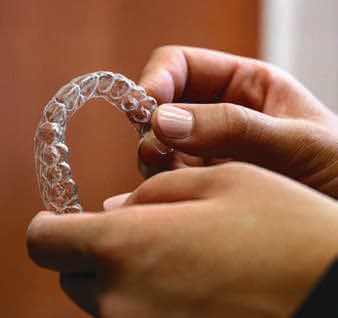
Researchers are testing a new technology that incorporates shape memory material for clear plastic dental aligners, an alternative to traditional metal braces. The clear aligners still need to be improved to the point that there are two materials — clear aligners and metal braces — that are as good as each other.
The material isn’t a hard plastic, so if you take it out and put it in hot water it will shrink and soften up, and that will make it easy to put back in your mouth. Then the mouth temperature will harden it back to its original shape and move the teeth accordingly. To make a thermoplastic aligner, a patient’s mouth is scanned, and a dental mold is created, as with other plastic aligners. But instead of sending the scan out to a company that will manufacture the aligner, orthodontists using the 3D printer can immediately make aligners onsite in their dental practices.
To advance their understanding of how thermoplastic can be used in orthodontics, they simulated the biomechanical behavior of the aligners and the stress response of the teeth, periodontal ligaments, and surrounding bones. They are studying the shapes and orientations of tooth attachments to show how aligners can be specifically refined for each patient. (Image credit: WVU/Davidson Chan)
For more information, visit here .