
Inside this issue
Overview
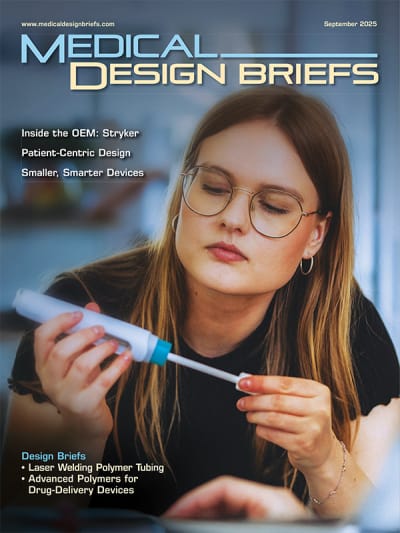
This issue of Medical Design Briefs, published in September 2025, presents a collection of innovative advancements in medical technology, focusing on the integration of new materials and designs to enhance medical diagnostics and human-machine interactions.
One of the standout features is the development of a novel device that converts mechanical stress into electrical signals through friction between laminated conductive and dielectric materials. This device employs self-folding paper technology, which eliminates the need for manual folding and reduces fabrication efforts. The research highlights the mechanical properties of these self-folding paper structures, examining how variations in printed line width and paper thickness influence fold angles and restoring forces. The findings indicate that connecting multiple origami folds in series significantly boosts power output while maintaining durability over extensive compression cycles, making it a promising tool for next-generation smart devices.
The issue also discusses the Digits modules, which aim to redefine human-machine interaction through reconfigurable robots. These robots can adapt their shape, stiffness, and haptic feedback, enhancing virtual reality experiences and rehabilitation efforts. The adaptability of these modules is designed to cater to diverse user needs, ensuring richer interactions for individuals of varying sizes and abilities.
Another significant advancement covered is the development of 3D microprinted polymer whispering-gallery-mode microlaser sensors. These sensors are designed for highly sensitive on-chip biosensing, paving the way for cost-effective lab-on-a-chip medical diagnostics. The research led by A. Ping Zhang from The Hong Kong Polytechnic University emphasizes the potential of these sensors for early disease diagnosis, including conditions like cancer and Alzheimer’s disease. The unique design of the microlaser sensor, which features a Limacon-shaped disk microcavity, allows for the detection of extremely low concentrations of human immunoglobulin G (IgG), a common antibody in blood and other fluids. This innovation addresses previous challenges in integrating microlaser sensors into lab-on-a-chip systems, facilitating real-time, high-sensitivity detection of biomolecules.
The issue also highlights the capabilities of a sensor that can identify six common hand gestures with an impressive accuracy of 98.8%. This technology can detect the duration of finger pulls, enabling wireless Morse code communication, which showcases its potential as an assistive tool for individuals with disabilities. This development underscores the importance of creating technologies that enhance accessibility and improve the quality of life for users with varying needs.
In addition to these technological advancements, the magazine discusses the challenges associated with integrating these innovations into practical applications. For instance, the coupling of light into microlaser sensors typically requires the use of tapered optical fibers, which can be difficult to align and are sensitive to environmental disturbances. The issue explores alternative methods for delivering light, such as utilizing the emitted light from the microlaser sensor itself, which could simplify integration into lab-on-a-chip devices.
Overall, this issue of Medical Design Briefs encapsulates the ongoing evolution of medical technology, emphasizing the importance of innovative materials and designs in enhancing diagnostic capabilities and human-machine interactions. The advancements presented not only highlight the potential for improved medical diagnostics and rehabilitation but also stress the need for accessibility and user-centered design in the development of new technologies. As the field continues to evolve, these innovations promise to play a crucial role in addressing current healthcare challenges and improving patient outcomes.
Features
-
Articles
10 Inside the OEM: Stryker Thrives Amid Global Headwinds
15 Patient-Centric Design and Collaboration in Drug-Delivery Devices
19 Fitting More Functionality Into Increasingly Smaller, Smarter Devices: Heterogeneous Integration
-
R & D
23 Leadless Pacemaker Prevents Invasive Surgeries
23 Surgical Microscope Uses Tiny Cameras
23 Smart Capsule Designed to Study GI Tract
23 Wristband All-in-One Monitor for Diabetes, Cardio Care
24 Soft Brainstem Implant Delivers High-Resolution Hearing
-
Global Innovations
42 PHOx: An Innovative, Safer Polymer for Implantable Medical Devices
-
Videos of the Month
Tech Briefs
-
25 Laser Welding for Polymer Tubing: A New Solution for Adhesive- and Additive-Free Joining
27 Elevating Modern Drug-Delivery Devices with Advanced Polymers
29 CO-TENG: An Origami-Inspired Self-Powering Sensor for Smart Wearables
30 Handheld Device Could Transform Heart Disease Screening
32 DNA-Inspired Design for Stronger, Flexible Sensors for Wearables