
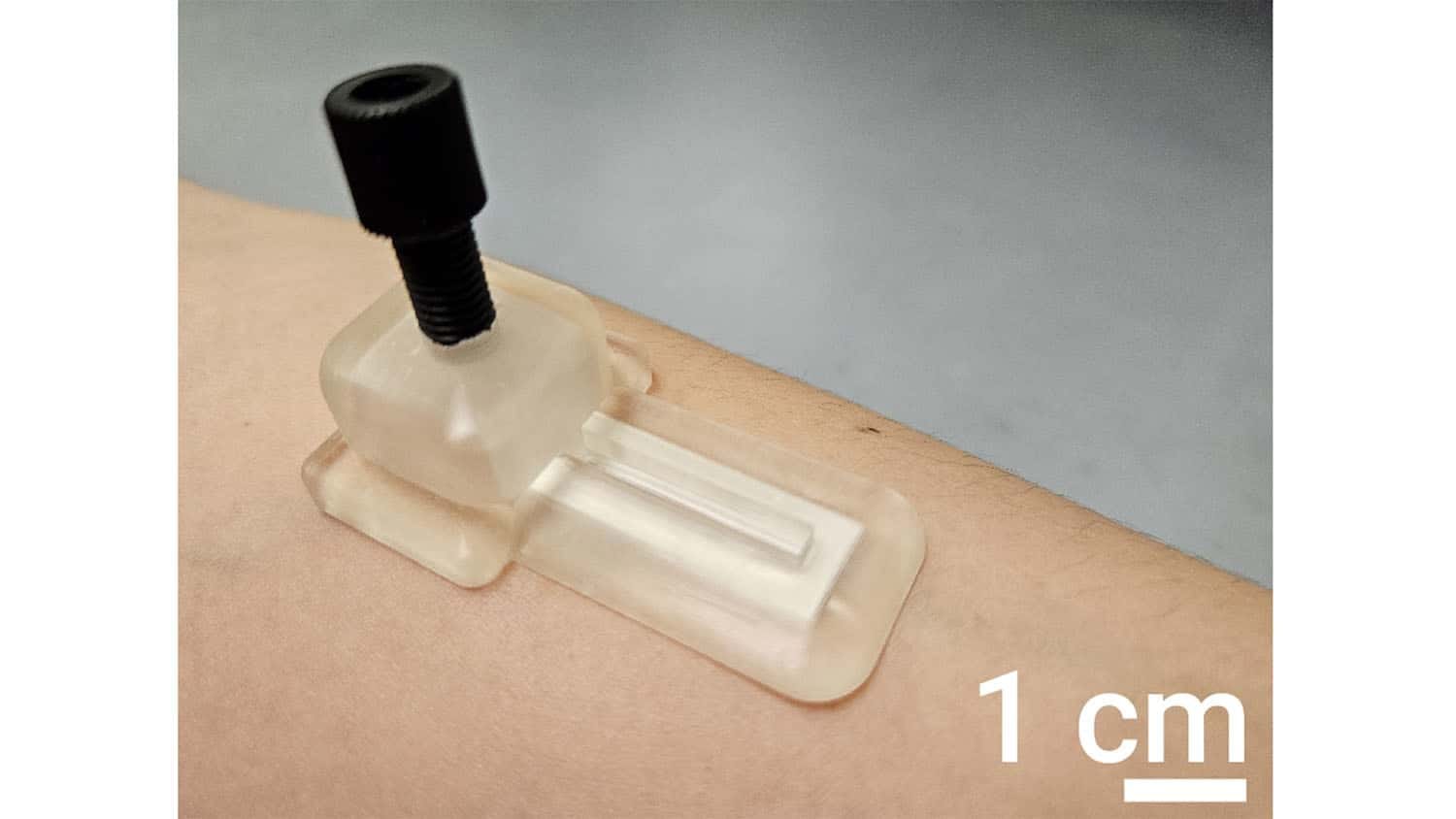
Researchers have developed a self-powered microneedle patch to monitor a range of health biomarkers without drawing blood or relying on batteries or external devices. In proof-of-concept testing with synthetic skin, the researchers demonstrated that the patches could collect biomarker samples over periods ranging from 15 minutes to 24 hours.
The researchers tested the patch on two synthetic skin models. For the proof-of-concept testing, the researchers monitored for cortisol, which is a biomarker for stress that fluctuates over the course of the day.
The patch consists of four layers: a polymer housing — which is effectively the part of the patch you can see; a layer of gel; a layer of paper; and the microneedles themselves. The microneedles are made of a material that swells when it touches the interstitial fluid (ISF). The ISF wicks through the microneedle until it comes into contact with the paper. As the paper begins absorbing the ISF, the fluid comes into contact with the gel that is on the other side of the paper. That gel contains a high concentration of glycerol. The imbalance of glycerol between the gel and the ISF creates osmotic pressure that pulls more ISF through the paper until the paper is saturated.
The patches are made from relatively inexpensive materials that are widely available.
The researchers have begun human testing with the patches and are developing electronic devices to read the paper strip from the microneedle patch. The researchers are looking to talk to talk with companies in the diagnostic space to explore additional applications as well as potential partners about scaling up production.