
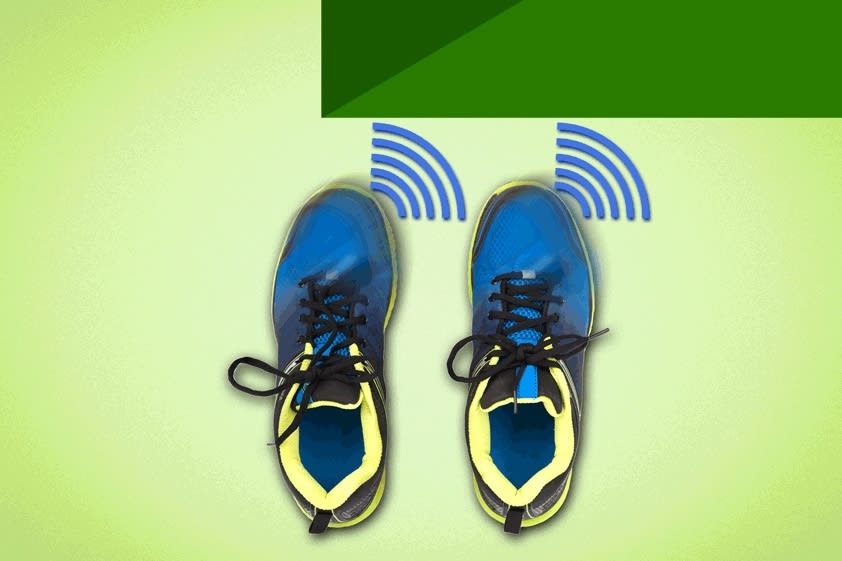
Researchers from the Massachusetts Institute of Technology's Department of Aeronautics and Astronautics (AeroAstro) and the Charles Stark Draper Laboratory are developing a new space boot with built-in sensors and tiny “haptic” motors, whose vibrations can guide the wearer around or over obstacles.
At the International Conference on Human-Computer Interaction, the team presented the results of a preliminary study designed to determine what types of stimuli, administered to what parts of the foot, could provide the best navigation cues.
The work could have applications in the design of navigation systems for the visually impaired. The development of such systems has been hampered by a lack of efficient and reliable means of communicating spatial information to users.
For the pilot study, graduate student Alison Gibson developed a device that spaced six haptic motors around each of a subject’s feet — one motor each at the heel, big toe, and instep, and three motors along the outer edge of the foot. The intensity of the motors’ vibrations could be varied continuously between minimum and maximum settings.
On the basis of the study results, Gibson is developing a boot with motors at only three locations: at the toe, at the heel, and toward the front of the outside of the foot — away from the middle location where stimuli sometimes did not register.
Stimuli will not be varied continuously, but will jump from low to high intensity when the wearer is at risk of colliding with an obstacle. The high-intensity stimuli will also be pulsed, to help distinguish them from the low-intensity ones.
In principle, the motor at the side of the foot could help guide the user around obstacles, but the first trial of the boot will concentrate entirely on the problem of stepping over obstacles of different heights. The researchers will also be evaluating the haptic signals in conjunction with, and separately from, visual signals, to determine the optimal method of conveying spatial information.